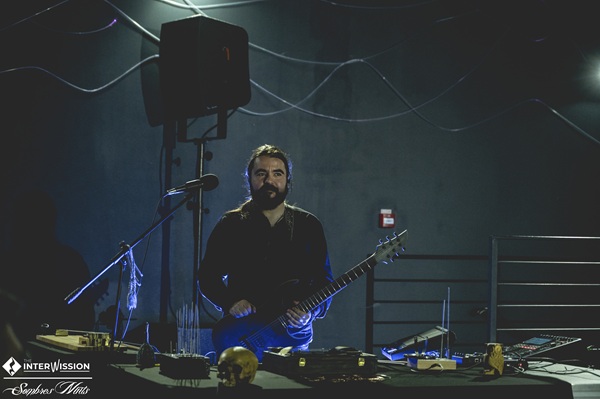
When you think of Costin Chioreanu, a whole world of images comes to mind: album covers steeped in the atmosphere of the music they accompany, illustrations that seem to conceal stories of their own, and animations that give movement to strange, otherworldly visions. For decades, his work has moved between sound and image, drawing on the darker realms of metal and the force of intuition. Since founding Twilight13Media in 2003, he has cultivated a visual language of his own, one that reaches beyond the surface of things in search of what lies hidden beneath.
With “Audial Phantaforms: UI”, his latest creation, the artist ventures into a realm where live music, animation and Romanian dark folklore converge. Here, the forests are more than landscapes, the past has not entirely relinquished its hold on the present, and the shadow of Vlad the Impaler hangs over a world suspended between history and myth. Through this audiovisual performance, he explores the darker depths of Romanian culture, evoking the sense that something ancient and unknowable still stirs beneath the surface of the familiar.
I met him in person at Dracula Film Festival, organised by Fanzin Cultural Association [Asociația Culturală Fanzin] at Cinema Astra [Brașov, Romania] on 17 October 2026, where we spoke about the origins of his artistic vision, the worlds he brings to life through images and animation, and the ideas behind this realm of living darkness.
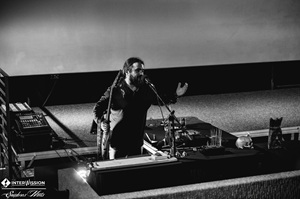
Costin Chioreanu [17 October 2026]
© Ionuț Iancu [Sombres Nuits, The Interwission]
I. The First Spark
Before the images took shape, there was the music. In the underground of the 1990s, records passed from hand to hand, their sounds opening doors to places that seemed to exist beyond the everyday. For the artist, the urge to draw came from a desire to give those experiences a visual form of their own.
Costin, you’ve been part of the metal scene since the 1990s, first as a fan, then as an artist working across different forms of visual expression. Looking back, what was the first spark that drew you toward the visual side of metal?
Costin Chioreanu: Interesting question to start with. Everything felt magical back then. It was much more than listening to a metal record; it was like discovering an entirely new world. I still remember some of my first cassettes, including “Wildhoney” by Tiamat and “Turn Loose the Swans” by My Dying Bride. The latter eventually became the subject of my first original artwork for a band. Strangely enough, around twenty years later, I started working with My Dying Bride officially, and three years ago I released an album featuring Aaron as a guest.
But back to your question: the music fascinated me because it opened up a universe I wanted to explore. I also felt that the artwork on those cassettes didn’t do justice to the magic inside the music. Sometimes, somebody would photocopy a cover, put it on a cassette, and sell it, thinking, “Okay, I want to make some money…”.
For me, a cassette was something sacred. The music deserved more attention and respect. I felt the need to draw something that could express what I was experiencing while listening. That’s how it started, back in 1994.
I was drawing even before that, too. I think most artists who end up creating a lot of artwork start somewhere similar. You start by copying one style or another.
How did you develop a visual language of your own without simply reproducing the styles you admired? I’m asking this because you have such a recognisable style. Nowadays, when I see an album cover or a festival poster, I can often tell whether it’s your work or not.
Costin Chioreanu: Thank you, thank you!
I’ve been drawing for as long as I can remember. It was the first thing I did when I was able to hold a pencil, and I never stopped. Even in my childhood drawings, before I discovered metal, there was something distinctive about the way I treated lines and forms.
When I entered the metal scene, I was deeply impressed by artists such as Necrolord and Dan Seagrave. They were my idols. But I never wanted to become a copy of any of them.
Whenever I tried to imitate their work, it was an act of respect towards the records I loved. Those old photocopied covers didn’t do justice to the original artwork, and I wanted to give the music the visual treatment it deserved. It was never about wanting to paint exactly like Necrolord or spending hundreds of hours perfecting a painting in somebody else’s style. I wanted to find my own way of doing things.
Back in the 1990s, it was difficult to get your hands on records from abroad, and sometimes you didn’t even have access to the artwork at all. How did that shape your imagination when creating your own images? Were you guided by the music, the lyrics, or something more intuitive?
Costin Chioreanu: It was a combination of things, but intuition played a major role. I think that connection between intuition and the inner voice has guided me throughout my life.
I remember getting a “Turn Loose the Swans” by My Dying Bride cassette with a completely blank cover, apart from the title printed in Times New Roman. I took it home and listened to the album hundreds of times. The music was mysterious, almost spiritual, and I felt that I needed to create something in response to it.
One of the images I came up with featured a cathedral with a small bird in front of it. It was probably the heaviest thing I could have created. At the time, I had lost two birds, and that was the most crushing thing that had ever happened to me. I never had pets after that. I didn’t want to go through that again. I have a cat now, though, because of my wife. The cat came as part of the package.
Access to lyrics was difficult, too. We sometimes had to wait until 1996 or 1997 to exchange printed lyrics with other people. Before that, you often had to listen carefully and try to figure out the words yourself.
But I was never particularly interested in illustrating lyrics literally. I preferred to let the music guide me.
Sometimes, the lyrics mark the limitations of language. That’s why, for example, I’m coming to my project for tonight, because I feel that everything comes straight from the subconscious. I don’t want to have to tell you guys something I’ve learned and developed at home, then come here and say, “Hello, I’ve come to play you this song, and here are the lyrics!”.
Sorry to say this, and this isn’t a criticism of music as it is today, but I believe a time will come when we’ll be more connected to ourselves, take a step further, and become more abstract, going deeper with our expression.
So, with this long introduction, what I wanted to say is that I’ve never been inspired by lyrics. Honestly, decades after discovering some of my favourite records, I found out what the lyrics were about. “Draconian Times”, for example, is one of my favourite records ever. I understood why I hadn’t wanted to read the lyrics in the first place. Something inside my head didn’t want to read them.
I’ve always had a tendency to put things I like on a pedestal, making them, in my mind, 200 times more interesting than they actually were. That’s why I let only the music speak. That’s enough for me.
Sometimes, the lyrics can impose certain boundaries on us.
Costin Chioreanu: Exactly. It becomes very difficult because you’re forced to draw or picture something line by line. I’m living this. I’m making a living out of it, so it’s true. But I’ve learned how to manage it and not take it so radically.
As I said, I always need to hear the voice. I like the voice. It’s something very particular because the voice is the only internal instrument. All the other instruments are external, so it’s the most important one. But it doesn’t need to have lyrics, you know.
The voice will highlight certain accents, certain elements and frequencies. The idea you want to transmit is enough for someone who is open enough to receive the information. Information doesn’t need to be as descriptive as our language. That’s my opinion.
II. Against the Grain
The road towards an artistic life rarely runs in a straight line. At university, he found an environment he loved, but also encountered those who tried to steer him away from drawing. Meanwhile, the work that would become Twilight13Media was beginning to take shape, often after hours spent designing things far removed from the music that mattered to him.
Moving forward from your childhood and teenage years, you went on to study at the University of Arts in Bucharest. How different was that experience? What was the approach to the ideas you had at the time, especially since you were already working on metal covers? I imagine it was a difficult period for you.
Costin Chioreanu: It really was, for many reasons. My previous experiences with education had been difficult. I don’t want to call those places low-quality, but education in the 1990s was pretty nasty, regardless of whether you went to a good school or a bad one. They were all full of bullying, and life was pretty hardcore.
I hadn’t attended a preparatory school or an art school before university. At university, the energy was different, and I loved it. I loved that energy.
I was part of the generation that experienced a period of significant change. I started university in 2001, if I’m not mistaken, and began my master’s degree in 2006 or something like that. A lot changed during that time, including the university’s acceptance of things like this.
For example, my diploma project was exactly what I had been doing. I created a complete project involving a vinyl record, a CD and promotional materials. The graphic design class was top-notch. You couldn’t ask for more, and I wasn’t asking for more.
But this story probably answers your question more fully. Imagine that between 2001 and 2005, I barely drew at all because of my teachers. They told me, “Costin, you’re not an illustrator!”. But I knew I could draw, I loved drawing, and I’d already been doing it for 20 years. I also knew what I was doing there, you know? And they tried to crush that.
When Twilight13Media started in 2003, it happened at exactly that point. At the beginning, all the pieces were digital art.
I was a huge fan, and I still am, of Niklas Sundin, the former guitarist of Dark Tranquillity and the founder of Cabin Fever Media, one of the oldest and greatest graphic design studios in Sweden. Today, we’re very good friends. He’s been doing artwork for bands for 30 years.
This was really hard because, for many years, I was doing only digital art because of the people there. It was a really difficult time for me.
Would you say that Twilight13Media was a way of escaping the mainstream, in a sense?
Costin Chioreanu: Yes, but at the same time, during our first year at the University of Arts, we had a team working on a logo for our own business, something like that. I came up with the name and the logo, which has remained unchanged for 23 years. I haven’t changed anything.
And yes, it was also what you mentioned, a way of escaping that world. I don’t know how conscious I was of that when I first started it, but it also became something exciting for my future.
From the very first year at university, the students who got better grades and things like that were being hired by advertising agencies. So I started working in my first year to pay my university expenses. I was actually operating at a loss, not breaking even.
It was also a way of escaping that world. I only became completely independent around 15 years ago, something like that. Until then, I was working for advertising agencies, designing labels for juice, salami or whatever. And then, at night, I would work for bands, going without sleep for a long time.
III. The Art of Seeing
An image rarely begins with the image itself. Before choosing a technique or making the first mark, our interviewee tries to understand the character of the music and the people behind it. Yet intuition can only take him so far if the vision on the other side of the commission leaves no room to breathe.
You’ve worked with hundreds of bands, not to mention all the festivals in Romania. What’s your creative process like? When you’re working with a band or a festival, how do you decide on the visual direction?
Costin Chioreanu: First of all, it’s like detective work. I need to gather as much information as possible about the record: what the members of the band want to say, what they look like, how they sound. But not how they want to sound. How they really sound. If I can, I also try to see them perform live.
Some bands just send me three things, and I’m always asking for more and more. Often, they don’t have the time to provide that much information.
I’m quite serious about this because I want to find something specific.
Another aspect of what I’m doing through this project is that I’m essentially acknowledging everything as a being. I’ve reached a point where I also consider my feelings, my ideas, my frustrations and my fears to be beings, entities that can be fed, that can become egregores and concepts, and that can guide my life.
Their power can be thrown away or forgotten in the darkness. You know, it’s like the death of the soul. I want to find the particular energy that defines the work of a band. After that, I access the field, and the ideas come. But I need to understand that energy precisely in order to make the right call.
It’s strange, but think about it. Any of us might want to write a good article about something and really get creative. You start thinking, but it’s not just thinking. Your whole presence is there, inside your thoughts. And then you’re no longer here. You’re somewhere else.
This has happened to me quite often when writing.
Costin Chioreanu: You see? You’ve already been there. You can access that place instantly. I believe it’s the place that marks our relationship with infinity. And then everything is there, all the information.
But you need a way to access it. Just as you did with the early internet, you needed a proxy address to go directly to what you were looking for. When you understand the energy of something, you know where to look within that vast field. That’s the most accurate way I can explain what’s happening inside me.
Then the ideas simply come. I feel that I need to do something, but I’m not consciously thinking it through. The ideas arrive on their own.
The style can vary, too. I don’t necessarily have to work in one particular style. I might need to paint by hand, take a photograph and mess it up, make a collage, or use all kinds of techniques. The technique also comes from understanding the energy.
When people fail to appreciate the importance of the energy of the things around them, mistakes are born. To me, a mistake is the only thing we can call something that hasn’t been properly aligned with what it’s supposed to express. You might create something just to show an idea or to get something out of your system, without really being present in the process. You think, “I know what to do. I’ve done this before. I’ll do it again.”. Then people wonder why it didn’t work.
That’s why: you didn’t fully connect with what you were doing. You were completely absent and treated it like an ordinary day at work: “I need to get this done. It’s fine!”. But it’s different from that.
Was there ever a point when an artist had one vision and you had another?
Costin Chioreanu: Normally, these kinds of issues come up with bands and musicians. They very rarely come from festivals, especially when the project is something particularly creative.
I’ve had some interesting experiences. One was with my very good friend Tomas Lindberg, who passed away. He was very serious and went deeply into the subjects he was interested in. He would philosophise about them a lot, and he had a very precise idea of what he wanted, even when it was something extremely difficult to express visually.
That was a good experience, for example, because there are good experiences and bad experiences.
At the Gates has always been one of the most difficult bands for me to illustrate in metal. You can work with more experimental music, even dreamy death metal, and that’s fine. But At the Gates is something else.
When you hear that melodic Slayer-like quality, that sound they developed, you think, “Okay, what the fuck is this?”. It’s not some obvious magical thing. Well, it is magical, but you need to get inside it to understand it.
So, as I said, that was a good experience.
I’ve also had some bad experiences that were more difficult to get through. Some bands had a very specific idea, and I felt pushed and forced into it. I didn’t like that very much.
Sometimes I think, with the way AI works nowadays, why not just use AI? Or, in other cases, there have been situations where someone wanted me to work in the style of another artist who charged more for their work. I mean, why not hire that artist directly? Come on, man. We’re all going to look bad if we do something like that. Everyone will understand what you’ve done and why you’ve done it.
There are different situations. It depends on the moment and the people involved.
IV. Beyond the Frame
Some drawings seem to contain a movement that has yet to begin. For the artist, animation offers a way to set his images in motion and bring his work full circle. But the moving image does not make the artwork disappear. Beneath every sequence, there are details and stories that deserve more than a passing glance.
After doing so much work in this field, what drew you towards animation?
Costin Chioreanu: I guess it goes back to my childhood. Before discovering metal, I used to make a lot of comics of my own. I still have them. I have comics from 1991, 1992 and 1993, most of them inspired by action films. I was obsessed with “Rambo” and that kind of thing.
In a way, comics are the foundation of an animated film. I guess that interest was always there.
I wasn’t particularly interested in watching animation, though. I’ve never been to an animation festival in my life. I tried going to one once, but I found it incredibly boring because there were so many clichés.
For example, I experimented with a personal film called “The Hunter”, which was released last year. It received very little attention from animation festivals, and that came as a complete surprise to me.
But when I applied to some festivals, I began to understand why. There seems to be a set of expectations about what you’re supposed to do to be appreciated. And that’s exactly what I don’t want to do.
It’s like a trend. You become part of that trend, perhaps because you’re friends with the right people, or for some other reason. I’m not going to spend my life on that kind of thing.
That’s why “The Hunter” remained outside that world. I keep it within the metal scene, although it’s too experimental even for what I want to do there. So, in a way, the project has been left levitating out there on its own.
To go back to your question: I felt that it could be another extension of what I was already doing. A different way of taking it further. For example, now, when I look at these artworks [pointing to the gallery], they are proof of that, because they’ve been made using elements… And animation, in my opinion, is the highest level I can reach.
As a visual artist, I make music and create artwork. If I also animate this world, if I put it into motion, then the circle is complete. I wanted my craft to form a closed circle.
When I started doing this, I realised something after creating around 200 animations for bands. I don’t think these people realise how many interesting things I draw for them. Many of them watch the video once and say, “Ah, cool! That’s crazy, dude!”.
But there are so many things in there. Some of them could open up new possibilities for expression. I said to myself, “Man, I should rearrange these elements a little and present them as artwork, because they deserve to be seen. They’re really good.”. And here they are.
It’s similar to what I used to do back in the day with photo manipulation. But instead of using stock photographs, as was the trend at the time, I’m using only my own drawings and paintings. I think it’s amazing. Basically, it’s all my work.


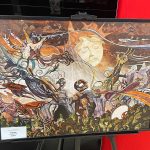
The exhibition featuring the work of Costin Chioreanu [17 October 2026]
© Din Întunerec
You’ve created so many pieces…
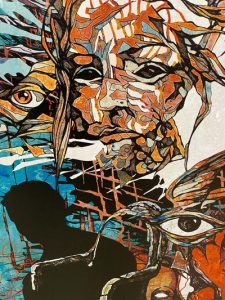
“Embers Fire” realised by Costin Chioreanu [17 October 2026]
© Din Întunerec
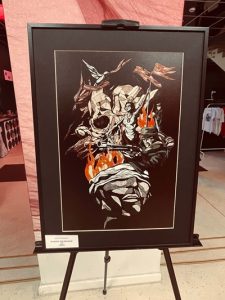
“A duty to escape” crafted by Costin Chioreanu [17 October 2026]
© Din Întunerec
This is what happens after the video: the artwork is still there, inside it. They’re saying, “Hey, we’re interesting, too. Please look at us. We’re not just a simple movie. We have a story to tell!”.
It’s not just about fulfilling a request like, “Nuclear Blast wants to release a new Immortal video. Okay, Costin, please do something. We’re releasing this, so do it quickly!”. Everybody wants things done quickly. But there’s so much more to it.
Which piece has stayed closest to your heart?
Costin Chioreanu: I suppose all of them, but at least one must have a particular reason for being here. There are many, actually, so it’s hard to pick just one.
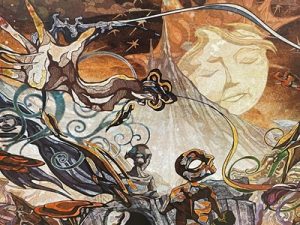
“Moon” created by Costin Chioreanu [17 October 2026]
© Din Întunerec
Costin Chioreanu: Thank you!
In terms of animations, it is hard to pick just one as well. I’ll pick one at random, because it’s strange how animation has become such a huge part of my life. It’s probably the biggest part of it now.
This style has been very successful, and everybody sees that. I literally can’t do much more than I already do because the workload is crazy. I make around two videos a month, and I’ve been doing that for years. Sometimes it’s one. If I have two projects that are eleven minutes long each, even completing one of them can mean spending an entire month working and barely sleeping.
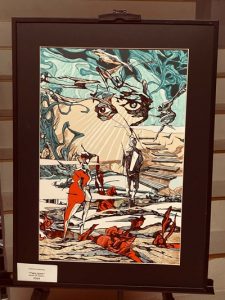
“Twilight” by Costin Chioreanu [17 October 2026]
© Din Întunerec
Edge of Sanity was always something sacred to me, something that should never be touched. There are at least three or four albums in their discography that I consider almost godlike.
This was the first album of theirs I heard, in 1995. I need to confess that it marked me in a way that went beyond anything I’d listened to before, beyond Tiamat, beyond My Dying Bride, even beyond black metal. Black metal is a whole different story for me, and a huge part of my life, but this album was something else.
Why is this one so important? The song “Twilight” is where the name Twilight13Media came from. The title was so important to me that I used it to name my own studio.
Then Century Media, an old client of mine, got in touch and said, “Hey, Costin, we all know how much you love Edge of Sanity. We’re going to need you to make a video for us.”. I said, “What?”. I had never imagined that would happen. I thought the band was completely finished. It wasn’t like the miracle of Edge of Sanity coming back, which was already something I hadn’t expected. I was a huge fan of Edge of Sanity, and when they returned, around 2012 or 2013, I was shocked.
I first met them in 2011 and told them my story. Their music had even caused some surreal experiences in my life, if you can imagine that. Something really strange happened to me during childhood.
So, with this project, it was the same feeling. Who could have imagined it?
I put everything I had into it. Just imagine how difficult it was to illustrate something that had been at the very top of my world during the most magical part of my childhood.
It’s like being a religious person and having someone tell you, “Tomorrow, you’re going to meet Jesus, and you need to make a video for that!”. You’d be thinking, “Fuck! Shit! Okay!”.
It’s an important thing.
What’s strange is that, with all these animations, the subject I’m working on seems to enter my life precisely when I’m experiencing something related to it. It doesn’t feel random. It happens every time. Sometimes the subject isn’t relevant to the moment when I receive the brief, but it becomes relevant when I start working on it. I don’t have to release every video immediately. Thank the universe for that! Maybe five per cent of them have very tight deadlines. But even those five per cent lead to another strange experience. I’ll receive a brief and be told, “Okay, we need this in four months.”.
I’ll think, “Whoa, okay, I have time to work on it!”. Then, after all those months, when I finally start working on it, the very thing I’m making the video about happens in my life. And I think, “Whoa, that’s magical!”.
It is magical, and I’ve started to accept it. It’s been happening for a few years now.
So, when I receive a task, it’s almost like a tarot reading. I’ll think, “Oh, shit, this is about war. Fuck, okay, I don’t like that. I hope I won’t get caught up in some major bullshit!”.
And I’ve noticed that you have your own way of combining cool and warm colours. They don’t look separate from one another. How do you achieve that? It’s really interesting.
Costin Chioreanu: I’ve never thought about it.
I honestly don’t do it on purpose. I’m trying to think of an explanation now, and we’re both directing the question back at me. I’m trying to find the right answer within myself. I guess it’s because I like balance. I’ve thought about that before. Maybe there’s something inside my soul that calls for balance.
I always enjoy balance in every sense. One of my deepest beliefs is that there is no good and bad. Maybe that’s why.
Everything simply exists, and everything needs to be part of everything else. There is no black and white. There are no separate categories of cold and warm colours.
Thank you for noticing that. It’s interesting. I’ve never really thought about it, but that’s all I can say.
V. Where the Forest Remembers
Some places seem to hold on to the past more tightly than others. In the interviewee’s view, the Romanian countryside is not merely a landscape recalled from childhood, but a living presence that has shaped his understanding of folklore, history and the unseen. In “Audial Phantaforms: UI”, those early experiences meet the figure of Vlad the Impaler and a darkness that belongs to the land itself.
With “Audial Phantaforms: UI” taking shape on stage tonight, what is going through your mind as you prepare to bring this project to life?
Costin Chioreanu: I am fine. There were quite a few technical glitches. I’ve been working on this setup for about three years, I think, and I’ve finally found the best way to make it work. It’s a hybrid of digital and analogue equipment. There are lots of pedals and other things underneath these tables.
I can’t say that the guitar is the main instrument, although, in a way, it is. The project has a heart that’s divided in two.
I tried to create as many possibilities as I could for the live sessions, because this project is made entirely on the spot. Everything I’ve recorded has been done in the same way: I turn everything on, put on my in-ear monitors, press record, and have no idea what’s going to happen.
Then it happens.
I need to be tuned in to what’s going on, to find the right way into the right place, so to speak.
For example, tonight we have the myth of Dracula. That’s why I want to thank the festival organisers so much. They made an extra effort and printed an eight-page booklet explaining some of the ideas, because there is a lot to understand.
People need to understand that I’m not here to make another “Nosferatu”, another German Expressionist film, or anything of that kind. This is something completely different.
First of all, it’s deeply personal, for many reasons.
Could you tell me more about why it’s deeply personal?
Costin Chioreanu: First of all, I grew up in the countryside. I spent most of my childhood in a beautiful area of high hills, not quite mountains.
I was used to going into the forest alone and forming very deep connections with my surroundings. For example, my best friend as a child was a creek, a small stream that flowed through the area. That was my friend, and I used to talk to it.
I’d share music with it. I had a little Walkman, and I would receive cassettes from Bestial Records, all kinds of black metal, really good stuff, as well as releases from Misanthropy Records. I’d listen to them with my friend and out in the woods.
Through those experiences, I could feel how powerful Romanian nature is. It’s also very rough, in the sense that it’s close to its original state. It’s raw and wild, but in a magical way.
It doesn’t just look like a forest. No. It’s a fucking entity. You can feel that it’s alive because the human presence hasn’t affected it that much. And, of course, there’s also the fact that we haven’t developed that much of a culture around these things. In the end, that has had some positive consequences, because we still have this sense of the magical.
Even now, I get goosebumps when I imagine that some of the forests we have today are the same ones that existed in Dracula’s time, in the time of Vlad the Impaler. The same trees have been standing there. They’ve been there all along. They know.
These things make us realise that we’re not made of plastic. We’re not completely disconnected from the world around us, even if we sometimes behave as though we are.
We’re caught up in our lives, our modern routines, social media and trying to make enough money to keep things going. Sometimes, all that takes up so much of our energy that there’s nothing left for anything magical. We get home and think, “Okay, man, I’ve had enough. I just want to put on some Mayhem, smash a bottle of whisky and forget about everything!”. But what I’m doing tonight is connected to my own perspective. People should understand that it’s me, Costin, doing this. Everything comes through my vision and my personal connection with this energy. And that energy is real. Vlad the Impaler was a real person.
My connection with Romanian nature is also a major part of it. That’s why nature plays such an important role in this film. And it’s not just nature, but its magical side, too. When I was a kid, I used to have visions. I’d see trees starting to walk, things like that. The bushes would have eyes. They were looking at me, and I could hear them breathing.
The film is about that: a world close to the medieval world, a world that belongs to another time. These entities still exist, and they’re portals into that other realm, into something that comes from Vlad’s time. That’s the first aspect.
The second is that I’ve always been a huge horror fan.
The third came from revelation. I was living in the Netherlands for years, and I realised something: why was I born in Romania? There must be a reason. I realised that all of us, including you, have a reason for being where we are. Think about it. You know your own bedroom better than anyone else. You know that space. There’s a reason you’re connected to it.
Otherwise, nothing matters. We could just throw ourselves into the sea and die. Everything would be pointless, and that’s not a good place to go mentally.
So, I realised that I should do something about this.
There are people coming to tonight’s event whom I met through this project, people who have spent ten years studying Vlad the Impaler and have PhDs in the subject. They’re coming tonight. And they don’t know what to expect. I haven’t spoiled anything for anyone, not even for my wife, who worked with me on the animation. I didn’t want to show her the finished piece beforehand because I want her to experience the whole thing with the music, too.
I could write a whole book about what’s happening tonight! I love the project and the potential it has. I think people will feel that it’s based on something true.
Of course, I’m just a channel. I’m here, connected to the energy, because I know where to go and how to call it. It will come through. I don’t even know how to explain what I’m doing mentally. I haven’t learned my lesson yet! At every level, “Audial Phantaforms: UI” is a statement. It’s a desire to bring Romanian culture to the level it deserves.
I genuinely see this art film and live performance, the whole concept, as something that can continue to grow. I have ideas for the future.


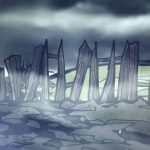


Fragments of “Audial Phantaforms: UI” [17 October 2026]
© Din Întunerec
VI. Dracula, Reclaimed
The legend has travelled far beyond the place that gave it a name, acquiring new faces with every retelling. The artist does not seek to erase those interpretations, but to approach the story from his own point of view, through the landscape, traditions and living darkness that have shaped his life. What begins as a personal work also becomes a statement about how Romanian culture might present itself to the world.
Oh, ideas for the future? Picture me intrigued!
Costin Chioreanu: This time, the exhibition wasn’t originally planned as part of the project. The festival invited me to do it, and the exhibition is more closely related to the style used for the festival itself. But for the next appearance, or perhaps the one after that, I’d like to include a different kind of exhibition. I don’t want to give too much away, but I want to start revealing the real depth of the different layers: the most important layer of nature, the historical dimension and the other elements that make up the project. All of these aspects will eventually come together into something much more complex.
I can see this project being shown in museums. For example, an art exhibition with photos by my beloved Olivia Chioreanu. We are doing so many projects and things together, even music, so in the next phase I see for sure more complex type of events, where we can put even more into frame or on the light if the stage what she is doing or what we do together.
Imagine presenting it at Dracula’s Castle on Halloween. What could be a more high-quality expression of what Romania can offer today?
Although, actually, I wouldn’t necessarily call it horror. It can be horror in a way, but that’s not how I see it. It’s definitely dark. But the subject is more specific than that. I don’t want to destroy the romantic image of Dracula. I’ll give the attendees the booklet, and they’ll understand what I mean. In this project, the romantic aspect of the story shifts away from the idea of Dracula as a crazy, perhaps even sexy, human character. Instead, it moves towards nature and its relationship with darkness, towards the living darkness of the Romanian landscape.
We have all these beliefs and traditions that need to be understood. If you tell a Romanian story in the backyard of my house after dark, you’ll feel that darkness breathing behind you. You’ll shiver. You’ll feel as though it’s alive.
I think that feeling defines part of Vlad the Impaler’s energy.
I don’t want to destroy the romantic image that came from the West. It has its own values, and I understand what it does. But it’s also interesting to explore other creative perspectives on him and his story.
One thing that stayed with me was the “UI” part of the title. Why did you choose it?
Costin Chioreanu: Honestly, I would have loved to give it a different name, but there are all the copyright issues surrounding Dracula and everything that comes with it. In the end, I needed to find another way around that.
It’s also a natural reaction for Romanian people born in Transylvania when they’re suddenly confronted with something that frightens them. I thought, “Okay, that’s perfect. I want to capture the essence of it. I don’t want to lose that living darkness.”. That’s what the working title was really about.
I actually like the way it sounds in Romanian even more. “Întunericul viu”, for example, sounds much more powerful in Romanian than it does in English. But I didn’t want to tie the project exclusively to Romania, either. I want to promote this work abroad, too.
I also thought “UI” was close to what I’m doing because I don’t use lyrics. The sounds and interjections come naturally, so they’re the right form of expression for this project.
Can we expect to see something like this in Bucharest?
Costin Chioreanu: I don’t know. It depends. A performance like this isn’t a regular show by a regular band. People need to be patient because setting everything up takes a long time.
There are so many elements involved that something always happens, and you never know where the problem is. There are so many connections and pieces of equipment that if one thing goes wrong, it can affect everything.
This morning, for example, we spent two hours trying to figure things out. We kept thinking, “Ah, okay, so that was the problem!”. Until you find it, it’s almost impossible to get everything working.
The whole setup is extremely sensitive. Some of the percussion instruments are highly sensitive, too, and the sound requires very careful handling. This project can’t be treated like a rock band. It needs its own space.
And the audience matters, too. This isn’t necessarily something designed for a metal festival. I didn’t want it to be that way. In my opinion, it’s very metal, but it belongs to a different world. It’s what metal might sound like inside our inner world.
VII. The Machine at the Threshold
Every new technology arrives carrying old questions about what it means to create. Artificial intelligence has made those questions harder to ignore, blurring the boundaries between tool, collaborator and author. Costin approaches the subject through the same belief that runs through his work: things are rarely as simple as the labels we give them.
I’ll keep my fingers crossed for a performance in Bucharest. Before I let you prepare for tonight, I’d like to ask you one more question: how do you see AI affecting the creative world today?
Costin Chioreanu: I don’t know. From the beginning, I never felt that AI was a threat.
Things like this have happened before. When Adobe Photoshop appeared, people had the same discussion. When photography was invented, there was the same debate.
AI is different, though, because it’s taking everything into a different dimension. That’s true. There are ethical issues, and it will change a lot of things in society over the next three years. I think the world will look completely different in five years. I can assure you of that.
We can’t yet imagine what those changes will look like because we can’t predict their full extent. But things will change, especially because of the people working with AI. We, as human beings, will change when we start having this entity that helps us in some way.
I have friends who have developed a very deep relationship with it.
So, in the end, it’s not so much about whether AI is good or bad. Honestly, it’s about who’s programming it.
It’s a cool tool. I don’t use it at all because I don’t need it in my work. As I said, I have a different way of doing things.
I would say that AI is what it is, and it arrived when it was supposed to, just like everything else. It will change everything in the way it needs to.
That’s also why I say there is no good and bad. Things are what they are.
Even when we dislike something, we dislike it because of a thought in our minds. It’s like having a programmer inside us, telling us, “You’re not allowed to like this!”, or, “You should love that!”.
But those thoughts are based on our experiences, which produce certain ideas. And the idea itself is the thing that makes us believe there’s something inherently good or bad about what we’re seeing.

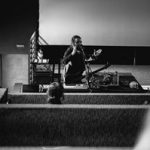
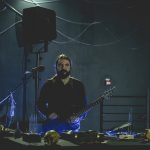
After the interview: Costin Chioreanu at Dracula Film Festival, 17 October 2026, presenting his own interpretation of the Dracula myth
© Ionuț Iancu [Sombres Nuits, The Interwission]