Spring returns by habit. SoundArt Festival returns by oath. Organised by Cavalleria Events, it has become a familiar presence in the city’s cultural calendar, returning each year with its particular blend of sound, atmosphere and artistic experiment.
This year again, the festival unfolded at the beginning of the spring, opening its gates with a warm-up gathering on 12 March at Encore Club, before the main rites followed on 13 and 14 March at Quantic.
Music was not the only voice present. On 14 March, “The Green Wardrobe” took place at Hidden, a gathering dedicated to sustainable fashion that offered a quieter counterpoint to the amplifiers and drum kits elsewhere in the programme.
Visual art also found its place within the festival’s orbit. Greek visual artist Manthos Stergiou, known under the name Manster Design, presented an exhibition of his works, adding another colour to the broader SoundArt landscape.
Events like this are never just schedules printed on paper. They are small constellations made of people, sound, expectation and chance meetings. I arrived with the same curiosity I carry each time, wondering what voices would rise above the murmur of conversation and the clatter of glasses. SoundArt Festival has long had the habit of gathering unlikely colours under one roof, and this year proved no different.

Official event poster
© Cavalleria Events
The First Sparks: SoundArt Festival’s Opening Evening in Encore Club
Held at Encore Club, the warm-up evening brought three bands to our ears: Twice Louder, Purple Caravan and Teraflora. An interesting combination of styles, well suited to usher us into the atmosphere of SoundArt Festival.

Official announcement poster
© Cavalleria Events
As promised, Twice Louder from Romania opened the night. Their name is not an exaggeration. They make noise. A deliberate, carefully built noise, often circling social themes.
They call their music rock, and rightly so. What they build within that frame carries clear purpose.
For the gathering, they chose to start off with an instrumental piece that allowed them to reveal their abilities from the first minute; cutting riffs and drums built to break the roof of Encore Club itself. The drummer deserves particular mention here. The performance was excellent, precise and forceful, setting a firm backbone for everything that followed.
Only after this introduction did the vocalist step onto the stage, carrying with her the song “Prometeu”. The transition worked well. The instrumental tension found its voice, and the piece unfolded with an optimistic message, carefully built and delivered with a vocal presence that completed the structure rather than merely resting upon it.
The set continued with “Ziduri de fum”, followed later by “Adam”, each piece reinforcing a detail that should not be overlooked: the entire performance rested on original compositions. No borrowed ground, no familiar covers to lean on.
By the time their final notes faded, the response was immediate. Twice Louder left the stage to applause, having done exactly what an opening act should do: wake the room and make it listen.
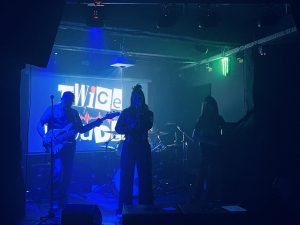
Twice Louder performing in Encore Club, 12 March 2026
© Personal archive
Applause also greeted the entrance of Purple Caravan. Also from Romania, but travelling a different road, the group moves within the sphere of stoner hard-rock, coloured by psychedelic echoes and the weight of heavy metal.

Purple Caravan performing in Encore Club, 12 March 2026
© Personal archive
Purple Caravan have their music around fuzzy, high-energy, riff-driven structures. Their aim, by their own admission, is to deliver what they call a shamanic balance alongside a certain sonic chaos, mixing the spirit of 1970s rock with modern production thick with fuzz.
The themes they explore are not simple. There is heaviness in their approach, but also something more searching. Their music carries a stoner attitude, playful yet intense, a fuzzy package of heavy riffs and psychedelic wanderings. One hears echoes of classic rock traditions.
Throughout the set they kept a steady line of contact with the audience, speaking between songs and treating the room less as a crowd and more as a gathering drawn into the same current. Among the pieces performed was the very first song the band ever wrote, a small but telling gesture that revealed both their beginnings and the road travelled since.
Humour surfaced more than once during the performance. It never broke the momentum, but rather added a human edge to the heavy sound surrounding it. One could sense that the members do not merely perform their lyrics. They inhabit them. At some point in their lives something urged them towards musical expression, and whatever that impulse was, it clearly made the right choice.
By the end of the set the effect was visible across the room. The distance between stage and audience had quietly dissolved. Even the most hesitant figures in Encore Club had stepped forward, drawn closer to the amplifiers and the thick haze of riffs that Purple Caravan had set loose.
From purple, we moved to pink and black-and-white. Yes, I speak of “Bloom & Doom”, the recently released album of the Bulgarians from Teraflora.
They entered our country with the clear intention of showing what that release could do. Did they succeed? I would say yes.
Their sound is crafted for the stage. A mixture of metal and post-hardcore, blending alternative metal and metalcore, balancing aggression with melodic passages.
I appreciated the repertoire they chose for the evening. It revealed the record while still giving space for variation. Just as importantly, they spoke with the audience, keeping that fragile line of communication alive. It made the set breathe.
They ended the show and, with it, our evening at Encore Club, leaving behind the pleasant certainty that SoundArt Festival had begun exactly as it should: with noise, curiosity, and the promise of the nights still waiting at Quantic.
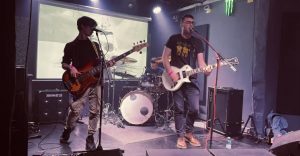
Teraflora live at Encore Club, 12 March 2026
© Personal archive
The First Night at Quantic: A Chorus of Many Voices
We barely had time to catch our breath before the first day of SoundArt Festival swept over us. And it arrived in full force, with a line-up of diverse bands, each carrying ideas honed with care and a sound all their own.

Festival programme
© Cavalleria Events
The task of opening the event belonged to Romania’s Hteththemeth. But their moment will come shortly. Bear with me, dear readers. The story is about to unfold.
First, a few words about what waited inside Quantic.
Just as it had been at Encore Club the night before, the crowd gathered quickly. I arrived roughly half an hour before the doors opened, early enough to notice that others had already claimed the nearby tables. Conversations drifted through the room. I caught fragments about Ordo Rosarius Equilibrio, and others about the art exhibition presented during the festival.
I liked what I heard while moving between the tables. In a world that increasingly bends towards whatever the social platforms decide to push forward, there are still people who want to listen to music live, to experience it with their own senses, and to understand what lies behind a creative concept.
Official event poster
© Cavalleria Events
There was bustle in the room. And the bustle grew the moment Hteththemeth stepped onto the stage.
Some concerts begin with a chord. Hteththemeth begin with a scene.
Before the music properly settled, the stage already resembled a small theatre. Strong light from behind turned the musicians into silhouettes, while projections slowly coloured the background. Figures appeared one by one, almost ceremonially. A lady dressed in velvet. A jester-like figure. Then a crowned presence completing the strange assembly. For a moment the hall of Quantic felt less like a club and more like an old chamber where something theatrical was about to unfold.
Musically, the Romanian band moves through territory that refuses simple classification. Elements of avant-garde metal meet theatrical rock and progressive structures. Their compositions rarely rush. They built their atmosphere patiently, letting the stage imagery and the narrative surrounding their characters guide the experience.
The set also introduced pieces from the new chapter in the story of Adoriel and Hteththemeth, expanding the strange mythology the band has been shaping for some time.
Yet the moment that lingered most in my mind arrived unexpectedly. “You Are My Last Girlfriend” from the album “Best Worst Case Scenario” [2016]. In the middle of that eccentric universe the piece appeared almost tender. For a few minutes the mood softened. Coloured lights moved slowly across the stage while the melody unfolded with an innocence that contrasted beautifully with the darker tone of the surrounding material.
The conclusion came with “The Romantic Side of Perish” also from “Best Worst Case Scenario”. The barrier between stage and audience had dissolved entirely. The guitarists moved into the crowd, weaving through the spectators as if the hall itself were part of the performance. The vocalist directed the band with broad, deliberate motions, shaping the chaos of sound into a living, breathing entity, like a conductor guiding a restless, unruly ensemble.
It was not merely an opening concert. It was a strange little play performed with amplifiers.

Hteththemeth opening the first night of SoundArt Festival, 13 March 2026
© Ștefan Lupașcu
After the theatrical world created by Hteththemeth, the stage emptied and returned in a completely different form.
The Italian Davide Laugelli approached the evening with a concept that quietly defies expectation. In most metal performances the guitar dominates the centre of attention. Here the bass assumed that role entirely.
Two instruments stood at the heart of the sound, handled with careful precision. Behind Laugelli, drummer Filippo Maccarelli provided structure. The music from “Out of the Nightmare” released in 2023 unfolded slowly, almost like scenes from a film rather than songs arranged for a traditional concert. At times the atmosphere felt rooted in horror cinema. At other moments it leaned toward science fiction landscapes.
This was a set intended to make you feel. I began cautiously, letting the music wash over me while I searched for its path. Gradually, the patterns drew me in, subtle yet insistent, until I found myself swallowed by the world they were shaping on stage. Every note, every pulse, pulled me deeper into the soundscape, until curiosity had given way to total immersion.

Davide Laugelli on the stage of Quantic, at SoundArt Festival, 13 March 2026
© Ștefan Lupașcu
Later that evening I told a friend that Davide Laugelli had been one of the presences that marked me most deeply during the night. The music did not rush.
Between sets the hall breathed for a moment. Conversations resumed, fragments of stories drifting from table to table, from corner to corner. I heard someone recalling reckless years, another voice mentioning the merchandise stands. The gallery and the gathering dedicated to sustainable fashion appeared in the discussions as well. It was that kind of crowd. Curious, talkative, unwilling to stand quietly in the background. And I realised once again that this is precisely the sort of place where I want to spend a Friday evening. And not only a Friday.
Then it was time to return to the hall, just as I received my coffee from the bartenders I have always admired for the way they manage the crowds.
It was time for Shell Beach.
The group entered without ceremony. The Hungarian band arrived carrying the weight and tension of post-hardcore in every note. Their sound is built on dense riffs and shifting rhythms, pressing into the listener with a ceaseless power. Each song felt deliberate, each pause carefully weighed, as though the hall itself had taken part in the ritual. The music offered no solace. It commanded attention, drawing the audience into its own unyielding current.
I had listened to little post-hardcore in my life. I discovered them the moment SoundArt Festival put them on the bill, and I decided to do my homework, so to speak. I enjoyed what I heard from “Solar Flare” from 2023 [and from the older “Acronycal”, 2007]. I also liked how it sounded live and appreciated the energy of the vocalist. A special moment.

Shell Beach going through their set, SoundArt Festival, Quantic, 13 March 2026
© Ștefan Lupașcu
If Shell Beach pressed the room into itself, Planet of Zeus reshaped it entirely. The band from Greece walked onto the stage with the calm assurance of musicians who know every note and pause as if born to them. Their sound straddles stoner rock and heavy metal, with a faint dusting of southern rock traditions brushing against the edges.
Within moments the hall shifted. Where tension had previously curled inward, Planet of Zeus pushed outward, loosening shoulders, drawing heads together, pulling the audience closer to the stage. Their music moved in wide arcs, echoing the spirit of classic southern rock while layering in heavier, modern riffs, a mix that lands equally well in a crowded club or beneath the festival lights.
At one point the vocalist turned to the guitarist and tossed a simple provocation at the crowd:
“The louder you clap your hands, the faster it will be played!”
One could guess immediately that applause erupted and refused to fade, carrying through the carefully chosen set. The band held up their end, answering the crowd with an energy that made bodies move almost on instinct. For a few moments, stage and audience seemed to collide, caught in the same pulse; a chaos that felt good to surrender to. This is one of the small joys of live music, the shared abandon that no recording can capture.
Beyond the spectacle, what lingered most was a sense of precision married to abandon. Every riff, every drumbeat, every vocal cry seemed measured yet free, shaping the room as if it were a living instrument itself. Planet of Zeus reminded the venue that music is both a challenge and a gift, something to be felt as much as heard.

Planet of Zeus performing at SoundArt Festival in Quantic, 13 March 2026
© Ștefan Lupașcu
Without warning, it was time for the evening’s final act – Ordo Rosarius Equilibrio. I had heard their name whispered over tables throughout the night, but as they prepared to play, it resonated even more insistently, even around the merchandise stand. The anticipation was tangible; this was a performance that promised presence over volume, depth over spectacle.
At the centre of the stage stood Tomas Pettersson and Rose-Marie Larsen, two figures whose command of the space was quiet but undeniable. Their presence alone shaped the evening, the very air in the room attuned to them.
The music flowed deliberately, drawing from dark folk textures, industrial undertones, and carefully measured repetition. It did not demand immediate reaction, nor did it seek to overwhelm. Instead, it invited attention, coaxing the audience into a shared awareness of the stage, of the performers, and of the space between them. Powerful in meaning songs, such as “Nature Seeking Equilibrium (War 4 the Principle of Balance)” and “Kiss Me Now [and I’ll Be Silent Just 4 You]”, unfolded like chapters of a dense, unsettling narrative, each note resonating in the hall with the weight of deliberate intent.
As the Swedes moved through the set, the room responded. Attendees swayed, leaned forward, or simply watched in rapt attention, drawn into the gravity of their combined presence. It was impossible to ignore how both figures shaped every second, how their movements and subtle interactions gave life to the compositions, making the music tangible in the space around them.
In conversation, the creative mind behind Ordo Rosarius Equilibrio described the project as a framework – a long-standing investigation into desire, morality, devotion and transgression. From the earliest releases under Cold Meat Industry to the current chapter with Out of Line, the duo have constructed a body of work where aesthetic and philosophy intertwine, and the apparition at SoundArt Festival was a demonstration of that dialogue.
By the end of the set, the audience had not merely listened; they had been immersed in the presence of the performers, in the careful orchestration of atmosphere and tension. The impression left was clear: Ordo Rosarius Equilibrio do not perform for applause or spectacle, but for the weight of their own presence, and for the attentive, willing gaze of those who choose to enter their world.

Ordo Rosarius Equilibrio closing the first night of SoundArt Festival organised in Quantic, 13 March 2026
© Ștefan Lupașcu
I decided to leave late, still listening to fragments of songs echoing through the venue.
As I stepped outside, I heard a child walking beside two adults say that the bands were very different. Perhaps that small remark said enough about the night. SoundArt Festival had managed once again to gather different worlds in the same place and let them speak.
The Last Night of SoundArt Festival: From Hidden to Quantic
As mentioned, a night before I left Quantic late, and the same happened on the second night, though that story will come a little later. Before returning to the concerts, I would like to touch briefly on the concept called “The Green Wardrobe”.
I was pleased to see it on the programme, particularly because Hidden is one of those places that stayed with me from the moment I first stepped inside it. I still remember the evening when Akral Necrosis performed there. Does anyone remember that show? The memory has not quite faded.
Hidden carries a particular atmosphere, the sort of space where different forms of expression coexist without friction. Concerts can take place there, but so can gatherings that explore other creative fields. Under its roof, music and visual culture appear to speak to one another rather naturally.
This is precisely where “The Green Wardrobe” found its place within SoundArt Festival. The idea behind it is simple in appearance yet complex in intention: a small initiative dedicated to sustainable fashion. In practical terms, this means garments created or curated with environmental responsibility in mind, encouraging reuse, ethical sourcing, and a slower approach to consumption. Within the broader cultural conversation, sustainable fashion attempts to reduce the ecological impact of textile production, one of the more resource-intensive industries in modern society. By favouring durability, recycling, and responsible materials, such initiatives invite people to rethink the lifecycle of clothing.
It was encouraging to see that this smaller component of SoundArt Festival drew attention and curiosity. Music festivals rarely extend their curiosity beyond the stage, yet here the organisers seemed willing to broaden the conversation. Judging by the number of people passing through, listening, discussing, and observing, the idea clearly resonated.
Only afterwards did the evening slowly pull us back toward the concert halls of Quantic.
The last night of the festival carried a line-up as diverse as the first. Among the names announced were A Broken Design, Annapurna, Euthymia, Calyces and Weather Systems.
The opening belonged to A Broken Design from Malta. Quite a group of seasoned musicians from a variety of musical backgrounds.
Their sound moves somewhere between stoner rock and grunge, built on thick guitar tones and a rhythm section that prefers weight over ornament.
I had never seen the group live before, though I had wanted to for some time. The live setting confirmed something that recordings only suggest: their music breathes differently on stage.
The guitars carried a dense, almost abrasive texture, while the drums held the composition together with steady, grounded patterns. Over this foundation the vocals arrived rough-edged and direct, fitting naturally into the gritty atmosphere the band builds.
What impressed me most was the balance between restraint and impact. A Broken Design do not rush their songs. They allow the riffs to settle, letting the weight of each passage accumulate before moving forward. The result was a solid performance, built on a carefully chosen selection of tracks from their discography, each piece reinforcing the band’s heavy, unpolished character. I would gladly catch them live again, or hear news of new material emerging from the Maltese group.

A Broken Design on the stage of Quantic, opening the second night of SoundArt Festival, 14 March 2026
© Ștefan Lupașcu
Before the next set began, the night allowed a brief pause. I found myself wandering once more through the gallery space, where conversations moved easily between the artworks and the music still echoing from the hall. A few familiar faces appeared along the way. One friend, in particular, could barely contain his satisfaction after purchasing a tableau from the exhibition. The quiet pride on his face said everything. Seeing it made me smile. Moments like these remind one that festivals rarely belong to sound alone.
Soon enough, attention returned to the stage, where Annapurna from Romania prepared to begin.
I had not often managed to catch them live, so their inclusion in the programme was particularly welcome.
Stoner/psychedelic rock driven by a hunger for shattering frequencies. Their music carves out a vivid, colourful soundscape, balancing heavy riffs with rhythmic momentum and psychedelic flourishes. Each composition unfolded with a sense of purpose, creating an immersive and intense listening experience that lingered well beyond the final note.
Having followed their discography, I could appreciate how their live execution expanded upon it, translating recorded tracks into something immediate and dynamic.

Annapurna live at SoundArt Festival, Quantic, 14 March 2026
© Ștefan Lupașcu
After Annapurna’s set, the focus shifted once more, drawing me back into the evening’s broader exploration of sound and thought. Euthymia, enough said.
The work of the international group moves through a meeting point of doom and progressive rock, where introspective themes stand beside broader metaphysical questions. The conceptual framework behind Euthymia draws on several sources. One can detect echoes of Carl Jung and the language of psychoanalysis, alongside more abstract reflections on inner and outer worlds. These ideas are channelled through layered compositions that recall the influence of groups such as Tool, Alcest and Sunn O))).
On stage, their performance unfolded with a careful sense of structure. Layers intertwined without clutter. There was a tangible weight to the lower frequencies, a fullness that anchored the compositions, while the higher registers shimmered just enough to lift the atmosphere without piercing it. Dynamics shifted with intent, giving the music a sense of ebb and flow that felt natural rather than engineered. Even in the densest passages, the audio remained defined, precise, and enveloping, creating a presence that drew the listener in and held them there, attentive to every subtle shift and swell.

Euthymia performing at SoundArt Festival in Quantic, 14 March 2026
© Ștefan Lupașcu
In the middle of the hall, a child quietly filmed the performance, occasionally turning to his mother with questions about the band. Watching his curiosity and fascination unfold warmed my heart.
Calyces emerged next, their presence alone hinting at the intensity to come. Having followed the band since their 2018 beginnings in Greece, I was curious to see how their careful balance of tension and release would manifest live.
Calyces operates in the space where heavy prog meets emotional extremes, constructing music that moves deliberately through despair, hope, and the subtle spaces in between. Their discography, from “Impulse to Soar” [2020] to “Fleshy Waves of Probability” [2025], demonstrates a meticulous approach to composition, where each passage carries a precise emotional logic.
Live, the band delivered with clarity and control. “Boneshatter” from “Fleshy Waves of Probability” resonated sharply, a stark confrontation of sound and rhythm, but the remainder of the set maintained the same rigorous attention to unfolding each idea fully. Shifts in tempo and texture were handled with care, allowing the music to expand without excess.
Every moment of the performance reflected the band’s intent, blending technical exactitude with emotional depth. It was a set that demanded attention.

Calyces on the stage of Quantic, at SoundArt Festival, 14 March 2026
© Ștefan Lupașcu
Like all good things that make you lose track of time, the festival came to an unexpected close. And the finale belonged to the alternative rock band Weather Systems from the United Kingdom. I already knew who Weather Systems are and what they can do, yet their presence on the SoundArt Festival stage brought a new level of subtlety.
At the forefront was Daniel Cavanagh, vocalist, multi-instrumentalist, and songwriter, accompanied by Daniel Cardoso on drums, producer, and musical director. Their debut from 2024, “Ocean Without A Shore”, formed the core of a remarkable performance.
The set drew heavily from the album, each piece executed with care and precision. Cavanagh’s vocals were flawless, carrying the music’s message with clarity and depth that left no room for doubt. The presence of Soraia Silva added a sensitive, delicate dimension, balancing the denser passages and heightening the emotional impact of the set. The highlights for me were “Do Angels Sing like Rain?”, “Synaesthesia”, and, of course, “Untouchable Part 3”.
A striking moment came with their rendition of Metallica’s “Sad But True”, released in 1991, which sparked direct communication with the audience and reinforced the connection between stage and hall. Every interaction felt natural, from brief exchanges of glance and gesture to the tangible energy the band projected.
The concert once again demonstrated how Weather Systems can combine technical mastery with pure emotion. Cavanagh’s vocal presence, supported by Silva’s subtle contributions, created a performance that was unforgettable, captivating, and profoundly moving, leaving the festival’s conclusion imprinted on the memory of all present.
The crowd did not rush to leave. On the contrary, even several minutes after the members of Weather Systems had stepped off the stage, people remained in front of the stage. I remarked to a friend that, should the band return, the audience might well linger for another half hour to hear them. The group did not, but the devotion was clear, and it was a quiet pleasure to witness.

Weather Systems sealing the night of SoundArt Festival organised in Quantic, 14 March 2026
© Ștefan Lupașcu
Echoes Beyond the Last Chord
In its seventh edition and under the banner of “Pax in Natura”, SoundArt Festival managed to surprise with personal touches. It guided the audience through varied musical and visual journeys, each distinct yet united by a shared sense of curiosity and engagement. Throughout the event, I did not encounter a single bored or weary face. On the contrary, I saw people returning repeatedly, eager to hear the bands that had long been on their playlists, to discover others anew, to understand the mystery behind Stergiou’s art, and to participate in a sustainable, thoughtful experience.
Among the many small conversations that impressed me, one story remained. A lady had set her heart on a painting by Stergiou, but could not take it home on the night of the concert. She lingered, speaking at length about it, her admiration evident in every word. With a measure of goodwill, arrangements were made so that the painting could be preserved until she could collect it at a later date. In that fleeting exchange, one could glimpse the quiet magic of festivals: the way art, music, and human care intertwine, leaving traces long after the final chord has sounded.