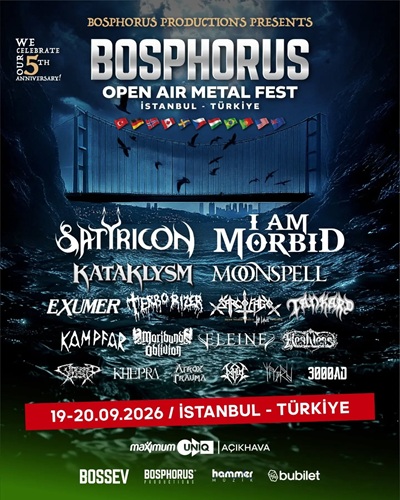
Every quest begins with a questionable decision, a destination on the map and the vague suspicion that things might get out of hand. Ours took us to Istanbul, where Bosphorus Open Air Metal Fest was preparing to welcome Satyricon, I Am Morbid, Moonspell, Kataklysm, Kampfar, Moribund Oblivion and a host of fellow miscreants, all gathering for two days of metal. We left familiar territory behind and set our sights on Türkiye, ready to see what awaited us on the other side of the Bosphorus. After all, when a gathering includes black metal schemers, death metal fanatics and thrash metal veterans, one hardly expects a quiet evening and a sensible bedtime.
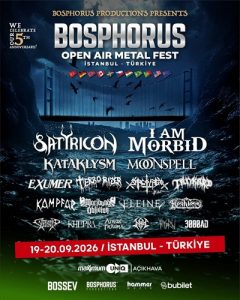
Official announcement poster
© Bosphorus Open Air Metal Fest
Istanbul: A City Between Worlds
Istanbul is that kind of a city that refuses to belong to just one world. Europe and Asia face one another across the Bosphorus, while centuries of Byzantine and Ottoman history linger in the streets, beneath the domes and behind the walls of its monumental landmarks. Mosques rise above the rooftops, the Grand Bazaar offers enough winding passages to test anyone’s sense of direction, and the waterfront provides a welcome respite from the city’s relentless movement. Hagia Sophia, the Blue Mosque, Topkapı Palace and the Galata Tower are among the places that make Istanbul worth exploring even when no festival awaits at the end of the road.
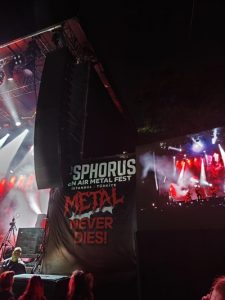
For a metalhead, the city offers a curious contrast: the call to prayer drifting across the skyline, the clatter of traffic and the promise of amplified extremity waiting somewhere beyond the tourist trails. Istanbul has its own rhythm, its own contradictions and a history full of empires that rose, ruled and eventually fell. We had come to witness a different kind of gathering, though the idea of an army assembling beneath an unfamiliar banner felt entirely appropriate. Our destination was Maximum Uniq Açıkhava, where Bosphorus Open Air Metal Fest would turn a corner of the city into a meeting ground for metal devotees from Türkiye and beyond.
Order Amid the Noise
Maximum Uniq Açıkhava sits beside a shopping centre, with a food court close at hand for anyone whose appetite extends beyond blast beats and distorted guitars. Food was also available inside the festival grounds, so finding something to eat was hardly a side quest requiring a successful Survival check. More importantly, the entire site was clean, well organised and carefully maintained. The schedule ran smoothly, with no delays to disrupt the proceedings. Such competence is always welcome in a world where festival timetables can sometimes prove more fictional than the legends printed on a tavern wall.
The setting added to the experience. Rather than an industrial wasteland or a muddy field at the mercy of the elements, the festival occupied a park-like outdoor space, giving the crowd room to move between the stage and quieter corners. The atmosphere was relaxed without losing its intensity, and the audience brought plenty of enthusiasm to the shows. With a line-up stretching from black metal and death metal to thrash metal and more melodic territory, the festival offered several paths into the underground, each with its own assortment of “monsters”.
One of the pleasures of travelling for a festival is discovering how a familiar scene changes when viewed from somewhere else. At Bosphorus Open Air Metal Fest, the crowd was a lively mixture of styles, ages and backgrounds. A woman in a floral hijab, dressed in black and accessorised with metal finery, stood out as a striking example of how personal expression finds its place in the scene. Elsewhere, elaborate make-up, leather, studs, and all manner of dark attire formed a colourful procession of their own. The contrast was noticeable, but it never felt like a clash. People had come to enjoy the music, and that common ground mattered more than any apparent difference in dress or background.
There was also a healthy contingent of younger fans, alongside visitors who had travelled from abroad. It was encouraging to see such a varied audience gathered for extreme music in Istanbul, and the friendly atmosphere made the festival feel less like a meeting of strangers than a temporary community. The most memorable moments were not necessarily the grandest ones, either. Sometimes the best stories begin away from the stage, in the company of musicians and festival-goers, when the barriers between performers and audience become considerably less imposing. As we would discover, a small discussion after the show could prove just as effective a gathering point as a wall of amplifiers.
Saturday, 19 September: The First Summons
The first day opened with New Zealand thrashers 3000AD, who had the unenviable task of convincing a festival crowd to assemble before the afternoon had properly begun. Their set included “Cells”, “Journeys”, and “3000 A.D.” from “The Void” [2020], and “Ghettocide”, released as a single in 2024. Their performance gave the day an energetic opening, with the trio bringing their ideas to an audience still finding its way into the festival grounds.
Khepra from Türkiye followed with a set fusing ancient mythological motifs with the intricate architecture of death metal. “Atra Hasis” and “Enki (Diaries of a Forgotten God)” from “Cosmology Divine” [2016] established the mythological territory, while “The Order”, “Consumed by Fire” and “Vision Genesis” from “Anatomy of Sin” [2025] completed the show. Their choice of material made for a fitting soundtrack to a festival unfolding in a city whose own history reads like a collection of competing empires, forgotten gods and conquered kingdoms.
The early hours also belonged to the more extreme end of the spectrum, with Czech death metal act Cutterred Flesh and fellow death metallers Fleshless adding further brutality to the proceedings. Their position on the bill offered a welcome reminder that a festival of this size should leave room for underground names.
Eleine then came with symphonic metal to the stage. Opening with the instrumental “Towards the Fields” from the 2025 EP “We Stand United”, the Swedish act moved through “Watch as We Rise” from “The Water Taste of Blood” [2026] and “We Shall Remain” from the album of the same name issued in 2023. The set balanced a theatrical presentation with a succession of melodic songs, offering a change of texture before the evening descended further into black metal and thrash metal.
Kampfar dealt in the sort of Norwegian black metal that makes the wilderness seem like a place with its own grudges. “Norse” from “Fra Underverdenen” [1999], “Tornekratt” from “Profan” [2015], and “Mylder” from “Djevelmakt” [2014], were among the highlights of the set. We were particularly glad to see the musicians in such formidable form on stage, their show bearing the mark of a vision that belongs entirely to them.
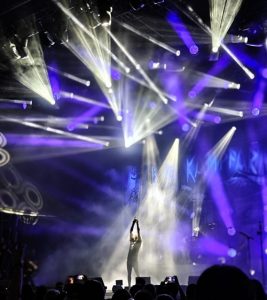
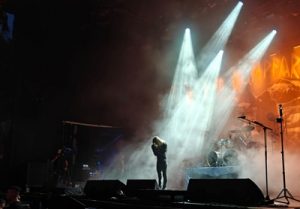
Kampfar
© Din Întunerec
Exumer brought German thrash metal to the fore with riffs sharpened to a murderous edge. The songs from “Death Mask Messiah” issued in 2026 set the pace, while “The Raging Tides” from the album of the same released in 2016 and “Possessed by Fire”, that ol’ good song from 1986, reached into different chapters of their discography. No grand illusion was needed here: the guitars did the carving, the drums drove the assault, and the riffs left little standing in their wake. Exumer played with the assurance of veterans who know precisely where their weapons are made and what they were made to do. Precision was their craft; momentum, their executioner.
Moonspell took the evening into more gothic territory. “Cross Your Heart”, “Far from God” and “Biblical” from their newest album opened the set, leading into “Opium” from “Irreligious” issued in 1996. The atmosphere grew darker with “Night Eternal” from the album of the same name [2019] before “Vampiria”, “Alma Mater” [“Wolfheart”, 1995] and “Full Moon Madness” [also from “Irregious”] closed the performance. For us, their appeal lies in their ability to make a show feel both theatrical and intimate. The Portuguese members of the group have spent decades refining a language of gothic grandeur, and the set drew from different chapters of their career without losing its coherence. “Opium” and “Alma Mater” were particularly welcome reminders of the enduring power of their earlier material.
By the time I Am Morbid took the stage, the first day had reached its most anticipated chapter for fans of old-school death metal. The project, featuring former Morbid Angel vocalist and bassist David Vincent alongside musicians devoted to the legacy of the band, delivered eleven songs drawn from the Morbid Angel catalogue. “Immortal Rites”, “Fall from Grace” and “Visions from the Dark Side” gave the tone, followed by “Blessed Are the Sick”, “Eyes to See, Ears to Hear” and “Maze of Torment”. The set continued with “Chapel of Ghouls”, “Desolate Ways”, “Dominate”, “Where the Slime Live” and “World of Shit (The Promised Land)”.
For listeners raised on the classic records, this was a chance to revisit material that helped define death metal’s more sinister and technically demanding side.
Sunday, 20 September: No Rest for the Wicked
If Saturday had established the festival’s breadth, Sunday promised another run of extreme metal, beginning with Turkish, Czech and Hungarian artists and building towards a closing stretch featuring Moribund Oblivion, Terrorizer, Gerald “Incubus” Minelli of Sarcófago, Tankard, Kataklysm, and, last but not least, Satyricon. The day began at 14:00 with Yaşru [doom/folk metal from Türkiye], followed by Czech death metal act Nahum and Hungarian thrash metal Atrox Trauma. These earlier performances set the tone for a day of contrasting sounds.
Moribund Oblivion were particularly important to the festival’s identity. Formed in Istanbul in 1999, the black metal act also represented the home scene on a bill otherwise filled with a lot of internationally recognised names. Their afternoon show was one we wanted to catch, not merely because of their place in the line-up, but because seeing a local band command a stage at an international festival offers a different perspective on the scene that sustains such events.
The group drew us into the story of “The Spawning of the Avenger”, a track from “Khanjar – Ruins of Kara-Shehr” [2004] that took on a different character live, before delving into the darker narratives of “Intertemporal” [2025], whose compositions explored humanity’s darker aspects, death and the legacy of our ancestors.
Black metal may have travelled far beyond its original strongholds, but its local manifestations are often where the genre becomes most interesting.
Terrorizer from the United States then brought grindcore’s characteristic combination of speed, aggression and brevity to the proceedings. Their set included “Hordes of Zombies” from the album of the same name issued in 2012, and “After World Obliteration”, “Storm of Stress” and “Fear of Napalm” from “World Downfall” released in 1989. The selection moved between the classic material of the band and later output, with little room for ceremony. Of course, their music does not ask for patience or contemplation; it demands attention, then leaves the listener to deal with the consequences.
Gerald “Incubus” Minelli of Sarcófago followed, bringing the weight of Brazilian extreme metal history to Istanbul [for the very first time!]. Their legacy is inseparable from the confrontational sound that helped shape black and death metal in the late 1980s. That presence was one of the day’s major attractions, offering a rare opportunity to encounter such an influencing name. Underground savagery held the event in its merciless grip.
Tankard offered a sharp change of mood without sacrificing any of the schedule’s vigour. The German thrash veterans played “The Morning After” from the album of the same name [1988] and “Ex-Fluencer” from “Pavlov’s Dawgs” [2022], followed by “Rapid Fire” from “A Girl Called Cerveza” [2012]. “Zombie Attack” and “Beerbarians” were also part of the set and they kept the pace moving, while “A Girl Called Cerveza” and “(Empty) Tankard” supplied the sort of irreverence that has long been part of their identity. Tankard have never needed to dress thrash metal in solemn robes; their approach is built on speed, humour and an unapologetic celebration of excess. After two days of riffs, blackened imagery and death metal’s darker obsessions, their catalogue provided a welcome reminder that the genre can be gloriously unserious without losing its bite.
Kataklysm raised the impact again with a set beginning with an intro before moving into “Soul Destroyer” from “Of Ghosts and Gods” [2015], and “Goliath” and “Die as a King” from their newest album issued in 2023. The Canadian band members brought the sort of tightly driven death metal that suits a late-evening festival slot: forceful rhythms, muscular riffs and a list of songs designed to hit hard in a live setting. Their position before the final act made for a suitably punishing prelude.
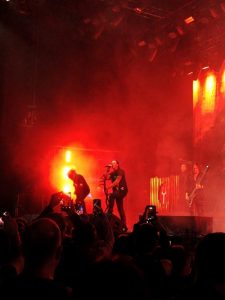
Satyricon
© Din Întunerec
Satyricon were the last to speak, and they spoke in the language of black metal. The Norwegian band opened with “Midnight Serpent” from “Deep Calleth Upon Deep” [2017], then moved through “Our World, It Rumbles Tonight” from “Satyricon” [2013]. They also played “Now, Diabolical” from “Kaleiodoscope” [2006] and “Mother North” [“Nemesis Divina”, 1996], a natural highlight.
The place of Satyricon at the end of the festival felt appropriate. Their music has always straddled black metal’s primitive roots and a grander, meticulously composed sound. They can be severe without becoming one-dimensional, and their material has the sort of presence that suits an outdoor stage after dark.
The Crowd and the Stories between Sets
A festival is never made of music alone. The performances provide its spine, but the memories that remain often come from the spaces between them: conversations that stretch longer than expected, small encounters and the sort of absurdity that becomes funnier with every retelling. And we had no shortage of such anecdotes.
Yet these details are part of what makes a festival trip worth undertaking. The music brings people to the same place, but the shared experience gives the event its character. The crowd at Bosphorus Open Air Metal Fest was diverse, enthusiastic and visibly comfortable in its own company. Whether dressed in black from head to toe, sporting elaborate metal accessories or simply arriving to hear favourite bands, people seemed united by the same uncomplicated desire to enjoy the occasion.
The organisers also deserve credit for the practical side of the experience. The venue was clean, the facilities were well maintained, the food options were convenient and the programme ran without the delays that can so easily undermine an outdoor event. These details may not make for the most dramatic tales, but they matter. A festival can book the finest musicians in the world and still frustrate its audience through poor organisation. Bosphorus Open Air Metal Fest avoided that trap.
Verdict: A Worthy Expedition
Bosphorus Open Air Metal Fest 2026 offered two days of varied musical experiences in a city that is already worth the journey. The festival’s greatest strengths were its range, the enthusiasm of the audience and the smooth organisation.
We left Istanbul with the sense that the journey had been worthwhile. The city offered far more than a backdrop, and the festival provided a meeting point for listeners whose tastes may differ but whose enthusiasm needs little translation. There were riffs to remember, old favourites to revisit and stories that will outlast the weekend itself. And, somewhere among the conversations and the last echoes of “Mother North”, there was the reassuring knowledge that the metal community remains capable of bringing very different people together.
Quest completed. Merch acquired. Sleep, at last, became an option.
Bosphorus Open Air Metal Fest
© Din Întunerec