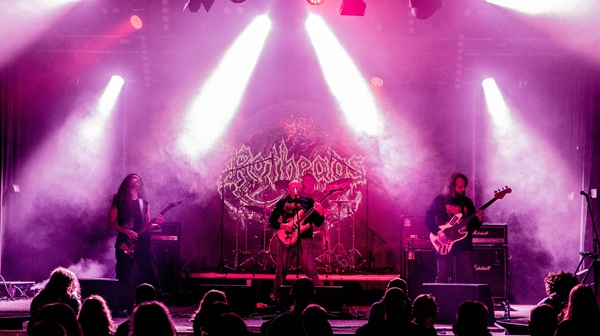
The best ideas don’t always come together straight away. For Rotheads, a song can begin with two unrelated riffs, take an unexpected turn and only find its final form after plenty of rehearsal. The Romanian death metal group, formed in 2014, followed this approach across the two albums, “Sewer Fiends” [2018] and “Slither in Slime” [2022], drawing inspiration from Finnish death metal, horror fiction, video games and even an urban legend from the pandemic years.
Back at Quantic in Bucharest, Romania, on 23 October 2026, the members of Rotheads talked about the stories behind their songs, the different ways their albums came together and the chemistry that keeps the band moving forward. We also discussed their new material, their increasingly fast playing and the satisfaction of seeing all those hours of rehearsal pay off.
Welcome back to Quantic! How are you feeling tonight?
Rotheads: We’re fine, ready to rock!
What made you accept the invitation to play here?
Rotheads: Well, we like Pungent Stench. They’re a legendary band in death metal and grindcore, so it was a nice opportunity, especially since we may not get another chance to see them play in Romania. It’s a shame they’re not here with the full original line-up, but having at least one member of the band on stage is still really cool.
Indeed! Moving a bit to your material, your first full-length album, “Sewer Fiends”, came out in 2018. What were the main inspirations behind it?
Rotheads: It was a mix of different things. Musically, we were influenced by Finnish death metal, perhaps bands like Sentenced and Depravity. There’s also a riff that sounds like Cannibal Corpse, although it wasn’t actually inspired by them. It just happened to come out that way.
Lyrically, we drew a lot from horror films and books. There’s even a song inspired by Frankenstein, as well as some references to the video game Fallout 2. The cover artwork also came from an idea we had used for our former band.
Another Fallout 2 reference!
Rotheads: Exactly! We thought the artwork was too cool to leave behind, so we decided to revisit it, make it even better and use it for the album cover.
Of all the songs on that album, “Rats in the Wall” is the one that has stayed with me. I’m curious about how you approached writing it.
Rotheads: It was a rather strange process. We had two main riffs. The first one had been around since we were working on the demo with our original drummer. Then there was another, doomier riff. They were completely separate ideas, almost like two different songs, and we were working on them independently.
At some point, though, things just clicked and we realised they could work together. We think we might have moved them to the same root note so they would fit, or something along those lines.
The song didn’t really work with our first drummer, because he wanted to make it overly complex in a rather unusual way. We were playing that doomier riff with triplets, sixteenth notes and all sorts of combinations. It became really difficult to keep track of everything.
When we got a new drummer, we decided to revisit the song and play it normally, without all the crazy stuff. The lyrics were inspired by H. P. Lovecraft‘s short story “The Rats in the Walls”, although we left out the racist cat’s name. It’s not a direct adaptation, but more of a retelling.
Which song from “Sewer Fiends” is closest to you?
Rotheads: “Dance of the Vermin”. The main riff is actually borrowed from a popular Romanian song, “Ciuleandra”. Beyond that, it has everything we enjoy about Finnish death metal, and melodically it’s close to the kind of music we usually write.
There’s also a funny story behind it. Our former guitarist came up with the main riff, but we had written another song featuring exactly the same riff. We remember thinking, “Whoa, what did you do? You stole the riff!”. It turned out we were somehow synchronised and had independently written the same thing.
There is also “The Mad Oracle of Seweropolis”. It’s quite a long song, very doomy, which is exactly what we love. It puts you in a trance. It’s almost hypnotic, and we really enjoy playing it, even though it goes on for quite a while.
Probably “Rats in the Wall”, too, mostly because of the slower section. It allows the bass to do its justice.
Moving on to your next album, “Slither in Slime”, released in 2022, how did the material come together?
Rotheads: Most of the songs came from different periods in our history as a band. We’d written quite a lot of material over the years.
At some point, the Spanish label Memento Mori got in touch and asked whether we had anything in the works. We’d just released a split with Vorus, Eruptive and Engrossed. We think they had listened to it and asked whether we’d be interested in making another album. They had also released “Sewer Fiends”. We didn’t really have a plan at that point.
We’d been thinking about putting out an EP, perhaps with four songs, but then we started going through our collection of riffs and unfinished material. We actually had quite a few songs that were already complete. “Spectral Visitation” and “Skin Forest”, for example, were ready to go. We didn’t make any changes to them; we simply played them as they were. It was fairly straightforward: we picked the songs we already had and decided to make an album.
We don’t think there’s a common lyrical theme running through the record. We just went with whatever came to mind. The memory is wanting to use the word “slithering” somewhere, perhaps in a song title, because it fitted the artwork, which depicts an angel with wings made of worms. We were thinking of something along the lines of “slithering wings”, but it didn’t sound quite right. Eventually, we settled on “Slither in Slime”. It sounded like an album title, and that was pretty much it.
You mentioned a few songs that were already finished, but “Gore Coffin” is also on the album. It’s one of my favourites. What’s the story behind it?
Rotheads: That’s a really funny story! Around the time we were writing the album, there was an urban legend going around. Some newspaper, probably one of those stupid publications that never checks whether anything is true, had reported this story during the pandemic.
Apparently, people were dying all over the world, and some families wanted to bring their deceased relatives back to their home countries. But because the bodies were under quarantine, they couldn’t transport them normally. Thus, there was this rumour about people smuggling corpses in special biological containment coffins, although instead of the bodies, they were sending whatever they could get their hands on.
According to the story, someone had found one of these coffins abandoned and open on Splaiul Independenței, with no body inside, just a collection of organs: livers, hearts and all sorts of other things.
We imagined the song from the perspective of someone finding such a coffin in the street and thinking, “Oh, wow, I’ll take this home and keep it in a jar as a souvenir!”. It’s a stupid, funny story, in a way.
At the same time, it’s rather sad. We don’t know what actually happened. Perhaps someone really tried to do something like that and ended up with a box full of organs. Who knows?
Stories like these make you wonder what else is still buried underground. But let’s bring things back to the present. What can you tell us about the new material you’ve been working on?
Rotheads: We have quite a few songs in progress. Some are more or less composed, but we still need to play through them and get comfortable with the material.
We don’t just write a song and then go straight into the studio to record it. We need to play it until everyone has had a chance to contribute their own ideas and style. We try to make the songs feel natural rather than simply sticking to what’s written down. We also work on the harmonies and lyrics, of course, as well as the tempos. We might write down a particular tempo, but once we start playing, we sometimes realise the song needs something different.
It’s a process of playing the same material over and over until it becomes natural, until it becomes part of us. That’s how we approach all our songs, including the ones we already perform live. We have some new members, so we also need to see how the current line-up feels when playing this material.
The chemistry within the line-up matters, too.
Rotheads: Definitely. The chemistry is already there, but we need to see what it brings to the songs. It makes sense, I think.
We also like to mess around with the structures. We take the basic riffs and rearrange them in all sorts of ways, moving parts around, switching things up and seeing what happens.
We’ve also been playing much faster lately. Much, much faster. We can’t help it!
Last but not least, what have you discovered about yourselves through being in this band?
Rotheads: One thing was learning to be patient. It takes patience to work through things slowly until they start coming together. We think that’s also how we approach the band as a whole. When something needs work, we put in the time and keep at it.
We’ve realised that, with hard work, perseverance and rehearsals, almost anything is possible. Now, we think we’re at a level now that we hadn’t reached a year ago, perhaps even longer. We’ve worked really hard, meeting twice a week to rehearse, and we’ve actually felt ourselves getting better and better as musicians.
That’s probably the most rewarding feeling you can have: seeing genuine progress. It’s amazing.





After the interview: Rotheads playing in Quantic [23 October 2026]
© Ștefan Lupașcu