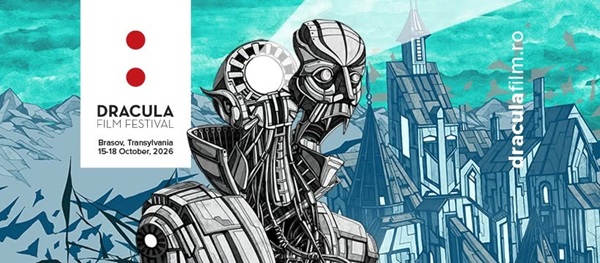
Some stories are told through cinema, others through music, and a few take shape in images that seem to have wandered out of a dream best left unexplained. At the 14th edition of Dracula Film Festival, organised by Fanzin Cultural Association [Asociația Culturală Fanzin], these art forms converged in Brașov, where horror, fantasy and the darker side of artistic expression took centre stage. Held at Cinema Astra from 15 to 18 October 2026, the festival brought together international film competitions, special screenings and a tribute to Steven Spielberg, while composer Simon Boswell was honoured with the prestigious “Count Dracula” Trophy for his contribution to cinema and film music.
Among the festival’s artistic highlights was an exhibition featuring the work of Costin Chioreanu, the Romanian visual artist and musician whose distinctive imagery has become closely associated with the international metal scene. His presence felt particularly fitting at an event devoted to the fantastic: his work inhabits that fascinating territory where the unsettling meets the beautiful, and where folklore, symbolism and music become part of a larger visual language. The artist also created the official poster for this year’s festival and presented “Audial Phantaforms: UI”, a world-premiere cine-concert combining live music and animation to explore the myth of Dracula through an original artistic interpretation.
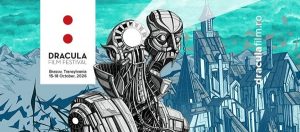
Official festival poster
© Costin Chioreanu
Supported by the Apollonia Hirscher Association of Brașov, with backing from Brașov City Hall and the Brașov Local Council, Dracula Film Festival offered more than a procession of monsters on the silver screen. It created space for artists to experiment, for filmmakers to share their visions and for audiences to encounter stories that remain in the memory long after the lights come back on.
With the programme promising cinema, visual art and a live performance rooted in Transylvanian myth, I set off for Brașov to discover what this year’s gathering had in store. The road there would bring its own memories, the city its familiar charms, and Cinema Astra a few surprises of its own.
Through the Mist and Into Brașov
I began my journey in rather chilly weather, with the sort of mountain mist that seems determined to conceal something just beyond the reach of sight.
The forests along the way were dressed in autumn colours, their leaves shifting between ochre, copper, russet and deep gold. Here and there, the trees disappeared into a veil of fog, leaving the hills looking like the borders of some forgotten kingdom, one in which the old stories had not quite surrendered to the modern world. It was difficult not to feel that the landscape itself had decided to contribute to the festival’s atmosphere.
There was also a touch of nostalgia to the journey. I had not travelled to Brașov at this time of year for nine years, and the familiar route brought back a few memories along with the changing scenery. Time has a curious habit of making even an ordinary road feel significant when enough years have passed since the last time you followed it.
The weather, meanwhile, had its own plans. As soon as I arrived in Brașov, the rain began, sending people hurrying towards cafés, shopfronts and whatever shelter they could find. The streets acquired that particular autumnal bustle in which everyone appears to be pursuing the same urgent quest: getting somewhere warm before getting drenched.
Beyond the rain, Brașov felt much as I remembered it from the summer, when I had left the city after Rockstadt Extreme Fest. It remained beautiful, welcoming and full of places that invite you to slow down for a while. Traditional confectioneries and terraces serving local dishes sat alongside the occasional fast-food establishment, while the streets retained that appealing mixture of old-world charm and everyday city life. There is something reassuring about returning to a place and finding that, despite the passing years, its character has survived intact.
Cinema Astra: Where the Stories Gather
Making my way through the city, I eventually arrived at Cinema Astra. The venue welcomed its filmgoers with festival posters, small souvenirs, wine from Domeniile Sâmburești and, most notably, an exhibition featuring the work of Chioreanu. It was a fitting introduction to an event that sought to bring together film, music, illustration and the strange creatures that inhabit the space between myth and imagination.
The exhibition immediately offered something to linger over. Rather than treating the visual arts as a decorative addition to the festival, it placed them firmly within the experience, inviting visitors to consider how images can shape the way we hear music, interpret stories and understand the worlds artists create.
Chioreanu is a complete artist, I dare say, whose creative pursuits extend well beyond illustration and graphic design into painting, animation, video art and music composition. With a background that brings together two lifelong passions, drawing and heavy metal, he has developed a distinctive visual language that has earned him international recognition. Through his studio, Twilight13Media, founded in 2003, he has collaborated with hundreds of bands and musicians, including Ghost, Emperor, Wardruna, Mayhem and My Dying Bride.
His ability to translate the atmosphere and emotional weight of music into imagery is particularly striking, and the exhibition offered a glimpse into this versatility through works such as “Twilight”, created for the Swedish progressive death metal band Edge of Sanity, and “Scars of Light”, made for the Italian progressive death metal band, Bedshore. Another piece, “Moon”, was created for Borknagar, a group with a sound that blends Viking metal with folk and black metal, while “APT” was made for Norway’s Dødheimsgard, a band with roots in black metal, now moving towards avant-garde metal. Alongside these, the exhibition featured numerous other works created for artists from different corners of the metal scene.


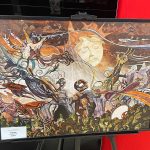
The exhibition featuring the work of Costin Chioreanu [17 October 2026]
© Din Întunerec
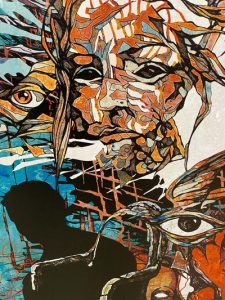
A closer look at “Embers Fire” realised by Costin Chioreanu [17 October 2026]
© Din Întunerec
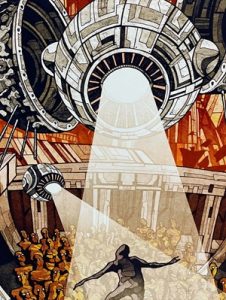
A closer look at “Totalitarian” realised by Costin Chioreanu [17 October 2026]
© Din Întunerec
His compositions also reward a closer look. The forms can appear chaotic at first, as though assembled from fragments of dreams, nightmares and half-remembered myths. Yet the longer one spends with them, the more the visual elements begin to reveal their own internal logic. A line leads the eye somewhere unexpected; a contrast between colours changes the emotional temperature of the image; a figure emerges from the surrounding shapes, only to become part of the wider composition again. It is the sort of artwork that refuses to surrender all its secrets at once.
For me, this is where Chioreanu’s work becomes especially effective. It does not merely present darkness as an aesthetic choice. It creates an atmosphere in which the familiar begins to feel unfamiliar, and the viewer is left to decide whether what lies beyond the frame is a threat, a revelation or simply another fragment of the world we have yet to understand.
“Audial Phantaforms: UI”: Between Sound and Shadow
After spending time examining the exhibition and discussing the works at length with their creator, I turned my attention to one of the festival’s most anticipated events: the world premiere of “Audial Phantaforms: UI”, a cine-concert conceived by Chioreanu.
Combining live music with animation and moving imagery, the performance offered an artistic interpretation of Dracula’s enduring myth and the folklore of Transylvania. The artist created the animation alongside Olivia Chioreanu, bringing together sound and image in a production that explored familiar symbols from an unexpected direction.
The atmosphere was eerie from the outset, but not in the obvious, blood-soaked manner one might expect from a festival devoted to Dracula. Instead, the production seemed to reach for something older, something rooted in the landscape and the stories that have accumulated around it. Forests of towering fir trees, mythological figures and images evoking the natural world gradually formed a visual language of their own. The emphasis felt less like a straightforward retelling of the vampire legend and more like an exploration of the forces, fears and beliefs that have shaped the folklore surrounding it.
The music was equally important to the experience. Performed live, it provided the production with a formidable emotional backbone, shifting between passages of tension, intensity and contemplation. The instrumental execution was superb, with the vocals adding another layer to the music and the imagery complementing both. Indeed, every element seemed to serve the same purpose: to draw the audience further into the world unfolding on screen.
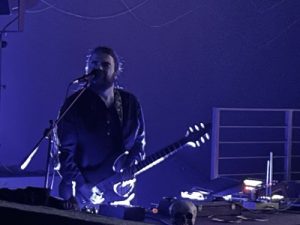
Costin Chioreanu [17 October 2026]
© Din Întunerec
Perhaps the most effective thing about “Audial Phantaforms: UI” was its ability to hold one’s attention without relying on constant spectacle. It was the kind of production that made me sit perfectly still and follow it from beginning to end, unwilling to look away for fear of missing a detail that might prove important later. In a world where so much entertainment competes for our attention by shouting at us, there was something refreshing about a work that simply invited us to surrender to its atmosphere.
It also stirred a more personal kind of nostalgia. Certain images brought back memories of places from my childhood, along with the stories I used to share around campfires. Those tales were rarely polished or entirely coherent. They were stitched together from local legends, half-remembered warnings passed down by grandparents and the imaginative excesses of children who had discovered that darkness makes almost anything seem possible. A rustle in the trees became a creature; a distant sound acquired a supernatural explanation; and the forest beyond the firelight became a place where the rules of ordinary life no longer necessarily applied.


Fragments of “Audial Phantaforms: UI” [17 October 2026]
© Din Întunerec
Chioreanu’s production brought back something of that feeling. It reminded me that folklore does not survive simply because people believe every story they hear. Sometimes it survives because a place, a sound or a particular arrangement of shadows makes us willing to believe, if only for a moment, that the world might contain more than we can explain.
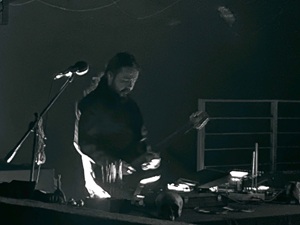
Costin Chioreanu [17 October 2026]
© Din Întunerec
The Festival’s Final Reckoning
The evening concluded with the Dracula Film Festival awards ceremony, where the jury recognised the films and artists that had stood out throughout this year’s programme. The feature-film competition was entrusted to a jury comprising Romanian actor Gabriel Spahiu, Irish filmmaker and cinematographer Randal Plunkett, and French-Lebanese director, editor and screenwriter Christophe Karabache.
The short-film competition was assessed by cultural promoter Irina Calude, director Tudor Botezatu and editor and lecturer Eugen Kelemen, while the “Dracula Digital” jury consisted of actor and director Eugen Neagu, filmmaker and producer Florian Zapra, and actor Ștefan Iancu.
The “Dracula” Trophy went to “Heritage”, directed by Baptist Agostini-Croce, while “The Shadow”, directed by Michael Joseph Kovich Jr., received a special mention in the feature-film competition.
The “Dracula Digital” Trophy was awarded to the Brașov-based Filmsylvania team, comprising Ioan Petrițan, Mihai Năstase and Dragoș Ștefan Ghic, for “Clementia Dei”. The jury praised the team’s perseverance, motivation and creativity, as well as the artistic choices that helped bring its story to life.
The “Little Dracula” Trophy went to “Dagian”, directed by Péter Dóczé, while “Shard”, directed by Pablo Cabel, received a special mention. In the Romanian short-film competition, the “Vlăduț Trophy” was awarded to “Knot”, directed by Sorin Valea.
Finally, composer Simon Boswell received the honorary “Count Dracula” Trophy in recognition of his career and his contribution to cinema and film music, adding another distinguished name to the festival’s international gathering.
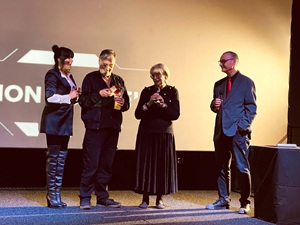
Simon Boswell receiving the honorary “Count Dracula” Trophy [17 October 2026]
© Din Întunerec
A Few More Words Before the Curtain Falls
Dracula Film Festival 2026 proved to be a thoroughly enjoyable experience, one I was glad to have made time for. Beyond the films themselves, what stayed with me was the opportunity to encounter different forms of artistic expression, from Chioreanu’s visual compositions to the immersive experience of “Audial Phantaforms: UI”.
The festival offered a reminder that horror and fantasy are not merely genres built around monsters, supernatural threats and elaborate special effects. At their best, they are ways of exploring memory, folklore, fear and the parts of human imagination that refuse to be neatly explained.
Cinema Astra also deserves a mention of its own. A venue’s atmosphere depends on more than the films screened within its walls. Clean surroundings, good acoustics, helpful staff and clear information can make all the difference between a pleasant visit and an unnecessarily complicated quest through an unfamiliar dungeon. At Cinema Astra, all these aspects came together.
I left Brașov with the pleasant feeling of having experienced something a little different. The autumn landscape had set the scene, the exhibition had offered plenty to contemplate, and the cine-concert had provided one of the evening’s most memorable encounters. The awards ceremony brought the festival to a fitting close, recognising the filmmakers and artists whose work had given the event its character.
Photographs, a handful of souvenirs and a vague promise to return might be the usual mementoes of a trip, but my time at Dracula Film Festival gave me something else: images that stayed with me, music that seemed to echo beyond the performance itself, and a renewed appreciation for the stories we inherit, reshape and pass on.
The final curtain falls. A handful of mysteries remain unresolved. And, for once, that is precisely the point.