What do Leonardo da Vinci’s anatomical drawings, Sumerian mythology, Lovecraftian horrors and extreme metal have in common? For Turkish band Khepra, they are all ingredients in a creative formula that leaves little room for simplicity.
Their unconventional vision came into focus on “Cosmology Divine”, released in 2016, a year after the group adopted the name Khepra, and “Anatomy of Sin”, issued in 2025. The two albums bring together their fascination with mythology, intricate arrangements and the interplay between folk metal and symphonic elements.
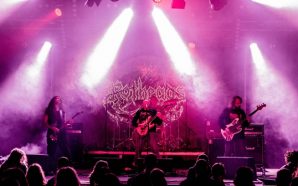
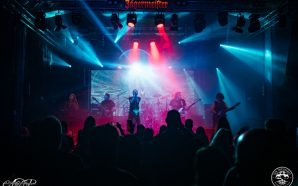
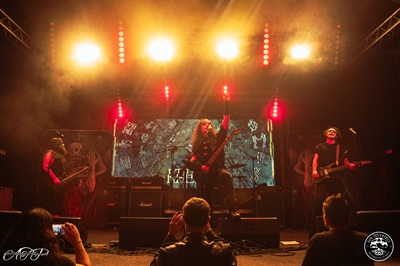
Following their appearance at QFest Day V at Quantic in Bucharest, Romania, on 2 October 2026, vocalist Doğukan “Dou” Kalender and his bandmates discuss the ideas behind their sound, the challenges of reuniting after years of inactivity and their plans for a third album that will explore new musical directions.
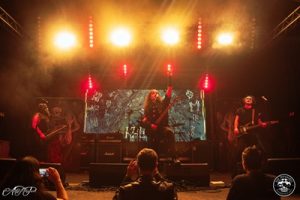
Khepra [2 October 2026]
© Art Through Photography
Doğukan “Dou” Kalender: Hello, and thank you for welcoming us.
We feel good. The sound was great, and the audience was amazing.
The crowd is everything. If people are having fun and we are enjoying ourselves on stage, then everything works. It is an exchange of energy. When the lights come on and you see satisfied faces in the crowd, you feel happy as well.
It was a good gig, and it was the final show of our 2026 tour. We are glad to have reached the end of the tour because we need a little break and some rest. After that, we plan to get back to work and prepare the new album. Next year will be busier, hopefully.
You started out as Gürz before changing your name to Khepra. What prompted that decision?
Doğukan “Dou” Kalender: At the time, Gürz represented a power folk metal band, and we were composing softer songs with more ethnic and symphonic influences. We eventually decided to change the name because Gürz was a Turkish name, and we wanted something more international.
We chose Khepra, which refers to a deity associated with rebirth and regeneration in Egyptian mythology. The name also represented a transformation for us. We started using make-up, wearing costumes and developing our stage performances. In our opinion, we had evolved into something different, and the music changed along with us.
Batuhan “Krank” Belik: The music became darker, heavier and more extreme, with stronger symphonic influences. At the same time, we kept the ethnic elements and Anatolian instruments that had been part of our sound. It was a major transformation, both musically and visually.
You combine symphonic arrangements with folk metal and that is something that demands a great deal of precision and work. What attracts you to this particular approach?
Doğukan “Dou” Kalender: The fact that it is difficult is part of the appeal. It is a difficult genre to execute, and that is part of the appeal. I like a challenge. I am not a “less is more” kind of person. I am a “more is more” kind of person.
When composing and recording, you have to deal with enormous amounts of material. Some of our songs need a lot of attention. We want to bring all these elements together because, for me, music is not only something you hear; it is also a visual art.
We want the music and the stage production to work together. We have stage banners, a backdrop or screen, costumes and make-up. We want people to experience something beyond simply listening to four musicians playing a set. We want to offer a complete show, and we are still working to improve it.
The idea is to bring more energy to the stage. We do not want to walk on, play our songs and leave. We want to make an impression and leave something behind when we go.
We put a great deal of effort into our songs, and not every detail is immediately noticeable when you first listen to them. However, if you remove one of those elements, you can hear that something is missing. Every instrument has a reason to be there. All those details contribute to the finished composition.
Literature, mythology and other artists all seem to play a part in your creative process. How do you research the themes behind your songs?
Doğukan “Dou” Kalender: I write most of the lyrics, so I usually start by reading. I read books, find something that inspires me and then start digging deeper.
For example, while working on the second album, I visited an exhibition dedicated to Leonardo da Vinci and his anatomical drawings. That inspired us to start writing “Infinite as the Serpent”, the opening track. From there, we developed the themes of the other songs and brought them together to create the album’s overall concept.
Batuhan “Krank” Belik: Most of the time, we simply read. Most of us, perhaps all of us, are also fans of H.P. Lovecraft, so his work often finds its way into our music. Egyptian and Sumerian mythology, occultism and the old gods are other recurring sources of inspiration. It depends on what interests us at the time.
Your debut album, “Cosmology Divine”, came out in 2016. What do you remember about creating that material?
Batuhan “Krank” Belik: It was a concept album. Some of the first songs – “Atra Hasis”, “Enki (Diaries of a Forgotten God)”, “Desolation”, “We Are Descending” and “Steps of Immortality” – dealt with Sumerian gods and the story of how they destroyed their planet, Nibiru, before descending to Earth and causing chaos here, supposedly more than 9,000 years ago.
The final three songs from “Cosmology Divine” focused on modern science. You can hear speeches by Michio Kaku and Carl Sagan on the album. We wanted to bring together the cosmological and the divine, so we combined those ideas in the title.
I am also a huge Lovecraft fan, as mentioned. We incorporated mathematical patterns into “Obsession of the Mad”, which features what sounds like a Necronomicon ritual. There is also a passage built around unusual time signatures that follows a Leonardo Fibonacci pattern when you calculate it.
Doğukan “Dou” Kalender: We are nerds, really, and we wanted to have fun with these ideas.
One of our founding members, Kenan, contributed a great deal to the mathematical and progressive passages. Unfortunately, he could not be here because of work commitments. The album brought together many different ideas, but the central concept was to combine cosmology and the divine and build something around them.
After “Cosmology Divine” and the EP “Symphony Divine” released in 2018, we didn’t hear any new material from Khepra for several years, until you released “Consumed by Fire” in 2024. What happened during that time?
Doğukan “Dou” Kalender: At first, things were going well. We were playing also a lot of shows. In 2017, for example, we played alongside Archgoat, Harakiri for the Sky, Mgła and Abbath in Lithuania. Then work commitments and other circumstances got in the way.
Writing our music took time. We did not rush the process, because each song required a great deal of work. By 2018, however, the songs you hear now were already written. But we were like kids who had not matured enough yet. We were friends, but we were also too distant from one another. It was really like we were disbanded.
Eventually, we realised how unique it was to share ideas, stages, memories and experiences. That is not something you can easily recreate with other people. We decided to get back together in 2022.
Rebuilding the band took around two years, and we also lost the original recordings, so we had to record the vocals, guitars and other parts again. Safa had joined us by then and brought a lot to the table. Batu also contributed significantly to “Consumed by Fire”, writing around half of the song.
We decided to finish the album and, this time, keep moving forward rather than take another long break. Once you stop the engine, getting the car moving again becomes difficult. We wanted to take things step by step and establish ourselves as a touring band.
Batuhan “Krank” Belik: The sound also changed because we needed time to understand what we wanted to do next. We did not want to make another “Cosmology Divine”. Both albums represent Khepra, but in different ways.
We understood ourselves better and learned to make greater use of each other’s strengths. The second album is heavier, more extreme and punchier, and I think its themes work better as a whole.
Doğukan “Dou” Kalender: With the first album, everyone brought their ideas to the table, and each song developed its own identity. For “Anatomy of Sin”, we had a clearer idea of what we wanted to achieve. We arranged the songs so that they would complement one another.
When you wrote the songs for “Anatomy of Sin” [2025], how were you dividing the responsibilities inside the band?
Batuhan “Krank” Belik: We mostly contribute to the music rather than the lyrics or the themes, which usually come from Dou. We bring our ideas and materials together, each contributing in different ways. Dou is the maestro who collects everything, develops the theme and builds the story behind the song.
We mostly bring the music, while Safa contributes visual ideas as well.
Safa Adakul: Yeah, I do around 95% of the visuals of the band.
Doğukan “Dou” Kalender: More like 99%!
Which song on “Anatomy of Sin” are you most satisfied with?
Doğukan “Dou” Kalender: “Consumed by Fire”. I know “Infinite as a Serpent” is a unique song, and we put a lot into it, but I think “Consumed by Fire” represents many aspects of the new Khepra. That is also why we chose it as the first song to receive a video.
We have never played “Infinite as a Serpent” live, though, and I hope we will get the chance one day. Perhaps then we will have a different answer.
Safa Adakul: Our visual identity draws heavily on the old gods, particularly Egyptian mythology, which is also connected to the name Khepra. We use imagery such as pyramids and eyes, especially the Eye of Horus. I rely on these symbols a lot when working on the graphics for the band.
What was the biggest challenge each of you faced while working on “Anatomy of Sin”?
Doğukan “Dou” Kalender: The orchestration. We do not use drum machines; we record our drums live and then edit them. Going through all that material, putting everything together, preparing the individual mix tracks and exporting them without mistakes was an enormous amount of work. You have to be extremely careful when sending everything to the person who will mix it.
Finding the right person to handle the mixing was another challenge. The process is expensive and time-consuming, and if the person you work with does not share your vision, the result might not be what you expected.
Safa Adakul: I would add that confronting our own demons was one of the challenges behind the album. It is a dark record, and there is a lot going on in the lyrics. The themes might appear to revolve around gods, but “Anatomy of Sin” also expresses other things we wanted to confront. We wanted to approach those subjects in our own way, rather than simply expressing them through aggression or emotion.
Batuhan “Krank” Belik: Writing is also difficult; we all have our own expectations. Kenan and Dou do most of the songwriting, but we discuss the material extensively. Those discussions can become harsh, and sometimes being honest with yourself and your fellow musicians is painful. Still, those conversations are necessary if we want to make the music better.
How do you handle criticism within the band?
Safa Adakul: I usually take criticism well because I can learn a lot from the others. They are older than me, and although I am the youngest member, everyone has plenty of stage experience. I do not get angry very often, but sometimes I do. When that happens, I tend to keep quiet rather than react immediately.
Doğukan “Dou” Kalender: Kenan, Batu and I have been friends for more than 20 years. Safa’s brother was our classmate, so we have known him for a long time as well. We are very close, and I know that when someone criticises me, they are not trying to attack me. They want me to improve and correct my mistakes.
I used to take things personally. Before we started making music together, I could be quite temperamental. Eventually, I realised that this was not the right way to approach things. We have matured and learned how to listen to one another and understand different opinions.
Batuhan “Krank” Belik: I am probably the one who is most likely to challenge an idea. Clashes of opinion often start with me, but after 20 years, we have learned how to communicate properly. If I think something needs to change, I consider it carefully before bringing it up.
One of the things we do well is criticise ourselves and one another. We are involved in other musical projects, too, and that exchange extends beyond Khepra. We help one another become better people, not just better musicians or writers.
At the same time, I know that my opinion is subjective. Something that works for me might not be right for the band as a whole. Being aware of that helps us deal with disagreements without turning criticism into a personal conflict.
Moving on to live performances, how do you prepare for a show?
Doğukan “Dou” Kalender: We do not always have time for conventional rehearsals, so everyone prepares individually, at home. We have plenty of stage experience, but we cannot rely on that alone. We still need to improve with every performance.
We discuss what we want to do on stage and have even prepared documents outlining our plans. We study them and put them into practice.
Batuhan “Krank” Belik: One thing that sets us apart is that our preparation does not necessarily involve spending hours in a rehearsal room playing our instruments. We also practise the other aspects of performing: where we stand, how we sing, what we say between songs and how we interact with the audience.
There is a lot to consider beyond the music itself, from getting ready to being in the right place at the right time. These things matter when you are working at this level.
We already know our songs well because we have played them so many times. This year, we have had around nine gigs, and each performance gives us another opportunity to improve. We focus on developing the stage show and finding the right balance between preparation and improvisation. Not everything should be scripted.
At the same time, we tend to be in a very mathematical band. Every drum part, guitar line and other element has a purpose, and all these parts need to fit together precisely. We want to become even tighter during the next season, particularly with a stable drummer.
We have recently experienced a change of drummer, which is one reason why we could not rehearse as much as we wanted. Before this show, we played at Bosphorus Open Air Festival with a different drummer. We then had to make another change within the final seven days.
For this show, we reunited with our former drummer after seven years, without having the opportunity to rehearse properly. Our close friend helped us again. He had previously played with us in Germany, but we had very little time together before coming to Romania.
Safa Adakul: We rehearsed a little in the hotel room, although I would not really count that as a proper rehearsal!
Doğukan “Dou” Kalender: We know there is still work to do. We want to improve the stage show and become ready for bigger festivals, larger stages and bigger crowds. That is what we are working towards. If we want to achieve more, we have to keep improving.
We need to become tighter as a live act, and having a consistent drummer will help. The drums are the backbone of our music, especially when we perform with backing tracks and a metronome providing cues through our in-ear monitors.
When the drummer is comfortable with the material, everyone else feels more secure because there is someone they can trust to keep everything together. When that changes, you become anxious on stage.
Still, playing with major acts such as Kataklysm and other established metal artists has been a great experience. Sharing a stage with musicians of that calibre gives us something to learn from and work towards.
Since you were just recently at Bosphorus Open Air Festival, how was the experience of playing on home soil alongside so many international acts?
Safa Adakul: Considering everything that went wrong and the circumstances we had to deal with, we did the best we could. I would not call our performance perfect, but it was not bad either. The festival itself was excellent; I am talking about our own performance.
We have played in several countries, and every festival has its own strengths. The experience behind Bosphorus Open Air Festival was particularly noticeable. The organiser, the founder of Moribund Oblivion, has more than 20 years of touring experience and brings that knowledge to the event. He wants everything to run as professionally as possible. Even having fresh towels waiting for the musicians on stage makes a difference.
Doğukan “Dou” Kalender: I think it is good to play at home from time to time. We do not usually play in clubs in Turkey unless a major international band comes to the country and we have the opportunity to open for them. That is something of a principle for us. We are a Turkish band, but we want to establish an international name and perform in Europe and elsewhere.
Bosphorus Open Air Festival gave us the chance to perform in Turkey, which we do not often get to do. We are all perfectionists, so even when a show goes well, we tend to think about what could have been better.
Given the circumstances, our performance was probably the best we could manage with a drummer who had only seven days to prepare. We are grateful to him for learning the material in such a short time. Our drum parts are demanding, so being able to play them after just a week is remarkable.
You have already mentioned the importance of growing as a live act, but looking ahead, what can you tell our readers about the next album? What would you like to approach differently this time?
Doğukan “Dou” Kalender: There will be more input from the members, and we are more confident about what we want to do now.
Our debut, “Cosmology Divine”, was mixed by Logan Mader, who has worked with major names in metal, including Machine Head and others. However, working with someone so far away from us geographically and culturally meant that our perspectives on the music could differ. Psychon from Septicflesh is much closer to us in terms of cultural background and the way we approach things.
For the third album, we want to bring the guitars further forward in the mix. We are not completely satisfied with their presence on the existing material, and we want the new songs to sound punchier.
Batuhan “Krank” Belik: At the same time, we want to explore different approaches.
We want to experiment with more lead parts and more vocals. All three of us can sing, and that is one of the things that makes Khepra distinctive.
Before we part ways, what words would you leave with those who have stood by Khepra?
Doğukan “Dou” Kalender: We have so many things to say. We want to build a fan base of our own. As I said on stage, when I come to Romania for the second time, I want to see people wearing Khepra T-shirts.
We put so much effort into our merchandise, visuals, recordings, mastering and touring. This is not a cheap undertaking, and you also have to sacrifice a lot of your personal life. But that is why we want to do it: we are willing to make those sacrifices and reach a level at which we are satisfied with ourselves.
Hopefully, next year we will have a bigger fan base, more followers, more listeners and more reactions from the crowd. For example, when we were in Germany, people were singing along to “Consumed by Fire”, and they did so with such incredible feeling. That is what I want to achieve. It is a songwriter’s dream.
When you write a song, you put something of yourself into it. Sometimes we have so many things we want to say, but we cannot express them directly. That is why we do it through music: we express the things we feel through our songs. And when you see someone else singing those words, you realise that you have reached them. There is a connection.
I hope to experience more of that. We are already very happy with the support we have received, and we are truly grateful for it. We just want people to keep supporting us. Thank you, and let’s meet again soon. We love our fans.