Almost 35 years of Moonspell means almost 35 years of change. From “Wolfheart” and “Irreligious” to “The Butterfly Effect” and everything that followed, the Portuguese members of the group have continued to explore different directions within gothic metal, creating a catalogue marked by constant evolution.
Now, Fernando Ribeiro, vocalist and lyricist, has plenty to look back on, but also a new album, “Far from God”, to talk about and a future that shows no signs of slowing down. In an interview conducted at Posada Rock Festival, I spoke with him about the albums that defined different stages of Moonspell, the decisions behind their changes in direction, the Portuguese metal scene and their relationship with their audience.
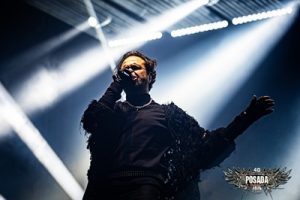
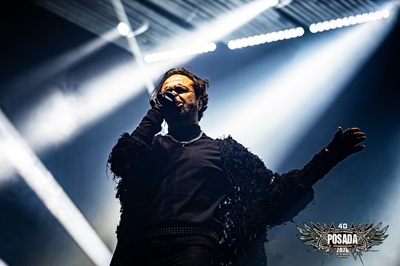
Fernando Ribeiro
© Paul Voicu [LivePictures Ro]
Fernando Ribeiro: Hello!
I’m feeling great about coming back here and playing for the Romanian wolfpack. It’s been a while since we’ve been here. We’re just rounding up the summer festival season and I’m always grateful for having a show in Romania.
In a way, it feels like you have a special connection with this country.
Fernando Ribeiro: Yes. We have some good Romanian friends. They used to live in Portugal. They have a band called God, and they always told us back in the ‘90s that we were very loved in Romania, especially because of “Wolfheart”.
Back then, we didn’t know about that because we were from Portugal and it’s 4,000 kilometers away. But when we came here for the first time, in the city of Timișoara, we noticed that. Then we went to Bucharest, then to Posada Rock Festival and it seemed like people really did not come to gigs only for the English, American or Swedish bands. They also liked bands from other countries.
Also, you know, the languages, Portuguese and Romanian, have some similarities. They have strong Latin roots, which facilitate a bit the communication. Somehow that gives us a certain feeling.
And I’m glad that people in Romania have listened to Moonspell for so many years.
Indeed, “Wolfheart” has gained a lot of listeners in Romania since its release in 1995. Going back to the beginning, what are your strongest memories of recording the album?
Fernando Ribeiro: It was a shot in the dark. We were very young; I was just 21 when we worked on it. Despite being so young, we went to Germany to record it for a very big label with a very big producer. As expected, not everything was easy. But we did that, and all of a sudden, like in a trick of magic, “Wolfheart” became very important for the fans.
It was very old school, because we gained the fans through the shows. There was no internet, there was no social networking back then, so we had to go to several places to play it again and again.
If I am to think about it more, I am daring to say that it’s a very magical album. I think it’s also one of a kind. Obviously, we evolved, we grew up as a band. We also changed a little bit the members, we also changed a little bit the musical direction.
But “Wolfheart” is a special piece for us, because it was the all-or-nothing album. If we would have not achieved something with it, maybe our history would be different. So, we have a lot of respect for the legacy.
What was the first word that came to mind when you heard “Wolfheart” after it was finished?
Fernando Ribeiro: “Fear”. I thought that nobody would like it.
Why did you feel that way?
Fernando Ribeiro: I don’t know. At that time, “Wolfheart” wasn’t a typical metal album. We had folk and gothic metal influences, we had Portuguese lyrics, and on top of that we were very young. Also, our instruments were not played very well. Younger bands nowadays play much better when they go into the studio.
Of course, we were also kind of curious to see where it will take us, but fearful too.
Even today we cannot believe the album reached so many people.
On the aforementioned album, “…of Dream and Drama (Midnight Ride)” is one of the songs that stands out. What inspired you when you wrote it?
Fernando Ribeiro: Well, when we started doing “Wolfheart”, we were more inspired by some of the black metal bands like Bathory and Celtic Frost. We were huge fans of Bathory, yeah…
But then we started listening to stuff like Type O Negative and Danzig. I think “…of Dream and Drama (Midnight Ride)” was our attempt to do a more “Type O Negative meets Danzig” song.
Moving on to “Irreligious” from 1996 you chose to take the music in a different direction from “Wolfheart”. What made you feel that the time was right for such a change?
Fernando Ribeiro: We felt that we wanted some diversity. “Irreligious” was a step on taking chances. And I think it has some of our best songs, like “Mephisto” and “Full Moon Madness”. We always play these songs. I think they never get old.
“The Butterfly Effect” takes its title from the concept associated with the mathematician and meteorologist Edward Lorenz, which explores how seemingly insignificant changes can have far-reaching consequences. When you were writing the album in 1999, what made that idea fit so well with what you were experiencing at the time?
Fernando Ribeiro: As you mentioned, The Butterfly Effect is a scientific concept created by Lawrence that says when a butterfly flaps its wings on Japan, it can create an earthquake or a tsunami in South America. So, in the end of the day, it’s about how small, insignificant things can affect a lot of our lives and a lot of the world’s.
It was released in 1999, when we were listening to a lot of industrial metal. Also, for the people around us, the year was a very important one. Everybody was afraid that the world would end, that the banks would crash because of technology… The banks did crash, but it was because of human greed, not because of technology. So, we kind of made that into an album.
It was an album that pissed a lot of fans because it was so radically different from everything we have done. But nowadays, I have my own label, Alma Mater Records, and we re-released “The Butterfly Effect” twice on vinyl and both times they were sold out.
Sometimes, in very special shows, when we feel like we have the time to go back and practise, we play a couple of songs from “The Butterfly Effect” and people are crazy about them. For example, we played a very big festival in Portugal last year and we integrated into the list “Soulsick” and people were just nuts about it.
For a big gig, people come to hear a lot of songs. Of course, they like it when we play “Alma Mater”, for example, but they also like it when we play the other songs.
And then there is “Far from God”, your latest album, issued in 2026. After “Hermitage” and everything that happened during the pandemic, you said you were not even sure you wanted to make new music. What eventually brought you back to the point where you felt ready to write another Moonspell album?
Fernando Ribeiro: It was a very long process because we felt that we were… Well, after “Hermitage”, after the pandemic, after everything that happened to the bands and to the world, and also because we had important albums coming to be celebrated, like “Irreligious” or “Wolfheart”, we thought about not doing new music anymore.
You know, we just wanted to play the songs from the old catalogue. People love that. We, on the other hand, didn’t find inspiration for something new. Indeed, I wasn’t very inspired to make new lyrics and new vocals. So, it took us five years until we started being inspired again.
Bands normally have two years on tour and, even if they are inspired or not, they have the obligation to make an album. It’s a contractual obligation. We have it too, but we talked with our label and said we don’t want to make a shitty album, a half-hearted album. Music is very important for us. Whatever we release and put the name Moonspell on has to be really meaningful and has to be really powerful and has to, first and foremost, prove that we still can do it.
So, it was a hard process, and for “Far from God” it was hard to choose a direction.
We were a bit lost because Moonspell had, at that point, so many directions. But then I was listening to a lot of gothic music, gothic metal, reading a lot about gothic culture, going to parties, even watching movies. And I thought that 2026 would be a nice year for a gothic metal album.
It’s not so adventurous, but it has some of the qualities that make Moonspell one of the leading gothic metal bands.
We started to work on it, then we closed our eyes. We hoped for the best. And the album… people love it! It has charted in a lot of countries. It’s a lot. We had all these YouTube numbers and streaming numbers that we have to keep track of.
But first and foremost, you know, we already played some of it live. It was the vibe that people needed. Its atmosphere is great.
From that album, is there one song that you feel captures what you wanted “Far from God” to be?
Fernando Ribeiro: Hmm… I really like “Our Freedom to Fall”, which is before “Reconquista”. It’s a heavier song.
But I think the one I’m most proud of, and I think that sums up the album really well, if I had to pick one to take to the desert, it would be “The Great Wolf in the Sky”. I think it’s a beautiful Moonspell song.
What is it about “The Great Wolf in the Sky” that makes it such a good representation of Moonspell at this point in your career?
Fernando Ribeiro: It has all the ingredients of a great Moonspell song. It has an aggressive part. It’s also very atmospheric. It has a beautiful chorus.
And people, when they listen to it, they are a bit in awe of the song. They are quiet. They listen to it. They are absorbing it. So, it really catches your attention, in a way.
I like the lyrics, too. And the way it came in the end just seems to me very proper, very Moonspell-like. I think that’s, after so many albums, what we want to achieve. It’s our own sound, our proper sound.
Something that people recognise from a distance.
Which song from the latest album was the most difficult to create?
Fernando Ribeiro: Oh, the last one, “Reconquista”. It was a song that we were more delayed with when it came to the album.
All the other songs were prepared, but that song was always running behind. Until it didn’t. Until it came up as a very good, strong track. When I listened to the song demo, I said, “This has to be the last song”. It’s epic.
It comes in the tradition of songs like “Full Moon Madness” and “Alma Mater”, so I think it’s a great song.
We never played it live. We’re going to play it for the first time in our show in Portugal. But I know it was a lot of work to do in order to make it sound like we wanted it.
It’s not a very complex song, but it has great vibes.
Since you’ve mentioned Portugal, I have to ask you about the Portuguese metal scene. How would you describe the scene there today, and what has changed since Moonspell first appeared?
Fernando Ribeiro: I think the scene there was struggling back in the ‘80s and ‘90s. There were many bands like Tarantula, Desire, The Temple, Ramp, Sacred Sin, in all kinds of metal, from thrash and power metal to death metal.
But I believe nobody back then wanted to make a band with a very original sound and a very proper sound, as Moonspell did.
So, we were a very strange “object” in the Portuguese scene when we started. Because we had black metal, we had gothic elements, we dressed differently, we thought differently.
I think that was the scene I was expecting for Portugal. Not something that was emulating the great success of Pantera or Sepultura or Metallica or Swedish death metal, but a band that had Portuguese roots.
From then on, I think the scene evolved a lot. I think besides Moonspell, the big shooting stars from Portugal are Gaerea.
We are very good friends with them and we are very proud of them. Also, I have a label, like I said, that releases Portuguese and Brazilian metal bands. That label has great bands like Okkultist, death metal with female vocals, and Thragedium, which is a very old band. They do a unique kind of doom metal rooted in Portuguese musical traditions. Out of my label we got Anzv, which is a black metal band with Sumerian influences.
As a conclusion, there is a lot going on now in Portugal. Festivals, bands, people. I think people believe more in themselves and I am glad Moonspell could help.
After almost 35 years with Moonspell, what would you like to say to the people in Romania who have been following the band for so many years?
Fernando Ribeiro: Well, first, a message of gratitude for all these years.
Moonspell is coming to be 35 next year. We are going to tour Europe for the new album and also for the old albums. So, we are probably coming here to Romania for a couple of shows.
I want them to pick up “Far from God”, which is our latest music released. And again, just to send them a big hug from Moonspell, from Portugal.
We appreciate them, we don’t take them for granted.
Thank you!
Fernando Ribeiro: Thank you, too, for the interview.