The year 2026 is shaping up to be a particularly compelling one for Gaerea. With the promise of a new album designed to break boundaries and to resist confinement within any single genre or subgenre, a busy live schedule already taking form, and a clear intention to probe the darkest corners of the human mind, the Portuguese band active since 2016 appear to be entering a defining phase of their artistic trajectory. Currently in the midst of the tour promoting the songs from the forthcoming record, Gaerea stopped in Romania on 31 January, taking the stage at Quantic in Bucharest. On this occasion, Din Întunerec spoke with Alpha, about the core themes of the new album, the writing process behind the new material, and earlier releases that continue to resonate strongly with audiences, as also noted in a recent live report.
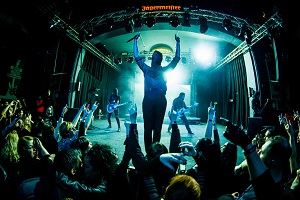
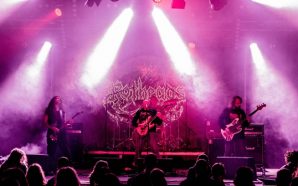
Gaerea performing at Quantic, 31 January 2026
© Ștefan Lupașcu
My greetings! I am very happy to ask you some questions about Gaerea. Before we open darker doors, let us begin at the surface. What stirs in your camp at this moment?
Alpha: Hello, thank you for your time! What is new in our camp? Oh, we have a new album, “Loss”, coming out in about a month, so we have three singles out already: “Phoenix”, “Hellbound” and “Submerged”.
And we hope to do a good job performing those three songs tonight in Bucharest for the first time.
Beyond the stage and beyond the mask, how are you holding yourself together these days, as a person rather than as an artist?
Alpha: Great! We can finally make this show happen.
Last time we were very unfortunate with the drones at the airport and all that, so we did not make it on time. But we are very happy to finally be able to play in Romania again, in Bucharest, for the first time.
We are more than glad to finally witness your performance! We will get into that soon enough, but until then, I am curious about your physical roots. Gaerea emerged from Porto, a city shaped by Atlantic winds and worn stone. What did that environment teach you early on, whether you wanted the lesson or not?
Alpha: Well, the environment of the city was for sure something very important for us in the beginning. It still is. I mean, it is our hometown.
We used to have a lot of influences from the city of Porto. We used to have a lot of videos where we would showcase the city of Porto, also in the new documentary that we are working on. We go back to the first places where we rehearsed.
We just did two very important homecoming shows in Portugal, where we were very happy to be back home after a few years. And now that we are, again, fully based in Portugal, it is a city that definitely brings a lot of nostalgia, good and also bad memories, but something that is still very important for everything we do.
I mean, it is our city. It is a city that saw us grow up from the very beginning. And I would say that even though we spend a lot of time outside of the country, it is a country that we still draw a lot of inspiration from, from our way of being Portuguese and from the culture that shaped us. Thanks for breaking the ice like this. It is always nice to speak about our home.
There is one more question related to this, and that is the following: how does the local scene breathe today?
Alpha: It is great. I think we are probably the second or third country in Europe with the most bands per capita.
There are a lot of bands, there are a lot of artists. If you go to a show, ninety nine percent of the people there have bands or more than one band. It is very blooming in terms of creativity and art.
Unfortunately, there are only two, three or four bands that tour outside of Portugal. It is us, Moonspell, probably Analepsy, and a few other new bands that are finally getting out.
So I would say it is a very small scene in terms of exportation to other countries, but it is very inspirational and very blooming in terms of music coming out almost every week.
Glad to hear this! Now, let us dig deeper into your releases. Looking back to your self-titled material from 2016, what remains untouched at the core of Gaerea today?
Alpha: Everything. We are still a band deeply inspired by humans. The way they behave, the way they dream, the way those dreams shatter.
Of course, I am not going to say that we are completely true to everything we believed in 2016. That would be lying. But everything starts with something that you just want to put out there, like that first release, the self-titled.
A lot of things were very important for us back then that are not so important these days. But of course the way we perform, the masks, some of the symbology that we used back then are still very important because they are part of our history.
Even though it is something that we would not come out with right now, it is something that is part of our initial vision and it stood the test of time.
When “Unsettling Whispers” emerged in 2018, it felt like a full embodiment of intent. Was that record written as confrontation or as confession?
Alpha: A confrontation or a confession? I do not know which one it was, but it was for sure us realising that we had something else to do.
When I started with the first EP, it was just me in a bedroom, and then a couple more people joined. The idea was just to do that record and put it out there.
Then we started to form a band, playing a few shows, and that is how “Unsettling Whispers” came to be. I think it is the first band album that we ever released.
So it is the continuation of something that was not supposed to be a band, but it became our first proper album as one.
“Limbo” followed in 2020, darker and more severe. What stood at the centre when you began shaping it?
Alpha: “Limbo” is a continuation of “Unsettling Whispers”. It continues the story of the vortex society that we had in the beginning and that continued up until “Mirage”.
Everything is told in the first person on that album. It is about this utopian society without feelings, like a mechanism ruling their lives. That ends with some sort of cathartic moment with a song like “Mare”.
In terms of sound, I think that was the closest to a dissonant black metal album we ever had. Very compressed, very fast, very brutal, very dissonant, but also very melodic.
I think it was the first album where we found a bit of our voice. Some things that still remain today were done for the first time there.
What proved most demanding during the recording of “Limbo”?
Alpha: It has been so many years. I do not know. I think for the first time we were doing very fast songs, so technically it was a challenge, but we overcame it.
It was the first album we did with Season of Mist, so we wanted to impress. We wanted to do something great. We wanted to go full colour mode, using gold for the first time in the cover art.
I do not know if there was a massive challenge, but it was something to prove. By then we were starting to do our first European tours, so we wanted to show the world that there was another band from Portugal that could do interesting things.
“Limbo” was probably the album that put us on the map in the black metal scene.
And when “Mirage” arrived in 2022, the internal structure shifted. What did that step allow you to reach?
Alpha: I think “Mirage” is way more layered than “Limbo”. It is more dynamic in terms of sound. There are more minimalistic, clean passages.
It is the album where we learned that we could keep the melody and the aggressiveness and still allow introspective, almost underwater like atmospheres, with more instruments added to the palette.
“Limbo” was aggressive and compressed. “Mirage” is “Limbo” with more experience. It is more fine tuned.
All our albums are very different from each other. But “Mirage” is a more experienced version of the band.
With “Coma” from 2024, another transformation took place. What do the early recordings of that album recall for you?
Alpha: The configuration of the band was different. By the time we recorded “Coma”, we had that structure for about two years, and it has been the same for the last five.
It was a very different band, a different mindset, a different approach to music and to people.
For the first time we went to a studio for two or three weeks, living there, cooking there, arguing there, writing more material there. That dynamic shaped “Coma” into a more melodramatic album.
We tried new things, organs, synthesisers, different writing approaches. You will not find fourteen-minute songs on “Coma”.
Because we felt that we had already done that on “Limbo” and “Mirage”. Very long songs, eight to ten minutes in length. We had already explored that territory.
It was time to evolve, to challenge ourselves, to do something different. We are more open with each other now, more transparent with our emotions. Age also plays a part.
We are no longer trying to prove ourselves to the world. We want to prove something to ourselves.
As a musician, you do not want to make the same music all the time. I think that is extremely boring.
Boring for me as a listener when bands do that. Boring for me as an artist if we were to keep doing that. I like to look at the bands I admire and see that one album goes in one direction, the next goes somewhere else, and another is completely different, almost crazy.
And then, with those albums in mind, they manage to create something new. That, to me, is the most interesting part of being an artist: to experiment. If you fail, fine, but you still experimented.
You do not want to reach the end of your life thinking, “Oh, I should have tried that.”
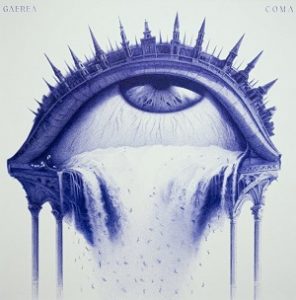
Official cover artwork
© Nathan Lorenzana
Even the artwork from “Coma” is a very intriguing piece. I remember seeing it at the Rockstadt Extreme Fest, displayed in large format, and I was wondering how did you choose it.
Alpha: I think I dreamt about it. I had this idea because, for a long time, I kept drawing in my home office, or in my home studio, this image of a giant eye, something that could exist as a life-sized structure. A huge city rising above this massive eye, something that, if you were to look out of the window, would feel like a scene taken from a Salvador Dalí painting, extremely surreal.
So I had this very rough, very bad sketch lying on my desk for a long time, and then we found the right artist, Nathan. A Mexican artist.
The great thing about him is that he uses a technique I had never encountered before, creating these hyper-realistic works entirely with a ballpoint pen. It took him, I think, around three months to complete it. He added a few more elements, because he is the artist, but he absolutely nailed it on the first attempt.
Indeed, he nailed it!
Alpha: Yeah, it is great! I am extremely proud of that cover art, and I have the original. It is a beautiful piece of art, for sure.
And it is one that stays in your mind, because you can connect it with the songs, with everything the album expresses.
Alpha: Yes. It is not a typical black metal cover. It is white, first of all, and then blue.
It is done with a ballpoint pen, which makes it slightly challenging for the traditional black metal eye. It is a cover you look at and feel that it could belong to almost anything in this world.
Turning now to “Loss”, which is just around the corner. At what point did you realise that this record could only be written in this particular way?
Alpha: I believe it comes with a lot of thinking beforehand. I always think about what an album should be about, and I believe that, in this period of our lives, both as a band and as individuals, it is about realising what truly matters. Not just the life of the band, but all the things you have sacrificed over ten years to make this band work. At some point, you begin to reflect on what is genuinely important in life. Of course, the band is great.
The fans are amazing. But there also has to be something like a home, a place to return to, a place where you can reflect on regrets, on dreams, on the things you still want to achieve. And I think this album deals precisely with all of that.
It is our most personal record. And again, it is an album where we went completely overboard with experimentation, writing songs in different structures, closer to pop, to black metal, to hardcore, to metalcore, or whatever felt right. We are simply no longer afraid of experimenting.
In the beginning, we were far more rigid, thinking it had to be black metal, it had to be fast, it had to be aggressive. I think this will be our fifth or sixth release, and we simply do not care about that anymore. We just want to write something that truly means something to us.
If it is a dark pop song, so be it. If it is a more metalcore oriented chorus, so be it. If it involves seven-string guitars, or music like “Hellbound”, which I think is one of the most aggressive songs we have ever written, so be it.
If you listen to the whole record when it comes out and compare a few songs, it can feel like a different band, because there are different momentums, different realisations, different periods of time, especially since this album took us about a year to complete. It is our most extensive and demanding writing and creative process. I am very, very proud of it, and we all are.
I think it is an album that truly defies us and challenges us a lot. We have to prepare ourselves both mentally and physically for shows like this one, for example. And that is good. It is refreshing.
It keeps you alert, because you feel that we are never doing something that is completely comfortable. We constantly choose things that challenge us, where everything can fall apart. And that is good. That is what keeps this band alive.
It is that constant challenge to become better and better, to try new things, and, of course, not to be ashamed of failing, which is something that happens a lot when you are just starting out. But yes, I do not think we are ashamed of failing anymore.
Why would we be?
That is very good to hear. Going to “Submerged”, which was the first track released from the upcoming album. What can you tell our readers about it?
Alpha: It is a song about regret. About being submerged in your own thoughts, regrets, and dreams that never came to be. About those moments when you believe something will turn out one way, and when it finally happens, it is completely different.
It also deals with a sense of delusion and self-deception. So, in essence, it is a song about the regrets one accumulates throughout life.
That is why we used water so extensively, because there is no sound underwater, no screaming underwater. That idea also guided the music video. We wanted to convey those muted expressions and blend our very aggressive way of performing into this concept of a silent, suffocated scream, which defines “Submerged”.
I see. How was working on the video? It looks very high quality, and I imagine it took a great deal of time to shape the concept and to find a team capable of executing it.
Alpha: We flew to Latvia for a few days to shoot three videos, the three that are already out. It was very difficult, because although the team was excellent and many people were involved, each of these videos was extremely demanding.
Trying not to breathe underwater for several seconds is insane, because you have to sink, so there is no air at all. It becomes excruciating at times, and spending so many hours in a pool, essentially keeping yourself submerged for an entire day of shooting, is physically brutal. But it was worth it.
Very difficult to execute, but we knew right from the start of the shoot that it was going to be something genuinely special and very different from anything we had ever done. And indeed, it is very, very different.
It is also one that requires several viewings in order to fully grasp its message, if I may add. Moving to another track you have released, “Hellbound”, I feel there is a certain cyclical quality to it, both lyrically and musically. Was that repetition meant to reinforce the idea of entrapment?
Alpha: That is simply the way we write songs now. It is no longer about having twenty lines of lyrics. We do not approach songwriting like that anymore.
We also want to enhance the live experience, to create moments where people can actually sing along, and we are not ashamed to admit that. It is what it is. We want the audience to feel more involved and to sing the songs with us.
That is part of this more pop-oriented structure that we had never explored before, and we just thought to try this because it feels right. We all listen to a lot of pop music, even if nobody in black metal would openly admit it. But every black metal fan likes some form of pop, whether they say it or not.
So it is really about being honest with our thoughts and emotions and simply writing. What if Gaerea had this pop-like structure, with choruses that people can sing, maybe even repeating them two or three times?
For us, it feels incredibly refreshing. We had never done anything like this before. Naturally, the lyrics start repeating themselves as well, because that is part of the writing style.
But it works. People know the songs, people sing along. It is pretty cool.
“I’ve Survived” is the central message of “Phoenix”. Is this your empowerment song, shaped by everything the band has been through?
Alpha: Yes, it is our empowerment song. Every hardcore band has at least one track like that, and we felt we could write something similar, something that would channel that energy. It reflects many moments in our history when nothing made sense, when we were close either to breaking up or to putting the band on hold.
There were extremely difficult periods when nothing seemed to fall into place. But ultimately, I think this is a song about resilience. It is not easy to be an extreme metal band from Portugal trying to break through. It really is not.
You sacrifice a lot along the way, and we have done all of that. In many ways, we still do. So this track is our pat on the back. A way of saying: here we are, we are still standing.
The band is bigger than ever. We keep growing. We are on a larger label. We can do this professionally. Of course, there are still many things that torment us, and that is precisely why we keep writing music.
But in the end, after ten years, this song tells us that we are still here, operating on a bigger scale than we ever imagined. And, frankly, it is a “fuck you” to everyone who tried to tear us down. This is our dream. This is what we were born to do.
It is also a reminder that there is always something good after the storm.
Tonight you’ll be performing the three new songs, alongside others from your catalogue. What is the dominant thought you are having about this show?
Alpha: Oh, the first time you play in a city is always something special.
I know today is going to be amazing because we’ve been waiting for this, and I know a lot of people have been waiting for this show to happen.
So it’s definitely going to be special. Most shows are special. Not all of them are great, but most are special because so many of the things we do, we’re doing for the first time on that scale. We haven’t been repeating venues, we haven’t been playing the same scale all the time.
The van is constantly, slightly growing. So every show is special, new, and different.

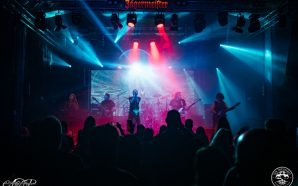
Fragments of Gaerea’s performance from Quantic, 31 January 2026
© Ștefan Lupașcu
Staying on the topic of live performances, what is one desire for tonight?
Alpha: Well, I think if we can pull through this set, which is a bit crazy, we’ll be very happy with it.
We always remember the first shows of each year because the first show somehow stays in our minds, and we want this one to stay in our memory forever. I want people to love it and enjoy it. I mean, I can’t really say what I’m expecting from the show because it might be shit.
But I do think it’s going to be special. We have a lot of emotions to release after a few weeks without playing. And, again, being able to finally do this show – it’s something really cool. So if we can get people to feel that it was all worth it, that’s the most important thing.
Beautifully said. Going a bit back in time, in 2024, when you performed at Rockstadt Extreme Fest, which memory stands out the most for you?
Alpha: Oh, Râșnov was phenomenal, and seeing the citadel from afar was incredible. The festival itself was amazing. We met really good bands, bands who are close friends of ours now. It was a really good environment, one of the best festivals we’ve ever played.
It’s far away, but most festivals are. Still, it was phenomenal. We played on one of the big stages. It was very warm. Super fun, really fun to do. I have good memories from Rockstadt Extreme Fest, and maybe one day we can go back.
Setting Rockstadt Extreme Fest aside, are there any other shows that you would consider highlights in your career?
Alpha: Last year, Brutal Assault was fantastic. Bataclan was amazing as well. Porto and Lisbon were something special; both Portuguese shows went really well. On our most recent tour, Austria and Munich also stood out as great performances.
I see. Glad you had so many fantastic experiences. As we’re wrapping up, do you have any words for your followers?
Alpha: Yeah, for sure. Romania has always been, and still is, a great country for us. We have a lot of listeners and people buying our music from Romania, so a massive thanks to everyone who makes things like this happen – like us coming to play Rockstadt Extreme Fest and Quantic. They’re really good people.
I know people there work really hard to make things happen, just like we do. So we value these moments even more. Thank you to all of our fans and everyone who makes these events possible in Romania.
Thank you, Alpha!
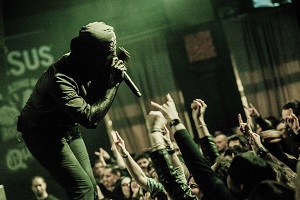
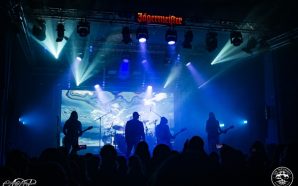
The last minutes of the Gaerea show from Quantic, 31 January 2026
© Ștefan Lupașcu