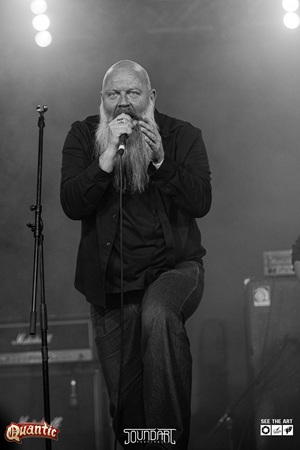
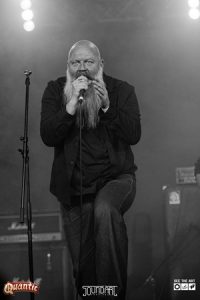
Kjetil Nordhus
© Valentin “Dieratte” Diaconescu [See The Art]
For the Norwegians who formed the band in 1990, the process was as demanding as it was ambitious, from writing the three albums and working with their producer and Kristiansand Symphony Orchestra to bringing the entire body of work to the stage.
The making of this material, the challenges it brought along the way and what remains after years invested in such a musical endeavour were among the subjects we discussed with Kjetil Nordhus, the vocalist of Green Carnation, on 25 September 2026, during Bucharest Prog Day II, when the group finally performed in Romania for the first time at Quantic.
Greetings, Kjetil! It’s nice to have you here. Tell me, how are you feeling?
Kjetil Nordhus: Hello!
I’m feeling great; it’s awesome that we got finally here. It’s been a long time waiting for this. Of course, when we were confirmed for the festival back in… I think it was 2021, there were obvious reasons why that didn’t happen.
So we’ve been kind of wanting to come here since then. And it did take some years, but I do think it’s a nice time to play in Quantic because we have lots of new music released.
Indeed, you now have the full trilogy of “A Dark Poem” released, and I’d like to delve more into some of its parts, especially those we didn’t touch on during our first interview. The entire trilogy revolves around Ophelia, drawing on both Shakespeare’s character and Rimbaud’s version of her. How did you arrive at Ophelia as the central figure of the trilogy?
Kjetil Nordhus: When we started deciding what to do with the trilogy, when we decided that we were going to do a trilogy, Stein Roger, who wrote most of the lyrics, came to me with that poem.
And I think kind of that opened up some creative doors for us. It’s hard to explain exactly why, but it was a time when he was reading a lot of poetry. He was reading Rimbaud. And that poem kind of just stayed with us when we started writing the music. So we wanted to give that piece of work kind of a thank you and a voice, like we did in our very last piece of the entire trilogy, where it’s actually read out.
It’s been a creative door opener for us, the Ophelia poem, and that’s why we have included it properly on the trilogy.
You started the trilogy with “As Silence Took You”. What memories do you have from the time when you were working on that song?
Kjetil Nordhus: It was basically me and Stein Roger working on that song. In fact, we wrote all the songs together, and we wrote most of the trilogy in the countryside, in the mountains in Norway, kind of near where our grandfathers are from.
It’s a place, it’s kind of two hours away from where we live, out in the middle of nowhere, and we feel really much at home there. So it felt very good for us to go up there so often and stay there for many days at a time and write music together.
I’m feeling like it is important to mention that when we wrote the songs, we didn’t write them album by album, starting with the first, then the second, and finally the third. No. We wrote everything at the same time, put the songs in the same box, and then we tried to compose three albums out of our new compositions.
I think of all the songs, we always knew that “As Silence Took You” had to be the opening track of the entire trilogy. It just has an opening vibe to it for us. The other song we knew had to be placed at the very end was the orchestral piece, because we really wanted it to close the album. Those were the only two songs whose positions we had decided from the start.
For the rest of them, we kind of tried out different combinations, and ended up with the first album being very energetic and full of information, the second album being much more naked and even more personal, and the third album being different again, because we start looking outside to the world again, lyrically, and of course it closes off with a 17-minute classical piece. So there are three quite different albums.
We wanted to make sure that album one could stand on its own, but also fit together with album two. Album two could stand on its own, but also fit together with album one and three. There were many different things to think about.
And on the first album, before we move on to the other two, there’s “Me, My Enemy”. I know Ophelia was an important inspiration for the song, but I feel like there’s something more behind it. What else was there?
Kjetil Nordhus: Oh, absolutely. That’s also one of the more personal songs. It’s about the feeling that you’re not good enough, whether for the people closest to you, those around you, or even society as a whole. In that sense, you become your own enemy. Sometimes you feel like you’re the one ruining things for yourself, through the choices you make or the things you do.
I think it’s also a song about regret.
I also believe it fits really well on the album because it gives you a bit of a break from all the energy. There’s still a lot of energy in the song, of course, but it’s a different kind of energy.
Yes, it does possess a different kind of energy. Going now to the second part of “A Dark Poem”, which starts with “Sanguis”. Why did you feel that “Sanguis” was the song that had to open the album?
Kjetil Nordhus: We thought it was a good bridge from the first to the second album. Lyrically, it touches on some really, really personal themes with someone’s upbringing and his relationship to his father especially. Also, a little bit his relationship to his mother, but mostly to his father.
So lyrically it was an introduction to part two, but musically it felt like a natural bridge from part one.
In the same time, we thought it was a great and really energetic opening to that album before taking it completely down on loneliness and so on and so forth. I mean, It fits well there because it is followed by “Loneliness Untold, Loneliness Unfold”. It gives the listener a chance to slow down and breathe a little. And if you listen to the first album and then move on to the second, it becomes a welcome moment of respite.
Although I do think that “Loneliness Untold, Loneliness Unfold” is one of the most intense songs actually on the albums because of its lyrics and stuff.
Speaking about “Loneliness Untold, Loneliness Unfold”, could you tell our readers a little more about the story behind the song?
Kjetil Nordhus: Yeah. It’s about a friend of ours who has kind of given up on life many years ago. He’s still alive, but he’s not going to do anything.
He lost the patience for everything, I suppose. He doesn’t go out anymore and he has kind of lost his battle and has resigned his will of living.
The song asks many questions. It’s a really, really sad song.
And we ended up with Stein Roger actually singing on that because he’s the closest one to that guy. We thought it was a good song for him to sing.
Did you think the song might help him in one way or another?
Kjetil Nordhus: Oh, we haven’t talked to him about it actually. I’m not even sure if he knows it’s about him. It could be about many different people because he’s not the only one, sadly.
But yeah, it is one of those songs that meant a lot to Stein Roger when it came to the lyrics and I’m really happy how it turned out.
It really is a touching song, and knowing these details makes it even more poignant. And while that song carries such a personal and human story, “Unconditional Artificial Chemistry” takes us into a very different territory. Ophelia is still a central figure in the third part of the trilogy, but this time you also bring artificial intelligence into the picture. What led you to explore that subject within her story?
Kjetil Nordhus: Ophelia is a very tragic figure, right? And we do think that by being as uncritical as we are towards things like AI, we could end up creating our own tragedy. Our entire society could.
So there is a link there somehow. I understand that it feels like we’re talking about something very current, and it is very different than the other topics of the previous albums. But everything surrounding Ophelia can still be seen in the world today. That’s one of the reasons we wanted to include her.
And if you look at the music video, it starts out quite perfectly. The song doesn’t even finish in the video. It stops ten seconds before it actually ends, which I thought was a great way of trying to show what is going to happen.
I’m quite sure it is going to happen. It is already happening.
Our trilogy is not an optimistic one at all.
But honestly, apart from relationships between human beings, which can have some influence over yourself, everything that’s going on, including the people in power, doesn’t give me much optimism for the near future.
And sometimes there can be a reaction to that. History shows that on many continents and at many different points throughout human history. But to be honest with you, I’m not sure that’s going to happen this time. I’m quite negative about the overall outlook for humanity in Europe, the US, the Middle East, and everywhere else.
Did you see the song, its lyrics and the video as something that could potentially change the perspective of the human beings, or was the intention mainly to make a statement and leave the listeners to draw their own conclusions?
Kjetil Nordhus: It’s mostly a comment. It’s us trying to remind people not to be so uncritical towards everything. I think AI is already very dehumanising, especially in the way it is being used in warfare.
It’s already completely horrible, and it’s just going to get worse and worse for many years to come. The song can be seen as a warning, too.
And if it can make some people stop and think, that will be a success for that song.
After “Unconditional Artificial Chemistry”, the album has “The Messiah Complex”. When you look at society today, what does the idea of a Messiah Complex represent to you?
Kjetil Nordhus: It represents many things today. It’s about humankind’s need to find an excuse for the bad habits.
You see it in politics all over the world. It’s a little bit related to things we’ve already talked about. It’s not really about religion. Well, not any more than anything else.
Of course, the Messiah Complex is a biblical term, so many people will know what it means. But I do think it’s extremely relatable to how we keep searching for something, no matter what it is, that can lead us somewhere. We kind of… I don’t even know if we hope it’s the right path or whatever it is.
Maybe it’s just a way of giving ourselves a good conscience about how we’re living our lives. And I just think that’s horrible.
There are so many examples of this in society today…
Then we have “Broken Souls, Common Enemies”. The title seems to suggest a world in which people are so consumed by their own brokenness that they end up turning against one another. Why do you think it’s happening?
Kjetil Nordhus: I think it’s about our need for big scandals and big news. Things that aren’t extreme don’t get any attention anymore. The police report that is read at the end of the song, between the guitar solos, is taken from The Black Dahlia Murder. It was one of the first examples we could think of that had that kind of extremity around it, so it became well known all over the world because someone was cut in two and put back together again.
And since then, things like that have just developed.
So it’s like we need the worst things in the world to grab our attention.
Good things don’t really do that anymore. Of course, that’s not 100% true, but that’s what the song is about. It’s about our constant need for scandals.
And that also has something in common with the way algorithms steer our attention.
There is a guitar solo in the song that really caught my attention. What made you decide that this was the right place to bring it in, and how did it evolve during the recording process?
Kjetil Nordhus: That part was actually taken from another song that didn’t make it onto the trilogy.
But we liked that part so much that we needed to find a song to put it on. We tried it on many different songs, but when we put it exactly where it ended up, it was perfect there.
And I think it’s a perfect ending to the participation of the band. It’s kind of our last song on the album, on the trilogy.
Yeah, the solo sounded different before we went into the studio. Then Björn and the producer decided to change it quite a lot. So there’s a little bit of a country vibe in the first half of the solo, while the second half is just super epic, which I think lifts everything at the very end.
Then it goes into double bass drums and three voices singing to lift it even further.
How did you react firstly when changes were suggested during the creative process?
Kjetil Nordhus: Oh, well, when it comes to someone suggesting that, sometimes it can be quite hard for you as a musician. But there was a reason why we chose to work with Endre Kirkesola as a producer. He knows the band really well and is now also a live keyboard player, so he was very central to the production of the album.
We needed to listen to the changes quite a few times before we realised that they were actually better than our original idea. We also know that Björn’s style of playing is something that makes Green Carnation what it is, and Endre is another part of what gives Green Carnation the sound. So, of course, we need to trust each other.
The creative process of a song isn’t always easy, and it shouldn’t be. That’s also why I keep coming back to AI. There is a big difference between ordering something and having somebody else make it for you, and actually composing something and working together with people you trust when it comes to art. They can come up with something unexpected, and suddenly one plus one is three. That will never happen with AI, no matter how advanced it becomes.
That’s another important point for me. AI can’t be human. That’s the main idea.
I agree. Going back to the album, you chose to work with Kristiansand Symphony Orchestra on the final song. How did that collaboration come together?
Kjetil Nordhus: It was an amazing time for us! When we got the opportunity, I signed a letter of intent with the orchestra back in 2017. So we already knew that we would work together when we started planning “A Dark Poem”.
In 2019, I think, I went to the orchestra and asked, “Is this possible to do it within the next three or four years?”. We found some dates, and they turned out to be perfect for us in the whole process of the trilogy.
Then we needed to write the piece, which we had never done before. That was the hardest part.
We spent a few months on it, and that was where we invested most of our time. But we felt that this was a once-in-a-lifetime opportunity.
We also worked with a guy called Martin Olsen from our hometown, who lives in Berlin and works with classical music. He’s a composer who works with German orchestras. We asked him to help us translate our musical ideas into something that could actually be performed by a symphony orchestra.
The orchestral recording took place after the band finished recording the drums, guitars, vocals and everything else. I remember the last day. We had two days of recording, and when we finished the second one, we were just like, “We did this!”. We had this feeling of satisfaction, knowing that we had actually pulled it off.
With everything you had to handle during this period, how did the process affect you personally and creatively?
Kjetil Nordhus: Oh, I think it completely drained Stein Roger of creativity for a while. And probably me as well. It has been a demanding period, releasing six singles and three albums in 14 months, with three different press cycles. It was a lot of work.
I’ve basically used all my spare time on this. I also work full-time, and I actually work with Kristiansand Symphony Orchestra. I didn’t do that when we made the agreements with them. By coincidence, I started working with them a few years later.
What do you feel you’ve learned from the experience?
Kjetil Nordhus: What I’ve learned is how hard it is, and how important it is to stand the distance, both creatively and with all the work around it. For example, I haven’t rejected a single interview, and there have been a lot of them. And I thank you all for that.
We’ve done everything, and we’ve put 100% into everything outside of composing and recording music as well. That has cost a lot. But Stein Roger and I agreed that we were going to do this, and we were going to do it 100%.
All the other guys have given 100% too. We truly wanted to do this so that we could create something we would be proud of for the rest of our lives.
Then, of course, there was the challenge of bringing these songs onto a stage. We played a concert in Kristiansand, our hometown, two weeks ago, performing all three albums with the symphony orchestra and guest artists. That was an incredible amount of work on top of everything else, so I wasn’t sure how I was going to react afterwards.
But it went incredibly well. People came from 21 different countries to our little town in Norway to see us play this. If that’s not inspiring, nothing is.
It felt like we had a thousand friends in the audience who wanted us to succeed. There was such a great atmosphere in the concert hall that evening. The orchestra loved it, and they played for a much louder audience than they were used to.
Everything was just so nice. I was sure I was going to want to stare at a wall for three days afterwards, but that didn’t happen. So that’s a good sign, I guess.
Oh, yes, it is! Last but not least, do you have a message for the Romanian people who supported your work?
Kjetil Nordhus: I just want to say thank you to everyone who listens to our music, comes to our concerts and supports us. It means a lot to us. Here, at Quantic, we’ve felt so warmly welcomed, and we really hope we can come back to Romania again soon.
Thank you for being there for us, and hopefully we’ll see you again!



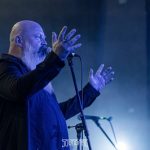

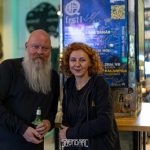
Bucharest Prog Day II [25 September 2026]
© Valentin “Dieratte” Diaconescu [See The Art]