When you thought of Green Carnation, you thought of “Journey to the End of the Night” and “Light of Day, Day of Darkness”. Naturally, you also thought of Norway and those passages of progressive metal that stayed with you.
Now, years after the formation of the band in 1990, you think of the trilogy “A Dark Poem”. More recently, you think of Prog Day II, which will be held on 25 September 2026 at Quantic in Bucharest, Romania, by Cavalleria Events.
Perhaps you also have questions about the band. I certainly did. Those questions were answered by Kjetil Nordhus in an interview conducted before the event.
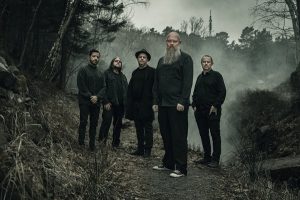
Green Carnation
© Lars Gunnar Liestøl
My greetings, and thank you for your willingness to answer my questions. Your time is appreciated.
Kjetil, you arrive from Norway, a place where you and your bandmates have already outlived several versions of the band. Span is not a straight line for this group, but a sequence of returns, cuts, and reconfigurations. Before we move into records and writing, I want to ask something simple. What state is Green Carnation in right now, as “A Dark Poem” continues to unfold?
Kjetil Nordhus: I think we are in the best place we have ever been, to be honest.
After the enormous effort of composing and recording the trilogy, the response from both old and new fans, writers and reviewers have put us in a place where we are very happy to be in.
We are now extremely ambitious in trying to adapt the albums into something special in a live setting. Of course, a big task, but we wouldn’t be doing this if we did not have the highest ambitions.
You have been active across very distinct phases, from the demo “Hallucinations of Despair” [1992] to the full-length album “A Dark Poem Part II: Sanguis” [2026]. If we look at the full arc, what do you feel connects all these periods?
Kjetil Nordhus: I wouldn’t try to make too strong connections between “Hallucinations of Despair” and “A Dark Poem, Part II: Sanguis”. But having said that, I think the people in Green Carnation have, in the different periods, been trying to push borders in one way or the other.
The 2026 version of Green Carnation is basically the same as the one that came together for “Light of Day, Day of Darkness” [2001], basically the only “new” guy is Jonathan, the drummer.
We have tried to push borders since the early 2000s, our own borders, the music’s borders leading to us pushing our followers’ borders.
When you think back to “A Dark Poem Part I: The Shores of Melancholia” from 2025, what was the main intention guiding its construction during the writing process?
Kjetil Nordhus: In the period composing the tracks for the trilogy [2018-2023], we didn’t compose songs particularly for this or that part.
We put together the albums after having composed all the songs. We wanted “A Dark Poem Part I: The Shores of Melancholia” to be full of information and energy, we wanted to push our borders even on the first album, and to surprise some people along the way.
We decided not to do any compromises with the music or lyrics throughout the trilogy and wanted to show that already on the first album.
“A Dark Poem Part II: Sanguis” is described by you as material that moves into more exposed, personal territory, while resisting any softening of the lyrics. When working on it, where did the usual writing discipline stop being enough?
Kjetil Nordhus: The nature of the issues we are discussing on “A Dark Poem Part II: Sanguis” wouldn’t be justified with us softening them. These are the things that are real, and we wanted them to stay real.
I don’t think we have ever softened our lyrics. But not since “Light of Day, Day of Darkness” have we talked about such personal issues.
The voice in the song “Sanguis” from the aforementioned album moves between obedience, resistance, and rejection of that same lineage. When shaping this shift, what decided the final form of that progression: the narrative, or the emotional logic underneath it?
Kjetil Nordhus: With this song, we needed to go through the lyrics again at some point. The song is about Stein Roger’s relationship to his father, and while in the studio to record it, his father suddenly died.
In the last few years their relationship had gradually become better, and it was a shock for everybody when his father went away. So, for me, this song is all emotions.
Remaining on the topic of the latest album, in “I Am Time”, what decisions were needed to keep the concept from overpowering the musical and lyrical structure?
Kjetil Nordhus: I think it is all about balance.
We need the lyrics, the “concept” and the music to fit together at all times, and we have used different ways of making sure that is the case in every song.
I cannot remember that we did something different on this song than all the other ones.
Moving to “Lunar Tale” of the same full-length, what proved to be the most difficult moment in its creation?
Kjetil Nordhus: It was one of several difficult moments on this album. When going this deep, we needed to work with ourselves to find the right balance, and that is a very challenging process.
Luckily, myself and Stein Roger have been talking about all the difficult issues regarding what we have been trying to do, which helps of course.
And now, with this new album and a rich catalogue, you are coming to Bucharest Prog Day II. You were previously meant to perform in Romania, but the pandemic interrupted that plan, so let me ask you, what does it mean for Green Carnation to finally play in Bucharest after that delay?
Kjetil Nordhus: Yes, it has certainly been a long wait. The planned show that was cancelled was really a big disappointment for us. That makes it even sweeter to finally be able to come.
It is our very first time in Romania, and we are extremely happy to come and meet old and new fans.
We cannot wait to come!
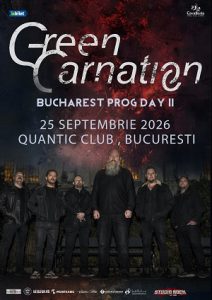
Official announcement poster
© Cavalleria Events
How does that context shape your approach to the set?
Kjetil Nordhus: It doesn’t really. We have a project going on now, with “A Dark Poem”, and we cannot wait to share that to the Romanian audience.
Is there a particular song you are most looking forward to performing in Romania?
Kjetil Nordhus: We haven’t decided the set yet. Just a couple of weeks before visiting Romania, we will play all three albums live in our home town of Kristiansand, Norway.
The Romanians will be the first crowd to hear “The Best of «A Dark Poem»” set that we will perform in late 2026 and throughout 2027. So, that is quite exclusive.
How do you view the Romanian music scene today?
Kjetil Nordhus: I am not going to brag about knowing a lot about the music scene in Romania.
The Colectiv night club fire in 2015 really touched me and I was happy to contribute on the “Back To Life – A Tribute to Goodbye to Gravity” with Nightshadows Lament, with members of My Dying Bride amongst other.
I have also had interest in the folk music scene in Romania for a while, where there are some amazing, amazing talents. But I am no expert.
Opening now to something else, and leaving live performances behind for a moment, is meaning in your music something you place into it, or something that forms later in others?
Kjetil Nordhus: With music, as all other things where people interact, there will always be one sender and one receiver.
I think we put a lot of ourselves into our music, and it is then up to the listener if he or she connects to it or not. That has to do with a lot of things, references, taste and openness to something new.
So, I do think we put a lot of meaning into what we do, but it is not worth too much for other people if they do not connect to it somehow.
If sorrow is transformed into sound, does it remain recognisable to the one who first felt it?
Kjetil Nordhus: As I was explaining in the previous question, it all has to do with the sender and the receiver. If they match, magic can be created.
Can a piece of music ever be considered complete, or is completion only an administrative illusion imposed by release?
Kjetil Nordhus: I think there are different stages when it comes to considering music.
Of course, we feel that the music we have recorded is complete.
But then we start working on transforming the songs into a live format, and then they get new life. In the live setting no song is ever complete, because every performance is different.
What are the next steps for Green Carnation?
Kjetil Nordhus: We have a huge task in preparing for our monumental show in our home town of Kristiansand on 12 September 2026. Then we will perform the entire trilogy live, with more than 100 musicians and singers on stage during the show, and with people from more than 20 countries coming to see it.
That is taking up a lot of our energy and worries for the time being, haha.
And finally, what message would you leave for those who have followed the band through the long passages of change, return, and transformation, and for those who may only now be encountering the work for the first time?
Kjetil Nordhus: We are a very honest band, trying to maximise our potential in all aspects.
I know that those who have followed us for a long time appreciate that, and it is our hope and ambition that new listeners will acknowledge the same. If they do, we are happy.
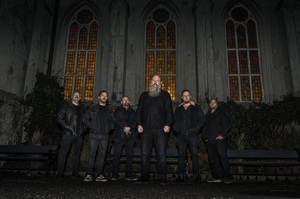
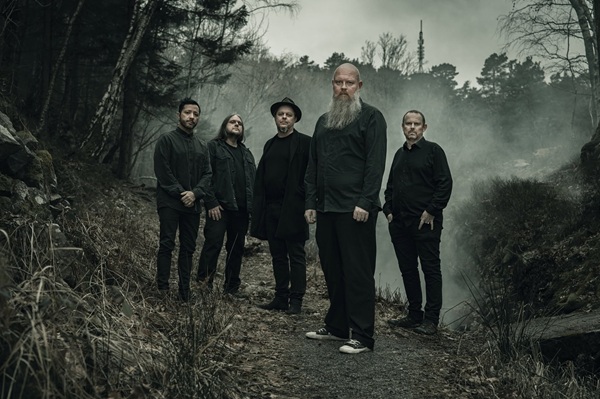
Green Carnation
© The archive of the band