“War has just begun.” That’s how Adam of Hate describes the central tension behind their latest release, “Bellum Regiis“. The Polish veterans are no strangers to weighty concepts, but this time the focus is sharper—power, dominance, and the myths we use to understand them. Their recent work has steadily drawn from Slavic lore, and “Bellum Regiis” continues that path while adding urgent reflections on war and propaganda in today’s world. It’s a release that feels both ancient and current.
Before their performance at Quantic Pub, Bucharest, Romania, on 13 May 2025, I caught up with Adam to talk about the ideas behind the new album, the resonance of Veles and Erebos, and how songwriting unfolds in the current Hate lineup. Here’s how that conversation went.


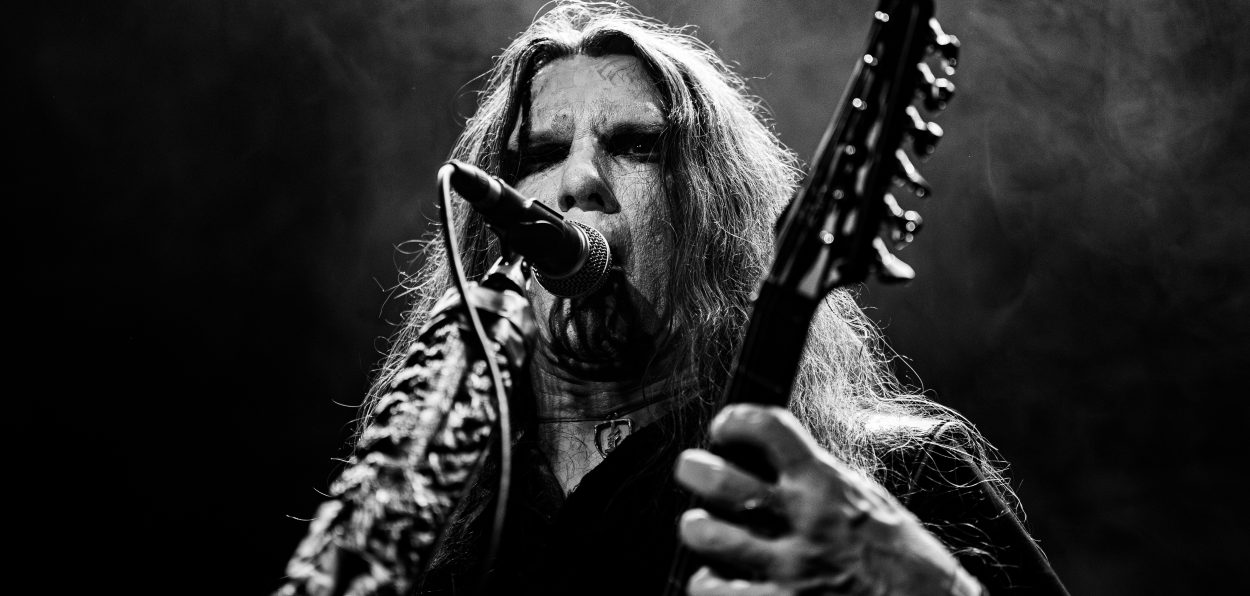
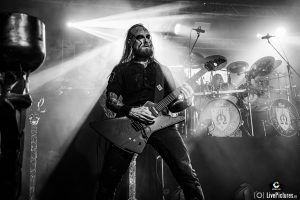
Adam performing at Quantic Pub, 13 May 2025
© Paul Voicu [LivePictures Ro]
Adam: It’s a big question. But I’d say there have been a lot of different visions over the years—strong thematic directions. The one that’s important to me right now, and to us generally, is the one connected to the new album “Bellum Regiis”, which means “War of Kings”—or it could also be translated as “War of Royals”. It’s basically about the lust for power, the pursuit of power, and the struggle that comes with it, you know. So it’s about war and conflict and propaganda as well. And it is, as you can imagine, inspired by the world that surrounds us—by this geopolitical situation that is around us right now, right here.
But there are also some stories from mythologies, just because they are very universal, and they are very good pictures of our, you know, let’s say, human features or human behaviors that are also connected with conflicts and hostilities and these kinds of things.
So the album has a very strong theming, I would say, but it’s not a concept album with its rigid form. It’s more like different topics, but everything is around pursuit for power and lust for power. And there’s this big question posed, which is: why are we as humans so much inspired by concepts like glory, power and wealth, and these kinds of things? And why is it so? Or dominance, you know—why is it so overpowering so often, to the point that it actually leads to conflicts and wars, and to situations where we have to pay such a great, such a high price for it?
Since we’re already discussing the new album, let’s dig a little deeper. The title track, “Bellum Regiis”, includes a reference to Veles. What would you say lies at the core of that song’s message?
Adam: Well, Veles is a pagan deity, representing—let’s say—the dark side of the forest, or rather, the dark side of human nature. Some people compare Veles to Satan, but it’s not that easy. I mean, you can’t draw such a simple comparison between the two, because pagan beliefs were completely different from Christian philosophy. That’s why it’s really hard to compare them—it’s a completely different picture of the world, I’d say.
For the archaic Slavic tribes who worshipped Veles, he was a powerful symbol. I think he still is. He represents the pagan view of life, the pagan view of nature—and that’s very inspiring. It’s been a great source of inspiration for me for at least the last decade.
We’ve built a few albums around pagan themes, starting with “Tremendum” in 2017, followed by “Auric Gates of Veles” in 2019, “Rugia” in 2021, and now “Bellum Regiis”, which also contains a lot of references to Slavic mythology. Even though there are a few nods to classical Greek myths, I think the majority of the album still centers on Slavic myth and pagan tradition.
What led you to choose this direction for the album? Why delve deeper into mythology this time?
Adam: Simply because mythologies are powerful—they usually offer great examples of drama, difficult choices, transformation of the human mind, and transformation of life itself. They tell stories that touch on the very essence of what it means to be human. These stories are rich with meaning, and many of them are widely recognized, which makes it easier to connect with listeners in a direct way—especially when we’re talking about Greek mythology. It’s fairly well known, so people can quickly grasp the references and understand the message behind them.
Of course, sometimes a bit of clarification is needed here and there, but the language of mythology is, I believe, quite universal—probably because it taps into something deeper, like the collective subconscious. I do believe in that idea: we each have our own subconscious, but there’s also a shared layer, filled with archetypes and mythological figures that speak to us on a fundamental level. That’s why I turn to mythology so often—it resonates quickly and directly.
Greek mythology is widely recognized, but Slavic mythology is still relatively obscure. That’s mostly because it wasn’t preserved in a written, unified form. It’s more of a reconstruction, pieced together from stories scattered across the Slavic world—from Eastern Slavs in Russia to Western Slavs and the Balkans. There are many deities, tales, and linguistic variations, but in the last ten years or so, there’s been a wave of books and publications trying to bring it all together. That material has been very inspiring to me—it continues to fuel my imagination.
All right, staying on the topic of your new album—because there’s a lot to say here, and I’ve been listening to it quite a bit at home… There’s a lyric that really struck me: “Black-winged night’s possession/Erebos awoke”. What does the awakening of Erebos symbolise for you within the narrative of this track?
Adam: Erebos is a personification of the dark side in Greek mythology. So Erebos is, essentially, darkness. “Erebos awoke” means that darkness has awakened—and in this context, it refers to the darkness of war. It means that war has just begun.
This track, “Bellum Regiis”, carries a very bellicose tone. It’s about war and about a struggle that’s been present since the dawn of humanity. After several decades of relative geopolitical stability, we’re now witnessing what may well be the beginning of a much larger conflict. That last part of the song acts more like a warning: darkness has awoken, and something massive—perhaps a large-scale war—is taking shape. We need to be aware of it.
Got it! Switching to another track, “A Ghost of Lost Delight”—there’s a line about scaling the wall and breathing life into the stone. What’s that about? Are we dealing with metaphysical transformation, or is it more about memory and identity?
Adam: It’s definitely about metaphysical transformation. The main message is life after life—being reborn in another form, not necessarily in another reality. So, yes, it deals with the concept of reincarnation. It reflects the belief that death is not the end, that there’s something beyond it—worlds within worlds, so to speak.
Ancient Slavic people strongly believed in this idea. For them, life was a journey, a chain of interconnected cycles. So the core energy—your essence—never disappears; it just changes form. That’s the heart of this song. On one hand, it’s melancholic. There’s definitely sadness in it. But on the other, it gives hope. It says: “Death is not final.” You can scale that wall and live again in another form.
It ties into the old Latin phrase “Non omnis moriar.”—”I shall not completely die.” A part of me will go on, maybe even forever. That’s the idea.
Powerful. So would you say “A Ghost of Lost Delight” is the one that sits closest to your heart—or is there another track that holds that place?
Adam: That’s a really difficult question, you know? Because a new album is like a newborn—you love it entirely. Right now, I’m still very much in love with all the tracks. We’ve just released it, and most of the songs reflect my thoughts and personal taste. So it’s hard to pick just one.
That said, I’d point to two key tracks: the opener, “Bellum Regiis”, and the closer, “Ageless Harp of Devilry”. They really represent the album’s essence. The arrangements, the riffing, the overall style and intensity—they’re exactly what I love. And more importantly, they’ve opened up a new direction for us. We’ve found a more aggressive, bolder style, and I’m sure we’ll continue developing it on the next records. These songs mark a turning point in how we express ourselves.
How did you approach the songwriting process—was it a close collaboration, or was it difficult at times to connect and organise your ideas?
Adam: Well, usually the procedure is like this: I come up with the main ideas, with all the riffing and the main arrangements, let’s say, and then I work closely with the drummer on every single detail of the songs. When we have the main ideas complete—let’s say the main forms of the songs—then the other guys get involved: the bass player and the lead guitarist as well. From this point on, it’s more like a collective effort, you know, and we add some new parts, some new elements to the story.
At the same time, I’m working on the lyrics, so it goes interchangeably—the music and the lyrics come together more or less at the same time. In the case of “Bellum Regiis”, we had an extended lineup. We brought in a female vocalist, Eliza Sacharczuk, and also Michał Staczkun, a guy we’ve been working with for years. He’s responsible for the soundscapes, synthetic backgrounds, and orchestrations on the album. I worked with him in his studio on those parts. As for Eliza, I was looking for a female voice that would contrast with mine in an interesting way. Her voice is amazing—she’s got a great range and can sing in various styles. She’s actually a music teacher, and while she mostly sings folk, she’s equally comfortable with classical techniques. It was pretty easy to get her involved—she’s the wife of a friend of mine.
At one point we got together and did some pre-recordings, and those turned out so promising that a few months later, we were in a studio near Warsaw, recording properly. I’m very happy with the results. The contrast between my voice and hers really adds something dramatic to the songs. What’s more, she actually sang in Greek on the album—she used to live in Greece, so she speaks the language. I thought that was a great opportunity, so I selected some fragments from classical Greek literature—specifically from the dramas of Aeschylus—that fit into the songs. She sang them beautifully in Greek. It worked so well that I’d really like to continue working with Eliza on future material. From my point of view, what she brings is exactly what the album needed.
How did you approach recording and mastering this time around?
Adam: This time we recorded partly in Sweden and partly in Poland—but mainly in Sweden. The person who oversaw the process was David Castillo, a producer and sound engineer from Sweden. He’s very experienced and has worked with bands like Katatonia, Opeth, Candlemass, Tribulation, and many more. I met him a few years ago in Stockholm when we were touring with Vader—someone gave me his number, I called him, and he came to the show. We talked face-to-face, stayed in touch, and later started planning this album.
We ended up recording drums and doing some of the production at his studio—Ghost Ward—in Stockholm. I did more recording in Poland and then returned to Stockholm for the mixing and mastering with David and his team. It was a great collaboration, and I’m really happy with how it turned out.
What was the idea behind the album cover?
Adam: Regarding the artwork, the cover was created by Daniel Rusiłowicz—a graphic designer we’ve been working with since the “Erebos” album in 2010. He’s also a good friend. The original idea was to depict a king—not a triumphant monarch, but a figure who’s been through suffering and hardship. A tragic figure. Daniel executed that idea perfectly. When you look at the cover, you see someone who’s endured a lot, and the only remaining symbol of power is his crown.
The concept behind it is that power comes at a very high price—not just on a personal level for those who pursue it, but also in terms of blood, suffering, and human life. It’s about struggle and sacrifice. That’s the core theme: a fight for the throne that costs more than it gives. And I think Daniel captured that perfectly.
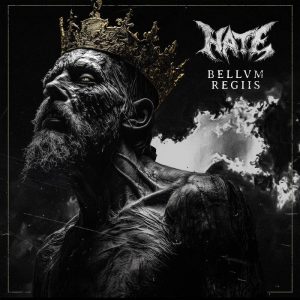
The official cover artwork for “Bellum Regiis”
© Daniel Rusiłowicz
Now, with a new album behind you and that striking artwork to go with it, you’re back in Bucharest—how does it feel to return?
Adam: It’s been some time. I’m glad to be here. I know we’re having a lot of followers in Romania in general—and in Bucharest especially—and we’ve been coming to your country, to your city, for some years now. Maybe this is our fifth time here. So people know us pretty well, and I’m quite sure they’re familiar with the new record as well.
So it’s a great opportunity for us to actually be able to present some new songs for the first time on this stage tonight. This is the first set of shows we’re playing in support of this new record. Tonight there will be, I think, only two songs from the new album—but next month, we’ll be adding more songs from the record, I’m sure.
And we’re going to play more tours and more festivals in support of this new record. I’m pretty sure we’ll be very active this year and next year, promoting “Belum Regiis”, and I hope we’ll be coming more and more to Romania as well.
Speaking of your last shows in Romania, how did you feel those went?
Adam: I generally have very good memories. I have some friends here, I must say. There are people I meet every time I come here—and sometimes outside Romania as well.
So yeah, I have very, very good associations with Romania in general, and with Bucharest especially. And as I said, I know we have quite good support here from the listeners. A lot of good reviews for the new album came from Romania, too. So I totally appreciate it, yes—and I’m really happy to be here again.
And we’re gonna deliver the proper show tonight, you know.
What do you appreciate about the metal community here?
Adam: Well, I would say you have quite a lively metal scene. And every time we release a record, some journalists from Romania reach out and we do interviews. I believe it’s a strong local scene. You also have festivals—Rockstadt Extreme Fest is one of them, right? It’s quite a well-known festival. So yes, absolutely, it’s worth coming here.
And how does it feel to be sharing the stage with Venom Inc. and Ater on this run?
Adam: It’s great, because we’ve been friends for some time with Venom Inc., also with Ater, and we’ve known each other from touring—also with Krisiun from Brazil. Unfortunately, the later is not going to perform tonight, but maybe will come to Romania another time.
Anyway, this tour really brings together bands that are very friendly with one another. We get along very well—perfectly, in fact—and it’s great to share the stage with Venom Inc., who are our friends, and also Ater—very good people from Chile, a very ambitious band. And yeah, I love what they do musically as well, you know. So it’s great.
Awesome! So what’s next for Hate? You mentioned something about continuing certain ideas from previous albums.
Adam: Some concepts, yes. Even some new ways of arranging material that we discovered while working on “Bellum Regiis”. We’ll definitely be continuing in that direction. I already have a few ideas for what’s next, but it’s still very early. I don’t even want to start proper rehearsals yet. First, we need to focus on playing some tours and festivals in support of the new album—we’ve got a lot of work ahead of us.
Most likely, we’ll begin rehearsing with some fresh ideas in the autumn. And who knows? Maybe we’ll continue working with David Castillo. That collaboration was excellent, and I really believe there’s still a lot of potential there. We can do something truly special working with him—and also with this extended lineup we’ve built. So yes, we’ll definitely keep heading in that direction.
Can’t wait for that! And on a more personal note—what’s a life lesson your career has taught you?
Adam: Well, I’d say that a career in music—especially when it comes to creativity—is like a journey. Of course, we make plans for this year or the next, but life has a way of verifying those plans. You have to stay flexible. For example, we were supposed to tour the US with Belphegor, but we didn’t get our work visas on time. We’re applying again now, trying to make it happen.
We really don’t like disappointing people—we’ve got a strong following in the States, and many were genuinely disappointed when they heard we had to drop off that tour. It was only because of the visas, and all these new, unnecessary regulations under the Trump administration. The process is ridiculous—very costly, long, and needlessly complicated. It almost feels like they’re trying to discourage foreign bands from coming over. But we’re not that easy to discourage. We’re working on it, and I’m confident we’ll make it to the US, hopefully for one or even two tours, once the paperwork clears. That’s one priority.
Are there any other regions or shows you’re especially looking forward to?
Adam: Another priority is the South American tour, which is already announced and confirmed—we’re going there in November with Vltimas. It’ll be eight shows across six countries. It’s a great opportunity. We’ve been to Brazil and Mexico before, but there are many other places in South America where people have been waiting to see us live. So this will be important.
And of course, we’ll be playing festivals throughout this year and next, in Europe and beyond. We’re going to be very active.
I see. I bet your followers in South America are excited to see you perform. As we wrap up, is there a final message you’d like to share with those following your work?
Adam: Keep an eye on what we’re doing—especially through our social media channels. There’s more material coming in connection with “Bellum Regiis”, including new videos we plan to start working on after this tour. We’ll also stay active with live shows, and we’re looking to elevate the visual aspect of our performances—more stage design, more effects—to better communicate the atmosphere and intent behind the music. So stay tuned, and we hope to see you out there.
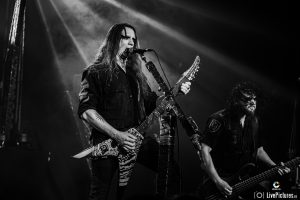
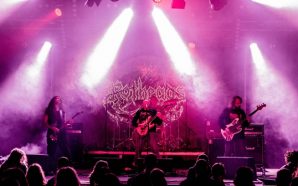
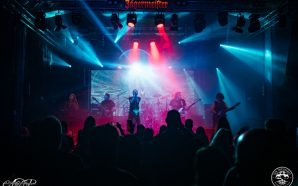
Hate performing at Quantic Pub, 13 May 2025
© Paul Voicu [LivePictures Ro]