Venom Inc. have always known what their music can do to a room full of people. It’s not about looking back, and it’s never been about comfort. It’s about stepping into a space and creating a charge—one that pulls people in, lifts them up, and leaves them with something they didn’t have before. That connection, that exchange, is what keeps it alive.
Ahead of their show at Quantic Pub, Bucharest, Romania, on 13 May 2025, we spoke with Tony “Demolition Man” Dolan, Curran Murphy, and Marc Jackson about the kind of chemistry that isn’t just functional but felt—onstage and off—about what it means to share meaning through sound, and about the spark that still drives Venom Inc. every time they take the stage.
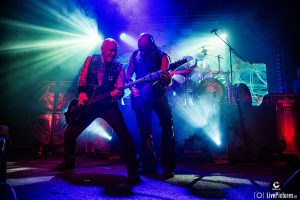
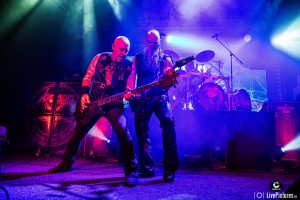
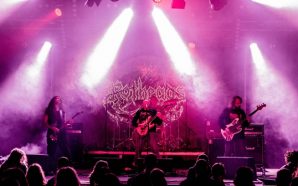
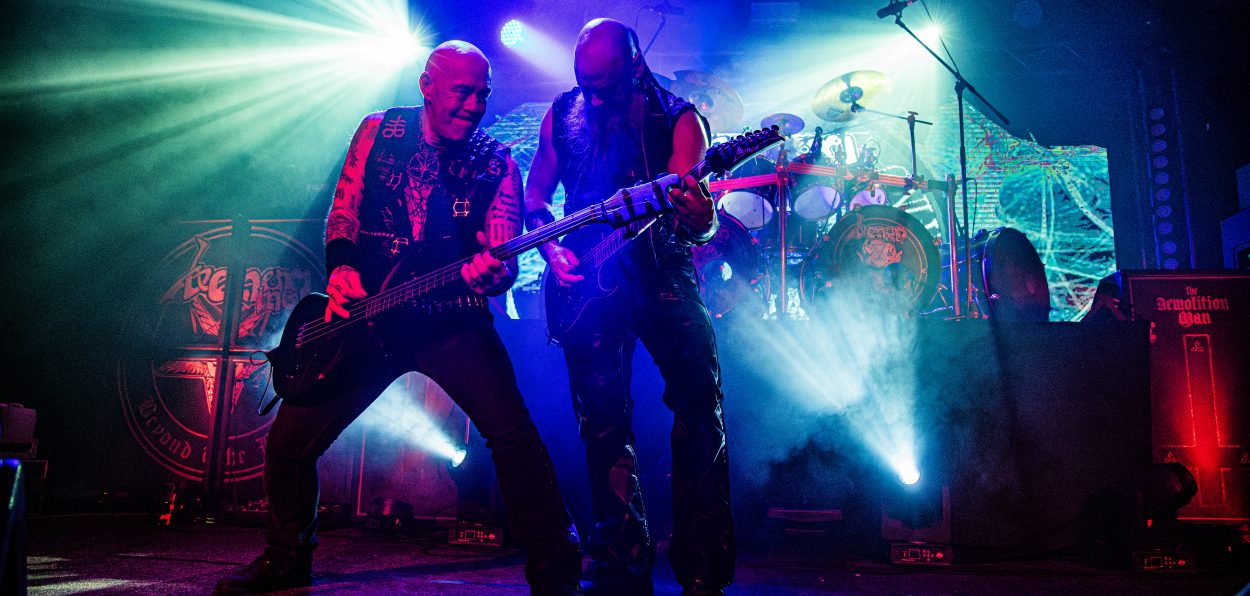
Venom Inc. performing at Quantic Pub, 13 May 2025
© Paul Voicu [LivePictures Ro]
Curran Murphy: Doing good, doing good, having a lot of fun on the tour. We’re having a great time with all the other bands, Hate, Krisiun, Ater. The crew is awesome, our light guy is incredible, and our sound guy is amazing. The shows have been wonderful!
Glad to hear that! Before we get into the topic of touring, I’d like to take a step back. Venom Inc. came to life in 2015—what sparked the decision to start this new chapter?
Tony “Demolition Man” Dolan: It was an accident, really! Oliver Weinsheimer, who is German, has a festival called Keep It True Rising. The festival takes place in southern Germany. He was at a show I was attending, and the idea just came to him—he wanted to do something a bit special for the people coming to the festival. Since it’s a retro festival, you know, he finds bands from back in the day and celebrates the music that’s part of our identity.
So he approached me. At first, I didn’t think I could make it happen, but he kept insisting. “You can do it—just play a few songs!” he said.
Eventually, we came together to play five songs. That was the plan: just five songs, have a good time, then go home. That was all we intended to do.
But it quickly made its way online, and it kind of went viral. Before we knew it, we were in Japan, then China, South America, Australia—we just kept going. It was like the car started rolling downhill and we were all in it. It just got bigger and bigger.
I coaxed Jon Zazula out of retirement to help. And we kept growing. We ended up recording albums with Nuclear Blast Records, and things kept improving.
But really, it’s fan-driven. We didn’t come back with any ideas of cashing in or chasing profit—this return was never about that. Never. Even the setlists—we put them together thinking of the people who are there with us. The other night we played somewhere in Europe. I had everything planned out, and someone asked us to play “Bloodlust“. We played it.
A few nights ago, someone in the front row held up his phone with “Don’t Burn the Witch” playing on Spotify, aiming it at Curran. He noticed, looked over to me, and we decided to play it on the spot. It wasn’t planned—but that’s the point. The music belongs to them just as much as it does to us. We’re just there to share it.
There’s no doubt—flexibility defines you.
Tony “Demolition Man” Dolan: Yeah, because, you know, when you write a song in your bedroom or wherever, it’s your song, and you’re proud of it. Proud enough to take it to your band—and your band, if they like it too, then they want to play it, and now you’re all proud of it.
But once you record that song and release the song, you release the song, which means it’s not yours anymore; it’s your listeners’. So, you know, I don’t listen to the “Black Metal” album every day. None of the members of Venom listen to it every day of their lives.
They recorded it, they play it during the shows—but they don’t listen to it when they go home. Yet, somebody out there does. And somebody out there is going through some stuff so the music is helping him or her. It helps them through their breakup, or the loss of a pet, or the loss of a family member, or leaving home, or living on the streets, or going into war.
You know, those songs have helped people—gave them strength. That’s what this extreme music does. It’s individuals making a community and giving strength to each other. And very much on stage, we deliver an energy to the audience—but we need their energy back, so we share the experience together.
If someone has something important they want to share, it’s our job to listen and connect with them. And if there’s a favourite song we can play—that’s exactly why we’re there.
How did it feel to come together as this lineup and realise there was something solid and lasting in the way it all worked?
Tony “Demolition Man” Dolan: It was pleasurable, because, you know, all the members, everybody’s been producing music all the time—so nobody’s ever really stopped doing music in one way or another. Curran was in Annihilator and Nevermore, Marc was in Acid Reign and Control the Storm, and he’s played all the festivals—he’s played Download and Empire of Evil.
So we’ve all kind of kept our mojo, if you like. But there’s something quite special about this. You know, it’s…
A chemistry?
Tony “Demolition Man” Dolan: Yes! Yes, yes, it’s a particular chemistry. Lots of people can play the songs—and play them very well—but there has to be something else. An inner something.
The same principle applies to painters. Lots of people can paint, but then there are great artists. Why are they great? And the other people, who are also good painters—why are they not great? It’s because there’s just something that connects, and you don’t know what it is.
If you go to the Louvre Museum in Paris, you can look at the Mona Lisa painting. She’s very small. It’s a very small painting.
You’ve seen it a million, million times. But when you’re standing in front of the original, there’s something mesmerising about what you’re looking at. There’s something in there that the painter knew, and he’s translating it.
And you can’t see what it is. You don’t know why it is. You just know that it is.
And that’s what happens with the music. There’s something special about it. You can’t put your finger on it, but you know it’s there.
Marc Jackson: The perfect example of that is my first show as a Venom Inc. member. It was in Indonesia, at Hammersonic Festival. Curran was stepping in for Mantas because of his health problems and all that kind of stuff.
Right there and then, there was a chemistry. It wasn’t just a guitarist stepping in. It was more than that. We went like this: “Ok, if Mantas doesn’t come back because of the health issues and whatnot, then this is the guy.”
It just clicked like that. The performance just worked.
And obviously, the lineup hasn’t changed ever since.
Tony “Demolition Man” Dolan: And you gauge it not just from your own perspective, but also from the fan perspective.
If it’s not genuine, the fans can’t relate to it—and that’s obvious. But when it is genuine, they’re immediately drawn into it.
They’re drawn into it, and they feel it. In Jakarta—where the festival Marc’s talking about took place—it was like this: we went there, Curran flew in from America, Marc and I flew in from England. No rehearsals. We just worked out the setlist in the hotel room, went onstage, and bang! It was like we’d been playing it for the last 20 years.
There was no gap. It just felt like you flipped a switch and the light came on. And it’s like—wow, how is that even possible? But it’s just something that happens.
It’s that magic that happens. Particularly when you’ve only got three members and that’s the consistent lineup—you’re more family than family. Do you know what I mean? It’s almost like we all came out of the same pod.
You buy peas, and they all come out of one pod. You have many peas, but these ones—they came out of this pod. And it feels like that’s the pod we came from. So we’re connected in that.
You know, I was about to describe you as a family, but it quickly became clear that what you have goes even deeper. Spending all this time together—did that reveal anything new about yourselves or about each other that hadn’t surfaced before?
Tony “Demolition Man” Dolan: No, I think I knew everything about the other members. We were very young when we began our thing. And like with every revolution, there’s an evolution. You start off young, and you hate society, you hate everything around you—your parents, your teachers, whatever it is. That eventually progresses into work: maybe your boss, maybe some of your colleagues.
And you want to go home, kick the dog, punch the wall. But what we’ve done with the music is give you a way to let that out. You can go home, slam on Amon Amarth or Napalm Death or Behemoth or Venom—or whatever—and just go, “Aaaah!” You release the energy.
And that’s a good thing. Why? Because when your mum walks in and offers you a cup of tea, you become the sweetest person in the world—smiling and thanking her for it. Yet ten minutes earlier, you might have had the door slammed shut, foot against it, shouting profanity at the top of your lungs.
You’ve got to let that out. That’s what we allow to happen. True freedom.
True freedom of expression. When you’re standing at a show, you don’t know if the person next to you is Muslim, Catholic, agnostic—whatever. Are they gay? Straight? Cross-dressing? You don’t know. You don’t care. Who’s their favorite band? Is it yours? Is it something else? You don’t know. You don’t care. Why? Because you’re all there together—and you celebrate the fact that that’s an individual.
And I’m an individual. We respect that individuality. We’re the people who stand up to governments and ask why.
You know, if you’re walking down the street in Kuala Lumpur and there’s a guy or a girl coming the other way wearing a Slayer shirt, you’d immediately look at each other—and you’d connect. Why? Because you’re feeling that you two are on the same page.
That sense of belonging, of knowing you’re part of something—it’s powerful. And back when we were younger, that connection turned into something loud and urgent. We were shouting, screaming, doing whatever we could to break out, to push against the world and just feel free.
Now, as older men, we realise: that’s still important. It still matters. We’ve got to carry that into the music.
“Free yourself! You can do it”—that’s what we’re still telling a 16- or 17-year-old. If you want to scream, if you want to shout, if you want to feel that liberty—come to the show.
On stage, I used to say, “There’s only one rule tonight—there are no rules.”
Of course, that doesn’t mean being violent. It doesn’t mean disrespecting the person next to you, or the club, or the organisers. It just means: feel free. Forget where you parked the car. Forget your boss. Forget the electricity bill.
Just be in the moment. That’s true liberty. When you’re on stage, you’re in the moment. Always in the moment.
Yesterday, we went on stage, and the band before us mentioned the layout—it was a thrust stage, which means it juts out into the crowd. They said it was hard to connect with the audience because of that.
So I said to Curran, “Let’s use it.” We did—we ran straight out onto it, into the audience.
Marc Jackson: He’d actually been in the audience the night before—or maybe a couple of nights ago. Honestly, if I had a mobile drum kit with wheels, I’d be out there too.
Tony “Demolition Man” Dolan: That’s the true engagement. It’s for them. The more they can be part of us, the more we can bring them in—closer. We can grab them. Pull them toward us. When you’re that close and you see the magic in their eyes—how they’ve lost themselves in it—it’s the most wonderful feeling in the world. And we feed off that. It lights us up too.
People often wonder what continues to inspire us to keep going after all these years. Well, this. You look into the eyes of a 17- or 18-year-old, and you see yourself. You think, “That was me in front of Motörhead or whoever it was. That was me!”
Marc Jackson: It’s about interaction, you know. You feed off the energy of the crowd, and they feed off the energy of the band. That’s one of the main reasons I want to get involved. I don’t just sit there playing drums—I bring the aggression it needs. I’ll stand up, shout at the crowd, do what it takes to get them going. It’s a vital part of the whole performance. If you want the crowd to lose themselves, you have to do your part too.
Curran Murphy: We want to show the crowd we’re losing it on stage too. We’re headbanging, jumping, running around. That tells them it’s okay for them to go wild too.
The one rule is: there are no rules. No one’s going to judge you for moshing or headbanging or coming right up to the front.
Like at last night’s show—there was that weird stage, where it stuck out in the front. The first thing I did was run out there and start yelling for them to come over. Just because the stage was shaped funny didn’t mean they had to hang back.
Tony “Demolition Man” Dolan: We wanted them up close. We wanted them with us. We wanted them to go crazy. It was about this: bang your head, break your neck, pump your fist. Sometimes you need to encourage the crowd to do so. Why? Sometimes they think, “Well, I want to go there, but what if I look like a fool?” From time to time, they feel a bit… held back. That’s where we take a stand. We scream, “Come with us!” Then they slowly get drawn in. By the end of the show, they’re right up front, just screaming and singing and losing their minds. It’s like, that’s it—you’ve just liberated yourself. Because nobody’s judging anybody here. We’re not judging anybody. We’re all in this together.
When you think about how live metal shows have evolved—especially with bigger budgets, elaborate stage setups, pyrotechnics, and visual production—how do you feel about all that?
Tony “Demolition Man” Dolan: There’s a lot of money in the industry at a higher level, and it’s become more about presenting a stage show.
Back in the day, there was Kiss, and that was it as far as staging went—pyros and all that. These days, everyone’s doing it, and it looks amazing—from Rammstein to Behemoth. It’s fantastic.
But for us, the show only really works if we can connect with the crowd—even without all the extras. We’ve played Wacken Open Air, we’ve played Poland Rock Festival to half a million people with all the fire and noise, and sure, it’s a blast—but even then we’re still trying to reach the audience. During these big shows, we feel like caged animals. We think, “If only I could just get down there…” That’s why club shows mean so much to us: the crowd is close, and the connection is immediate. That direct interaction—that’s what really drives us.
If I want to watch something beautiful, I can go to the movies. When I go to a show, sure, it’s pretty, and the sound is great—but I want more. I want my soul to feel like I’ve just eaten the best burger in the world—through music. I want to feel nourished by it. I think sometimes there’s too much focus on how it looks, and not enough on how it actually feels. And you’ve got to feel it.
Music is an emotional attachment. You know, if you go to the beach with your lover and sit there watching the sun go down, you’re not going to put on Napalm Death, right? You might, but more likely you’ll listen to something more ethereal. It could be “Riders of the Valkyries“, or some classical music, or even some commercial music that touches your soul. Maybe Adele or something.
But when you get home after a shit day at work, and your mum’s gone, and you didn’t do this and forgot that—and you get in your room thinking, “Oh, fuck it!”—you’re not going to put on Adele.
No, you’re going to put the worst thing on and just let go. And so, you know, that’s the thing with it. I think now people are losing a bit of that connection.
It’s a bad thing. You have to keep that. For bands like us to still be around. I’m not saying you can’t have those amazing shows—of course you must have them, because they’re fantastic—but you also need that connection.
It’s about a spark. It’s about passion. Metallica, Slayer—Metallica, the biggest band on the planet—didn’t have lots of money when they started. They all slept in vans, wore the same clothes for five months, ate whatever they could from catering, drank beer to keep themselves going and played all over the planet. Now they might have twenty cars and twenty-million-dollar art pieces and live the high life—but they didn’t always have that. So, why did they do it? Did they know they were going to succeed? No, they didn’t know they were going to succeed. They did it because they loved it.
Marc Jackson: Yeah, I think you’ve got to keep that free spirit in performance. Nowadays, a lot of metal bands use clicks on stage—and I get it, some setups need that, especially for drummers—but with some bands, it’s not necessary. And it takes away from the live, natural experience.
You know, you want to feel free on stage. It doesn’t matter if you slightly push the tempo or whatever—it’s live, it’s real. And that’s the thing with the old school bands: none of them used that kind of stuff. So it felt very real. I think that’s the big difference between the bands that were and a lot of the bands that are around now.
Tony “Demolition Man” Dolan: Also, we don’t choreograph anything. Tonight’s show is not going to be like last night’s show, and last night’s show was not like the first show, and the third show was not like the fifth show. The set is different. And so it’s like, you know, when you’re in the moment, each moment is its own moment, and we want that moment to be special for them. For them. Then we move on, and the next one is special for someone else. That’s how we approach it.
So, we don’t choreograph what we do. Sure, sometimes we say, “Let’s open with this.” Sometimes, we plan one or two things, but we’re constantly changing it—not out of boredom, but because we want to surprise people.
It’s like this… we play 30 shows these days. The first show, everybody takes a video, everybody photocopies the setlist and posts everything. So the people on the 30th show, who are waiting for it to happen, now know what you’re playing, what you look like, how you’re playing, what the setlist is. It’s like opening all your presents before Christmas morning.
That’s exactly what we want to keep alive—that sense that anything could happen, every single night. Anything. Like someone in the crowd holding up their phone with “Don’t Burn the Witch” on it, thinking, “That’s my favourite song—they’re not gonna play it…” Then, suddenly we see it, and we are playing it. And that person is like, “Oh my God, oh my God—where’s the phone? They are playing my favourite song!” Those are the moments. They are magical.
That’s why we just go on and we take it for what it is. And so it’s yours, it’s your experience. We don’t worry about being perfect. It’s all about making every performance a celebration. That’s the magic of it, and that’s why I cannot stop doing it. Because that magic fills us, you know? It fills us.
And for any younger bands starting out—the dream is the dream, of course—but if you don’t act on it, it’s just that: a dream. Before we started recording the interview, I asked you about one of your favorite mottos. You said, “I don’t dream, I act.” That’s exactly what it takes—not just in music, but in any field. Whether it’s art, journalism, teaching—whatever you do—you have to move. You have to do it. Dreaming alone won’t get you there.
And, you know, it’s a turn of fate. You could do it for thirty, forty years and never get to where you thought you might get. Or you could do it for a week, and all of a sudden—bang—you hit it. It takes one moment to change your life.
One single moment to change your life. And you’re only in that moment once. Once you’ve been in it, it’s gone. Forget it.
The next one—you don’t know. Just be in that moment and you’ll see it. When it comes, you’ll know. It’ll hit you like a ton of bricks and you’ll think that it’s your moment. And it truly is. You’re there. You need to grab it.
You know, it’s okay to think, “I’d like to…” but also to act. I always said—when I was a young man—I don’t want to be the guy sitting on a porch somewhere going, “I wish I would’ve…” No!
This is how things are with me: if I want to do it, I’ll just do it. And even if it doesn’t work out—even if you think you’ve failed—well, you never really fail. Other people might say you’ve failed. But what did they want to do? Maybe they failed. Maybe they’re projecting their disappointment because they didn’t achieve what they set out to do. So it’s about you.
Even if you give it your best shot and it doesn’t quite work out how you hoped—it still matters that you were brave enough to try. That’s the key. Because you’ll never know unless you try.
So just go for it. Go for it. The only person who’s going to stop you… is you. Just you. So go. Do it.
You know, Curran’s very good like that. He’s always positive. He believes anything is possible. He sees the possibilities.
He doesn’t sit around thinking of maybes. He acts. He moves straight at it. That’s how you succeed. That’s how you push yourself forward. That’s how you end up being an incredible guitarist, with the legacy and background he’s got. That’s how it happens. You believe in yourself. Believe in yourself, and you can do whatever you want. You just have to decide to do it.
How have you seen the metal community change over the years?
Marc Jackson: When it comes to the metal community, I remember us talking years ago about how metal had started to feel more like a trend—especially the modern stuff, where so many bands ended up sounding exactly the same.
But during Empire of Evil, there was this moment when suddenly I saw kids wearing battle jackets, denim vests, patches on the back. It felt like there was this shift away from that generic, modern sound towards something more old school. Because it felt more real. It had more spirit. Even in the production—it was rawer, more honest. It didn’t all sound identical. It wasn’t about chasing some slick production style or copying whatever modern band was big at the time.
Somehow, I feel like it went from listening to all this generic kind of modern metal—where so many bands sounded the same—to people striving more toward the old school. The older style felt more relatable and understandable; as said, it had more spirit, even in how the albums were produced. It felt real. It wasn’t just that every band wanted to sound like some modern act with identical production values—it had character.
That’s just what I’ve noticed, not only from the shows we’ve played, but also at festivals I’ve attended as a spectator. You’d see swarms of battle jackets covered in patches—Satan, Venom, Metallica, all those old bands. Bathory, too. I’ve seen a lot of shows where Bathory patches were front and center—key band, key influence. Hellhammer, Celtic Frost, all of that.
Tony “Demolition Man” Dolan: It’s about accessibility, as Marc said. I remember 10, 20 years ago, we’d play shows where the crowd was mostly guys our age, often carrying plastic bags filled with old records. That was the audience—people reliving the glory days.
But then, a few years ago, we played at Whisky a Go Go, and after coming back from a radio interview, I saw a line stretching down the street. I was shocked. I asked, “Wow, who are they all here to see?” They said, “Your show! It’s sold out!” And they were all young—20, maybe younger. It was an all-ages show: lots of girls, lots of Hispanic kids. I joked, “Do they know we’re old guys?” They knew. They didn’t care about that. They went crazy during that show. It was amazing.
You see that change at festivals too—more and more young people in the crowd, and they’re claiming it for themselves. And that’s how it should be. If we can give them a taste of what it felt like in 1984—when I went to my first show and lost my mind—then we’ve done our part. That’s what it’s about: passing it on.
And with some clear ideas about who you want to be, you went in to record the full-length “Avé” in 2017. Did you tap into that same sense of spontaneity you’d mentioned before?
Tony “Demolition Man” Dolan: Yeah, yeah! We kind of did, myself and Mantas. Firstly, we asked ourselves, “How do we even approach this?” Like, do we have to be what we used to be? I thought, “No, that would be a mistake. You’d just end up trying to rehash something you did when you were 20, and now you’re 40 or whatever. That’s not the point!” I mean, I get it—you want to keep that fire alive, keep yourself young in a way. Because there was a spirit back then. That spirit was real. But it would still be a mistake.
John Lydon writes a new song now for Public Image Ltd—it’s not going to be like he wrote “Anarchy in the UK” with Sex Pistols. Why? Because then he was angry. Now he’s a grumpy old git, but he’s not angry—not in the same way. So we knew we had to approach things differently, but without losing who we are. It was important not to chase someone else’s sound—Machine Head, or Slipknot. Sure, they are great at what they do, but they are not us. We had to stay true to ourselves and do it our way.
Honestly, that’s how we approach writing all the time: it’s about tapping into the spirit. That’s what matters. It’s not about how well we play—we can play anything—but we need that spirit. That’s where the focus was and is. We just asked ourselves, “What’s making us angry? What are we seeing in the world? What feels wrong?” From there—boom—it started to pour out, and the album was done.
And for me, personally, it’s always been about seeing music as images. Both these guys are amazing—they’re producers, they’re technically brilliant, and they write their own material. But I’ve always seen music as something that’s already out there, waiting.
It’s like with great painters. You look at someone like Rembrandt—was he painting onto the canvas, or was he uncovering something that was already there? Some painters do endless sketches, studies, different angles before they commit. But others just start painting, like they already know the final image before they’ve even begun. So they start to wonder—was it always there?
That’s how it feels with music too. I think all my lyrics already exist. The music is already around us. I’m just a conduit. I sit down, and it tells me what to play. I play, and maybe something feels off. So I try something else—and suddenly it clicks. It shapes itself.
And once it’s there, I listen. I ask, “What is this trying to tell me?” The music replies, “I’m angry!” I ask again, “What are you angry about?” Then I write. That’s it. It’s all out there. You just have to be open enough to let it come through.
That’s why a song like “Avé Satanas“, or “War“—or really, any of them—connects the way it does. It’s because people are in the same environment, absorbing the same noise, the same emotions, the same frustrations. So we feed off that energy—it goes into the music. And if you keep that honest and real, it communicates. You don’t even have to push it.
But if you start building songs in this overly structured way—like, “We need this kind of riff here, that chorus there, because technically this is how it should be”—you risk losing the connection. You might end up with something that sounds perfect but feels empty.
That’s the unpredictable part—the magic. You might write a song and think, “This is it. This is the one. We nailed it!” and then the album comes out, and the track right after—the one you barely thought twice about—becomes the one that really hits people. You’re like, “What about this one we put everything into?” And they say that it’s good, but it doesn’t touch them as much as the other song does. It’s always the one you didn’t try to perfect, the one that just was.
Curran Murphy: I want to say something about this album too—even though I wasn’t involved in it. I wasn’t there for the recording, so the big challenge for me with “Avé” was learning the material. Tony sent me the setlist, and I had to dig into all the songs, understand the parts, and figure out how to play them in a way that stayed true to the album while making sense for me as a guitarist. Naturally, I was comparing it to the classic Venom stuff. And honestly, what really stood out was the growth—the evolution in the playing and the songwriting. That was the challenge: how do I, as one guitar player, bring those harmonies to life live?
I had to get creative—using effects processors, programming harmony parts into the solos, setting up different delay patterns—all while still being able to switch quickly and play tight. It took a while to feel comfortable with how the guitars work on that record, because it’s quite different from my own style.
I remember my first show with Venom Inc., in Jakarta—we were running through some songs, and Tony stopped me and said, “No, that’s too stiff, too tight! You’re playing like James Hetfield!”—which makes sense, because that’s one of my heroes. Everything I did was tight, sharp, locked in. But he wanted it to be looser, more swung. So imagine this: right before the show, I’m suddenly trying to unlearn how I’ve been playing for two and a half weeks. That was a wild moment.
But after two months touring the US, the South American dates, and now finishing up this European run, I’m feeling much more plugged in—more part of the unit. I’ve come to understand what Marc meant by the push and pull: we don’t use click tracks, we don’t have triggers, no backing tracks or keyboards. Those things are great for some bands, especially in black metal or high-production environments. But with Venom Inc., it’s all analog. It’s loud, in your face, messy in the right way. We go out there, and we see it—people start the show with their phones out, and ten seconds later they put them away and just get hit by the sound. That’s what we want. And it’s exciting and fun and keeps me on my toes. There’s an electricity there, and an excitement! This is felt by the fans that come to our shows and go nuts, and post reviews of the shows.
Understood. Alright, Marc, throwing it over to you—which track from “Avé” gave you the most grief on drums?
Marc Jackson: You know, the hardest one—I’d say the most intricate one—is “Metal We Bleed“.
Why?
Marc Jackson: It kind of has that Judas Priest/Motörhead energy… just, yeah. There’s a lot going on. This is where it gets a bit technical. There are a lot of patterns on the ride and a lot of cymbal accents you have to follow. It would be very easy to just play over the top and lose the actual spirit of the song. So it’s about finding that balance—playing with energy, but also holding back enough so you don’t overplay and ruin it.
That’s the tricky part. And it’s got so many different styles of playing in it, really. Like in the middle section, there’s this melodic, kind of Judas Priest-type part going on, and again—I have to pull back. So you start off with a lot of energy, and then you need to ease off in that middle section.
There’s a lot of that going on. The dynamics really shift throughout the song.
Curran Murphy: In “Metal We Bleed”, you know, every part has a different feel or flavor. It’s like shifting gears in a sports car—you don’t start in sixth gear and expect to go; the engine dies. So you start in first and… and it shifts and shifts and goes and goes.
And so, like Marc was saying about his drum parts—it would be super easy for him to throw a million things over all these sections, because there’s so much going on. But that would just overwhelm everything and ruin the song.
Marc, being the great drummer that he is, is always thinking about that—on his own, during rehearsals, and then again live. But what I love is that he’s also not doing the exact same things every time. I catch him all the time—he’s always throwing in a little something.
When I hear it, I’ll turn around after the song and react—sometimes I’ll just look at him, amazed.
A few nights ago, he added this bit in one of the songs that completely caught me off guard. I asked what the hell that was, and he just laughed. Of course he knew exactly what he did, and I knew he knew.
Tony “Demolition Man” Dolan: It’s super fun—but more than that, it’s always the right bit, at the right time, in the right spot in the song. And I think that’s absolutely integral.
It comes back to what we were saying about not choreographing things. Like, yeah, in the studio, you’re excited and you put in all your parts. But even I don’t play everything exactly the same live. I’ll do different variations of what I recorded, just instinctively—because these guys all play with instinct. And that gives it an evolutionary kind of sound.
You might feel something in a certain moment—and you just go with it. And that’s what makes the difference. You’re always inside the framework, but you’re constantly feeling it. Like Curran was saying earlier, when there are two more players adding something, it gives you the chance to find something new in what’s already there. That’s the whole point—you keep discovering, and that changes how you approach things. You might normally accent here, but now you hear something and choose to support it instead. And that’s something you can’t fake. Anyone can play the songs, sure, but you have to feel them. There has to be a connection—an emotional one—and a respect for the dynamics. We change the dynamics every time. Because every song is played differently and we want the dynamics to be different.
You’ll see that tonight. Each track is different—they have their own meaning and feel. If we just played them all the same way, it would flatten the whole experience. We embrace those differences and channel them into the atmosphere we build on stage. That’s how the songs breathe on their own, in their own way—and the audience feels that. It’s like pushing a wave that crashes onto the shore, and just when you think it’s done, another one hits. Eventually, you’re not standing on the beach anymore—you’re in the water. That’s what we’re after. The set is built for that—to keep rolling, to keep overwhelming. If you can stop and catch your breath mid-show, then we’re doing something wrong. You’re not supposed to relax until it’s over.
Curran Murphy: Even with the guitar solos, it’s the same approach. Some sections are fixed, like in “Metal We Bleed”, where it has to go a certain way. But others, like in “Avé Satanas”, start with a recognizable motif, and then the second half just goes off the rails—totally loose. It’s like a freight train flying off the tracks. I get to follow wherever it takes me, and that means no solo is ever exactly the same. What you heard last night in Bulgaria, you won’t hear again tonight. That unpredictability is the fun of it.
And it’s not just me—Tony’s hearing new ways to play under my parts, Marc’s adding fills that weren’t there before. Like in “Parasite“, there’s this fill he started doing about a year ago. I told him, “That’s not on the record!” and he just nodded, asking if it’s not a cool fill. I said that it is—and that was that. He still plays it, and now I look forward to that part every night. That’s the energy we thrive on. We’re a three-piece, but we want it to sound huge. That’s why my guitar sounds the way it does, why Tony’s bass is dialed the way it is, and why our front-of-house guy runs the sound the way he does. Everyone’s pushing their end of it to make the whole thing feel alive.
We stick to the framework—whether it’s “Avé”, or “There’s Only Black”, but within that, we’re always throwing new paint at the wall.
Tony “Demolition Man” Dolan: It’s like Picasso. He didn’t paint the same thing every time, every week, every year. He didn’t paint the same thing over and over and over again. You know, his paintings vary; the style, the framework, the canvas, all of his selection of the paintings are different. Even the ingredients changed. And that’s the point: you’re not replicating, you’re creating.
You don’t go to an art gallery and see that Van Gogh painted the same field twenty times. Every piece reflects a different mood, a different day, a different version of him. Music should be the same. The songs might be the same “seed”, but they grow differently every time. You can plant the same rose bush in two different gardens, water it the same, and it still won’t look identical. And that’s okay. That’s beautiful. You have to let things evolve.
Sometimes I’ll hear something on stage I hadn’t noticed before—even in songs I thought I knew inside out—and that changes how I respond. It moves us collectively in a new direction. That’s how it breathes. And the audience? They’re a part of that. You can’t do this with just one wheel turning. You need all four.
Marc Jackson: Or three, in our case, haha. And more than that, you need to let the music breathe. You can’t put it in a box.
Take “Avé”, for example. It’s not technically hard, but it’s one of the trickiest to play right because you can’t rush it. It’s got this stomping, heavy feel—like “Sad But True“—and if you push the tempo too hard, it just falls apart. When the adrenaline kicks in, it takes effort to pull back, hold the space, and stay in the pocket. But that’s what gives everyone room to move. We’re not locked in—we’re listening and trusting each other. We know what the song needs, but we don’t try to control it. We let it unfold, together. That’s why no show is ever the same, even if the songs are.
Tony “Demolition Man” Dolan: And when a song is good—really good—you don’t want it to end. It doesn’t matter how tired you are, how little sleep you’ve had, or how many hours you’ve been on the road. When it’s time to play, there’s this charge in the air. Curran is the perfect example—he’ll finish a full set and then ask for more. And we are up for that! That’s how much we love being in that moment.
And yeah, sometimes the venue says, “That’s it, you’re done!” but if the audience isn’t ready to leave, we’re not done. If they’re still with us, still wanting more, we owe them that. They’ve given us their time, their energy, their money. So if it feels right, we’ll push it. There’s a bit of anarchy to that. Like, if you tell me that I have to stop, I’m going to keep going just because you said so. There are no rules here. Only the connection—us and them.
The fans mean everything to us. We want to communicate to them how exciting it is, how wonderful it is, and share that wisdom, because at the end of the day, that’s humanity. That’s humanity. That’s the coming together of our community, yeah. That’s the most important thing in the world to me, you know?
So when someone’s looking at a watch and telling us we’ve got to get off stage—it’s like, that’s never going to matter. It’s mechanical. Robotic. It starts to feel like a job when you keep telling yourself that you just need to get through one more day, that it’ll be over soon, and you just have to push through a little longer. It makes you state that you want to get rid of that. And our performances are never making us state that. For me, it’s simply that feeling of wanting a single moment to last forever—and for as long as we can, that’s exactly what we’re here to keep doing.
And with this mindset, you went into the studio once more, in 2022, and recorded the second album—”There’s Only Black”. Tell me more about it. The story of it. How did you choose the title?
Tony “Demolition Man” Dolan: The album was going to be two albums. It was going to be the Nine Circles—on how Dante’s “Inferno” works—and it was your journey from birth to death, and just what happens to you on the way. We wrote 24 songs for that, to go across two albums. Then Mantas had a heart attack. He almost died. They managed to save his life—bring him back to life. Some time later, he sent me a piece of music. We were recording this, and he sent me a piece of music, can you imagine it? I listened to it, and said, “Yeah, I really like that!” I also asked if he got some ideas for the lyrics. He replied that he already wrote them. Naturally, I questioned him about them. He replied, “Well, you know, when I died… the lyrics are about that experience…” He was very scared. He said he saw a vortex, and he was going into it. He was fighting to stay alive. He told me, “They talk about angels, and light at the end of the tunnel, and seeing people from your past. But I just saw black. There’s only black…” The hairs on my neck stood up. I was like, “Oh my God. That’s the name of the album: «There’s Only Black»!” Because it answers so many things. What is after death? We don’t know. Is it just black for us? If the sun went out right now, we’d all be in darkness. If the lights go, you know, we’re in darkness. People who are blind live in darkness—but they still sense things, and smell things, and touch things. So it doesn’t mean that it’s completely over.
What’s in a black hole? We don’t know. What’s at the end of the universe? We don’t know, but we’d like to know. What’s after life? We want to know. But we can only experience that as individuals—we can’t come back and tell everybody what it is. So if I go into a black hole, I’ll know what’s in there, but you won’t—until you do it. It’s the same thing with death. It’s the same thing with all of our discoveries that are beyond our reach. They’re beyond our understanding.
So it just seemed like the best title for the album. On top of that, the album changed for me then. It became about what’s going on in the pandemic. How many can die? “Tyrant“. What’s happening in the Middle East? “Inferno“. It’s like, we’re all raised from Hell, ’cause we’re in it.
All the songs changed their meaning. “There’s Only Black”—that’s not a negative title. It’s a reflective one.
And I simplified the cover, you know? It’s just an energy ball. People ask, “What exactly is that?” And I reply, “What do you see?” Some say, “A black hole.” and I say, “That’s exactly what it is!” Others see an energy ball, and that’s just as valid. It’s all about what you see in it.
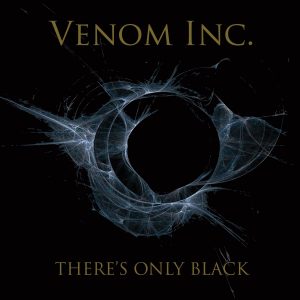
The cover artwork for “There’s Only Black”
© Venom Inc.
To some extent, it’s also an invitation—come in, find out what’s inside. If you love it, you love it. If you don’t, you don’t. If you connect, you connect. That’s what this invitation speaks to. You might connect to one thing, two things, all of it, none of it—but you won’t know until you come in.
And so each song was approached in that way.
In “Sons of Satan“, you know, from “Welcome to Hell“, there’s those lines: “Put away all your virtues/Stop your climbing the walls/Just sign your name on the paper/We’ll have ourselves a ball.” It’s the same thing. It’s like—free yourself, and don’t worry about it. Anything’s possible. But if you do it, and you trust me—you’re gonna find it out.
That’s the message in there. It became less about your journey from life to death, and more about a commentary on where we were, on humanity—and looking for that positiveness in your life. Feeling strong about that. Feeling empowered by that.
If your family’s saying, “That’s ridiculous!” and all your friends say, “You can’t!”—you’re the one who decides whether you can or not. They don’t decide. They’ll all live their lives, they’ll all do their thing, their way. And you won’t change that. So why do what they want? You have to do what you want. What do you want? How do you feel?
So the message is: “Come in, and feel positive about your decisions.”
One more thing that I must mention: we produced it very differently. It’s much faster, certainly. There’s some weight in there—with “Tyrant”, “Inferno”, maybe “The Dance”—you know, that’s a journey through hell, that’s the Nine Circles.
But yeah—it really came down to that. At that point, we just felt like life is over in a moment. And for Mantas it was different—he saw that. It marked him. It was like, it didn’t matter what he was eating, where he was sitting, what he thought he was going to do tomorrow—in an instant, it was all gone. And then he panicked. When he came back, he was changed. He’s still trying to deal with that in his head.
There’s an impetus of speed on the album. Let’s take “Infinitum“, for example. It’s fast. It’s like the protagonist is watching the sun being blocked out. And the outro—it’s like lying down. Lying down at the end of “Infinitum”. You’re lying down, just letting life drift away. And those kinds of emotions are in there.
What about the track “How Many Can Die”? That one’s also a favourite of mine.
Curran Murphy: There you go. She did that on purpose. She did. She’s making us improvise with the setlist.
Tony “Demolition Man” Dolan: We know what you’re doing. We know. Alright, getting serious now: “How Many Can Die” came purely from watching everything unfold during the pandemic. I just kept thinking, “Why are we going through this?” We were losing people to a pandemic. Nobody knew how to control it. We didn’t know what to do about it. We just watched it happen. Fuck.
For the first time in everyone’s life, the world was on pause. You couldn’t go anywhere or do anything, and yet nothing could stop it. The question lingered in the air—what comes next, where are we going, what’s about to unfold? And seeing those images… horrible. Then we came back—no more pandemic. And what do we do? We swing to extremes: bomb the hell out of each other, bomb Palestine, bomb Israel, threaten Iran, threaten America—threaten everything.
It’s like—we were all in it together, convinced we had to save humanity. And now it feels more like we saved mankind… and then turned our backs on it. So… I’m asking, “How many can die? How many are enough? How many people do you have to kill before we go, «Right, that’s it. Everyone’s dead. Now we’re fine. Now we can chill out—we’ve cleared out all the crap.»?” That’s the weight of that song for me.
“Conflict. Crisis. Facilitating war.” You know—create a conflict, create a crisis, and facilitate war for gain. That’s the whole point of it. It’s like: are we just making it up because someone wants to make money? So war makes money? They say, “Peace sells!” But who’s buying it?
That’s the age-old conundrum we’re in. I think with humanity—what really struck me, especially after going to Nagasaki and Hiroshima—is the impact of that. I have friends in Japan who are second and third generation survivors, and they still suffer from lymphoma, still have cancer caused by the radiation.
So you think: right, on the one hand, we create a bomb that can decimate a city and give people cancer through radiation—all to stop them from fighting. And then, at the same time, we’re pouring resources into curing cancer. What are we doing, exactly? Are we creating cancer? Or are we trying to stop cancer? Which one is it? That’s humanity. That’s the conundrum.
Another example… There’s a woman walking across the street—an old woman, she’s got her shopping—and I help her across. I exclaim, “I’ll get that for you!” and take her bags. But then I trip over this guy lying there—he’s a transient, shouting at people—and I get angry. I react, “Fuck off, mate!”
Hang on—am I doing a good deed or a bad one? I care about the old lady and her shopping bags. But this guy? No shoes, feet black, shouting at people because he’s on methadone—and I tell him to fuck off? Where’s the humanity in that? That’s imbalance. The right thing to do is the following: I check on him to make sure he’s okay, and I make sure she gets home safe. That’s where we should be.
And I see that all the time with people, and I just think: which part of humanity are we? The good one or the bad one? Because when you go looking for Satan, when you go looking for the devil—you are the devil. But you’re also good. You’re good and bad at the same time. And it just depends on your situation, your frame of mind—that’s what dictates which one you are in that moment, you know?
After everything you’ve just said about human contradiction—about kindness, imbalance, and what defines us in the moment—how does that perspective shape the way you experience life on the road?
Curran Murphy: Well, we started in January in the US, and we did two months right in the middle of winter, all across the States. Now, it just feels like a dream. This current one, the European one, will feel like a dream very soon too. I mean, we’ve been on this current one for almost a month. But the funny thing is, I remember maybe a week and a half, two weeks into the US leg, I was sitting on the bus with Tony and Marc and saying, “Hey, how come we don’t hate each other yet? When are we going to start fighting?” or something similar to that. Because in all my other bands, about a week in, someone’s already like, “Man, fuck you!” “No, fuck you!” “No, fuck you more!” You know? The fights start early.
I keep joking that we’re being so nice to each other, we’re going to nice-guy ourselves to death, because we’re all still getting along. It’s like, “Oh, hey, you’re not feeling too good today? Stay in your bunk, I’ll handle loading the gear.” or whatever needs to be done.
Another example—from the US tour—we were down in Corpus Christi, Texas. For some reason, Tony saw the bar was open, and he just went and unloaded the whole trailer by himself. So the next day I was like, “All right, I’m gonna make sure Tony doesn’t beat me to it!” And I ended up unloading the whole trailer on my own. Everyone was like, “What the fuck is going on?” But it’s just that—we’re all being so damn nice to each other. Like I said, we’re going to nice guy ourselves to death.
It’s been like that every time we’ve been out with Beyond the Black Tour, all over the world. We get along, we work great together, we hang out great together. We know how to lift each other up when someone’s down or not feeling their best. And to me, that energy really shows on stage. The crowd picks up on it too. It becomes this whole beautiful cycle—good vibes on and off stage, and everything just clicks.
Even the bands we tour with—normally, you’re on a tour with three or four bands, so maybe 18 or 19 people, all different personalities, and there’s always at least one guy who’s a jerk. Someone who’s no fun to be around. But that person is none of us.
We’ve toured all over, played with all kinds of bands. In South America with Possessed, I remember one night sitting at a bar, all of us hanging out, laughing and giggling.
Same thing on this tour. On this tour, the Krisiun brothers aren’t even playing tonight, but they’re still helping load gear. Impressive, right? It’s fraternity. Like Tony says, it’s a great community. It’s been like this for so long.
So the touring part is going great!
Marc Jackson: Yeah, and for me, one of the most amazing parts is seeing the age range in the crowd. You’ve got kids coming to the shows, teenagers, older folks who’ve been listening to Venom for decades. And then you’ve got this new generation—the kids who blow my mind. Thirteen-year-olds who know every word to every song we’ve ever done, just losing it as soon as we start playing.
Tony “Demolition Man” Dolan: It’s wild! You’ve got people in their 50s, 60s who were there when the records first came out… and then these kids, same songs, same energy, just a whole new wave. People in their 50s and 60s say they listen to these songs and suddenly feel like they’re 16 again, back in high school—grateful to be taken there once more.
Marc Jackson: Another great part of this tour has been the freedom to pull from such a wide range of songs when building the setlist. And of course, if someone asks, we’re more than happy to do it. Playing songs from Tony’s era—some of which were never performed live, not even by the original Venom lineup—is something special. When we bring them to the stage now, you really feel the strength in them, a strength that maybe didn’t come through in the original recordings. I feel like, as a band, we’ve helped shape those tracks into something closer to what Tony might have envisioned in the first place. Would you agree?
Tony “Demolition Man” Dolan: Yeah!
Curran Murphy: Hell yeah!
Tony “Demolition Man” Dolan: And we’re playing to a new generation. You’ve got someone who may have just heard a song that’s 40 years old. In the set, we’ll play a song recorded in 1981, and then a song from “There’s Only Black”, recorded two years ago—and there’s no crease in the fabric. It’s all the same thing. That’s kind of remarkable, you know? You’ve got a young person there, they weren’t even born when those older songs were created, but they’re responding the same way. There’s a magic in their eyes. There’s a fire lit inside them. That’s what’s amazing about it.
To be honest, we’ve been very lucky. Every tour we’ve done—we did a massive festival season, we did South America, we did the long run in the US with Salem’s Childe, and now we’re doing this with Ater, Krisiun and Hate. We’re having so much fun. We came together very quickly, like a brotherhood. Every band we play with, after every tour, wants to tour again.
Everyone’s incredible—not just in terms of musicianship or how differently each of us approaches things, but in the way we all genuinely respect each other’s individuality. We all support one another. We all watch each other’s sets.
Sadly, this tour is getting closer to the end, but the beautiful thing is the following: you travel across the planet, and then you’re at a festival and there’s your brothers again. At Christmas, we’re playing a show in the UK for Bloodstock Outdoor Heavy Metal Festival—a celebration of Candlemass‘ 40 years—and they invited us to come and play “At War With Satan” in its entirety. That’s what we’re about to do—just that album. Cat’s out of the bag.
For me—especially with the whole Venom history—coming to places like Croatia, Bulgaria, or Romania and walking into a venue to find familiar faces feels like reconnecting with old friends, sharing a moment that picks up right where it left off. I remember when we did this or that—it really feels like I’m with family. It’s like you might not have seen them in three or four years, but when you’re back, it’s like coming home. Those are your people. That’s something you carry with you.
Tell me more about a fan interaction that stuck with you—one of those moments that just stayed in your head after the show.
Tony “Demolition Man” Dolan: There’s one moment I’ll never forget—in South America. A girl came to the show with her mother. She was autistic, 16 years old, had drawn some pictures for us, just a really sweet kid. We got the both of them in the backstage, made sure they were okay. Out of curiosity, I asked, “What song do you want to hear tonight?” and she mentioned “How Many Can Die” from the other album “There’s Only Black”. I was genuinely surprised. She said, “Me and my friends love it, that song means everything to us!” It hit me—because the video opens with footage of mass burials during the pandemic in Brazil. I hadn’t thought about it from that angle. I was just reacting to what I saw happening in the world. But to them, that song had become something much bigger. It was their anchor.
That’s the last song I would’ve thought would resonate with high school kids. But there it was—their anthem. You think you know what will connect, but you never really do. It always surprises you. And it humbles you.
Also, we had one guy almost in tears. He was so happy, so overwhelmed. He said, “I never thought I’d get to hear these songs. And then you played this one, and then you played that one, and then I heard everything I wanted to hear!” You know, it was that kind of overwhelming moment.
I bet tonight will add a few more of those overwhelming moments to the list. Speaking of you guys being in Romania again—what does it feel like to return, and what kind of energy do you pick up from this place?
Tony “Demolition Man” Dolan: Amazing! You know, we’ve got so many stories from here. One that always comes to mind—Rockstadt Extreme Fest. Great crowd, good energy. Right after the show, we got a call from Poland Rock Festival. The call went like this: “Listen, we know you’re in Romania playing Rockstadt. Would you come and open the main stage?” We accepted it. And that was the start of an incredibly manic journey, ended up in the sunshine. Imagine: one minute, we’re in the forest in Romania, closing a stage. The next minute, we’re in Poland, in full sun, opening the main stage. It was like, wow—this is a crazy kind of life. But both events were magical. And to have them happen back-to-back—was it hard? Yeah. Did we sleep? No. Did we drink too much? I had to. Did we eat anything? Not at all. But it was a moment in our lives. It wasn’t something we had to think about for very long. It was magical. An endless adventure after endless adventure.
Curran Murphy: Even getting to Romania was its own little adventure. I flew in from the US, met up with the guys, and what should’ve been a 90-minute drive to the hotel took us nine hours. The driver got lost, Marc went to the wrong hotel, we got pulled over by the cops—just everything.
Tony “Demolition Man” Dolan: But it was fun, and to me, coming back to Romania feels like coming home.
Do you have any expectations for tonight’s performance at Quantic Pub?
Tony “Demolition Man” Dolan: No, I’m just excited. I want, of course, to see a lot of smiling faces. I know how good are the bands before us, and I know what we’re ready to give to the people. But I don’t expect anything. I want to experience it with them. However they want to take it in—that’s what’s great. I’m just ready to go.
Curran Murphy: I expect fun. Pure fun. I expect to have an absolute blast. I expect to get sweaty and crazy with all the Romanians—because that’s just how it goes. It’s hand in hand. That’s my expectation every night: to play my ass off, to do the best I can, to have the most fun I can with everyone there. That way, if I walk off stage and get hit by lightning and die, I’ll die with no regrets. Or, you know—very few regrets.
Marc Jackson: The most important part is the performance. We always give more than 100%. And for me, when it comes to turnouts or whatever, I try not to expect anything. I like the surprise of it—just walking out and seeing what’s what. I try not to have a look and see what the crowd’s like before we play, I like to just go out and be surprised. But I know a thing or two about your people, from yesterday’s show especially. Romania is crazy! So this concert is gonna be a good one.
Tony “Demolition Man” Dolan: They’re Romanians, they are crazy, yeah!
Seems like we’re having quite a reputation.
Tony “Demolition Man” Dolan: Yes! A good one. The performance at Rockstadt Extreme Fest… that was something else! Absolutely amazing. We thought before getting into it, “It needs to be a good show.” We always think like that. And it was. We wanted to surprise them, and we did it.
Looking back on everything you’ve experienced so far, what lessons has life taught you through all of it?
Tony “Demolition Man” Dolan: Live in the moment. Live for the now. We learn from the past, sure, but you’ve got to let it go. An old Indian chief once said, “You have to stand in the river.” When you’re standing in the river, the water hits you—it taps you—but it’s never the same water. It keeps moving. Let it pass. Let it come. Just be in the water. Be in the moment.
That’s my life lesson. If something bad happened, or something didn’t go the way you wanted—you learned from it. You won’t do the same thing again. Like, I put sugar in my coffee once. Hated it. The next time, I drank the coffee without sugar. Simple. You’re always making decisions to improve where you’re going. But don’t stress about the future—it’s not here yet. And don’t hold on to the past—it’s gone. You can’t change it. All you’ve got is now. Like Curran said—if we go on stage, do our thing, and then I step outside and a bus runs over me… was I living my best in that moment? Yeah. I mean, maybe I’ll regret getting hit by a bus, haha—but at least until then, I did everything I could. So yeah—just live.
Marc Jackson: There are so many people out there not living the life they dreamed of. Just stuck in a cycle—9 to 5, go home, sleep, repeat. People ask, “Why are you doing this kind of thing?” Well—because I wanted to. I worked hard to get here. That’s how it goes. If you want something, go for it. The only person stopping you… is you.
The news, all that bollocks—they just want you to live in fear. Financial problems, whatever—it’s not always true. Just live. Really live. You know, you can do whatever you want if you just go out and do it and give it a chance. Even if you don’t succeed, it doesn’t matter. You give it your best shot, and that’s what life should be about. You shouldn’t live life in misery. If there’s something you’re not happy doing, don’t do it. Change it. You always can.
Curran Murphy: When I first started telling people I wanted to be a musician, play in a band, release a record, get signed, and go on tour, they said, “Yeah, but what if it doesn’t work out? What happens when you turn 30 and you’re just some loser in a basement playing guitar?” and I was like, “Well, I can always go to college. I can always get a regular job. It’s not like when you hit 30, it’s over and you can’t do that anymore. No. It’s not like you’re suddenly homeless.” You even realise—hey, there’s heavy metal after 30. There’s heavy metal after 40. There’s heavy metal after 50. Mick Jagger is, what, 80-something? He’s richer than God.
Tony “Demolition Man” Dolan: He’s a goddamn vampire; when all the cockroaches are gone, he’ll still be alive.
Curran Murphy: Anyway, the point is: it only stops when you want it to stop. And what is success, really? Is success being metallically huge? Or is success just the idea of: I’m doing what I want to do, and I’m happy with my existence—I’m profiting myself, in a way.
Like Tony said, the past is the past. It’s easy to let the past turn into regret. And it’s just as easy to let the future become anxiety. But the here and now—right now—this is pretty good. I’m sitting here in Romania, waiting to play. They’ve threatened me with an amazingly good dinner. I’m doing an interview with you, and we’re all sitting here laughing, reminiscing about Poland Rock Festival, Rockstadt Extreme Fest, and joking about what’s next. This moment is fucking awesome!
You’ve given us a lot to think about already—but before we wrap this up, is there one last thought you’d like to leave lingering in the air?
Tony “Demolition Man” Dolan: One word: Van Gogh. If you bought an original Van Gogh, how much do you think it’d cost? A lot, right? Now, it costs a lot. But back then… back then it wasn’t like this. During his life, he sold one painting. One. Did it stop him from painting? No. So why did he do it, if he didn’t make money from it? Because he had to. That’s the difference. You don’t do it for the riches—you do it because you have to. That’s the matter with us, with Venom Inc.
Everyone should just figure out who they are and not worry about what others think. You have to be you. They have to be them. They’re entitled to their opinion—but that’s on them. When someone says, “I’d love to do what you do…” the answer is: you could. You just didn’t want to. I did. Sometimes it is about sacrificing some things. Like, you sacrifice sleep, food, a regular life—maybe relationships, family. It’s hard. You miss birthdays, and holidays. Christmas. Summer. But those things—they come back. Hopefully, the people are still around.
This is who you are… you can’t undo it.
Thank you for listening to us! This moment is special. Great interview. I’m really glad I came to Romania.
Thank you very much, too!
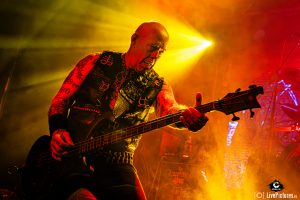
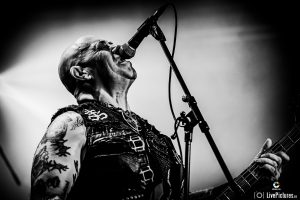
Tony “Demolition Man” Dolan performing at Quantic Pub, 13 May 2025
© Paul Voicu [LivePictures Ro]
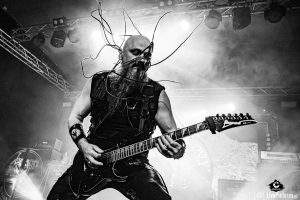
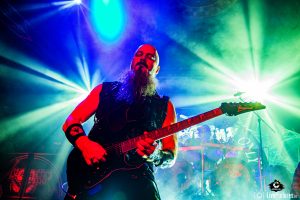
Curran Murphy performing at Quantic Pub, 13 May 2025
© Paul Voicu [LivePictures Ro]