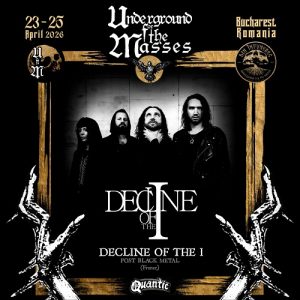
INTERVIEW: A.K. from Decline of the I on the Architecture of Thought and Underground for the Masses III
“Joy. I already played here two years ago with Merrimack and I have a very good memory of that concert. Furthermore, I have a special link with Romania because I studied Cioran in the philosophy department. I wrote a thesis on him [Cioran and music].” [A.K.]
There are artists who circle an idea. And there are those who take it by the throat and follow it into the dark, wherever it may lead. Since the inception in 2006, Decline of the I from France have belonged to the latter kind, threading philosophy through post-black metal not as ornament, but as structure. What began under the distant influence of Henri Laborit and his dissection of human response has since grown into a body of work that treats instinct, thought, and negation as material to be shaped and tested.
In conversation with A.K., it became clear that this was not abstraction for its own sake, but something lived, endured, and returned to. The foundation remained stark:
“I discovered the work of Henri Laborit when I was in my twenties, through a very good friend. I read «Decoding the Human Message» [«L’éloge de la fuite»] and I felt that the analytical framework he proposed for the world spoke to me intimately. I must have been in a situation myself where I felt assaulted by the world, by life, and I understood that, ultimately, there weren’t that many possible reactions to it: fight, flight, or remaining paralysed.”
From that premise, the project unfolded. Aggression is not spectacle here. It is constant, mundane, and exhausting, a condition rather than an event. What emerges instead is a quiet reevaluation of escape, stripped of its usual connotations. Flight, in A.K.’s framing, is neither failure nor retreat, but a necessary function of survival, often enacted not through movement, but through creation itself. Music becomes a place where confrontation is deferred, reshaped, or, at times, avoided altogether.
The shift towards Søren Kierkegaard did not disrupt this trajectory, but it deepened it. If Laborit offered a framework of reaction, Kierkegaard introduced the burden of choice. Anxiety ceased to be incidental and instead became structural, tied to the act of existing at all. A.K. spoke of it not as theory, but as something embedded in his own continuity, a decision that had to be renewed without respite. Even personal milestones, such as fatherhood, were absorbed into this same line of thought, reframed as acts of renunciation and commitment that echoed far beyond the immediate.
The music followed accordingly, bearing these ideas as imprint rather than illustration, with tracks like “Dieu vide” and “L’alliance des rats” holding beauty and tension in fragile balance, while “Éros N”. resisted stability until only its core remained, where coherence outweighed attachment.
With Underground for the Masses III approaching, a discussion about these matters becomes unavoidable, as well as about his return to the stage in this particular form, at Quantic from Bucharest, Romania. A feeling made its presence known when A.K. saw that Decline of the I would join the line-up, namely joy. By his own words:
“Joy. I already played here two years ago with Merrimack and I have a very good memory of that concert. Furthermore, I have a special link with Romania because I studied Cioran in the philosophy department. I wrote a thesis on him [Cioran and music].”
Thus, the return is not merely logistical. It carries recognition, perhaps even a degree of familiarity that sits uneasily within the broader disquiet his work often inhabits. He added more, letting the memory and thought speak for themselves, as the rest settled in the spaces between words.
Greetings. I am grateful for this opportunity to speak with you. Decline of the I has long captured my attention, so let me begin by asking: what first drew you to probe the human psyche through the lens of aggression and behaviour?
A.K.: I discovered the work of Henri Laborit when I was in my twenties, through a very good friend. I read “Decoding the Human Message” [“L’éloge de la fuite”] and I felt that the analytical framework he proposed for the world spoke to me intimately. I must have been in a situation myself where I felt assaulted by the world, by life, and I understood that, ultimately, there weren’t that many possible reactions to it: fight, flight, or remaining paralysed.
The conceptual trilogy drawn from Henri Laborit’s experiments charts a path few would dare follow.In tracing the instincts and conflicts of your subjects, what revelations emerged about aggression and the human condition?
A.K.: Ultimately, our daily life is composed of aggressions of varying intensity. Sometimes it is trivial, almost unconscious, and sometimes it is violent and frontal. We constantly have to choose how to react. All of this is exhausting. What I found very interesting in Laborit’s work is that the concept of flight is not at all synonymous with cowardice. Fleeing is sometimes [often?] the best reaction to have. It is a healthy reaction. Flight is not necessarily literal. Thanks to the pre-frontal cortex, man is capable of imagination. He can represent something that is not there. And flight into the imagination is the one I have experienced the most: in my art, in music, I can escape and no longer have to deal so frontally with all the vicissitudes of the world.
After the trilogy, your focus turned to the writings of Søren Kierkegaard.How did his meditations on existence, despair, and choice shape the tonal and thematic direction of your recent works?
A.K.: I find his approach to existence very pertinent as well. I am very interested in authors who propose a “grid” of existence; it allows one to find oneself in the face of the chaos of the world. In Kierkegaard’s work, anxiety is a central concept – that of choice.I experience this primal anxiety myself, which must have played out in my very essence: it was necessary to make the choice to be rather than not to be. And it is a matter of perpetuating [or not!] this choice at every moment.
I also made the choice to become a father and renounce carefreeness, a part of my freedom [notably, that of committing suicide if “things degenerate”]. All these meditations, without directly influencing my way of composing, inevitably inspire a certain colour, a certain fundamental feeling to everything I compose. Black metal is the music of the night. It is the music of anxiety, but also of what is hidden, of what does not immediately appear to the consciousness, which grimaces in the shadows before being apprehended.
Looking across your discography, which composition do you feel most fully embodies the vision you set out to create?
A.K.: I would say that the tracks “Dieu vide” or “L’alliance des rats” best capture all these feelings – sometimes contradictory – of beauty and anxiety mixed together.
Conversely, which track tested you most, forcing you to confront limits of patience, concept, or execution, before it could assume its final shape?
A.K.: On the last album, I think it’s “Éros N”. I don’t know why, but the form of this track was constantly evolving. There must have been eight different versions. In fact, only the main riff remained unchanged. The beginning and the end were different. I liked them, actually, but I felt it wasn’t quite there yet. That wasn’t right. It’s frustrating to have to throw away riffs and arrangements that you like, but it is the coherence of the track that takes precedence.
Going a bit to live performances. Before stepping onto the stage, what sensations stir within you, the quiet reckoning or the tension that precedes sound?
A.K.: There are several levels of consciousness that intertwine in those moments. I think about very concrete things like checking if my cables on stage are properly plugged in, if everything is ready for the video that needs to start. At the same time, there is excitement, a certain gratitude, too, for experiencing this.
Our concerts are often very intense, and I truly experience something I don’t feel elsewhere.
Staying with the topic of gigs, Underground for the Masses III, set in Quantic, Bucharest, Romania, approaches swiftly.What were your first thoughts when you learned you would play there?
A.K.: Joy. I already played here two years ago with Merrimack and I have a very good memory of that concert. Furthermore, I have a special link with Romania because I studied Cioran in the philosophy department. I wrote a thesis on him [Cioran and music]. A few years ago, I even went to spend a few days in his native village, near Sibiu. It was magical to walk those lands. And I am delighted to return to this country that speaks to me so much.
How do those thoughts shape themselves now, on the verge of the event?
A.K.: The weeks preceding the event are not necessarily the simplest because we are in the organisation phase. Rehearsals, managing merchandising, all the technical details… these are really not my favourite aspects of music.
Is there a fellow artist at Underground for the Masses III whose work resonates with your own pursuit of existential and conceptual intensity, and with whom you would relish sharing the stage?
A.K.: I am very happy to share the bill with my friends from other French groups like Malhkebre, Ritualization, or Temple of Baal [for whom I will exceptionally play bass]. And I’m curious to see Darvaza again, who are always very intense on stage.
If the trilogy and subsequent works are maps of thought and emotion, what terrain remains unexplored, hidden in the folds of consciousness you have yet to illuminate?
A.K.: That’s a good question, but I admit I don’t have an answer yet. At the moment, I am interested in what the essence of the “Self” could be. What exactly remains when you have removed emotions, thoughts, the body? Is there nothing else, or is there – a bit like for a film at the cinema – a screen on which images, movements, and actions are projected? Could I find this neutral “screen” within myself?
If you could return to the genesis of the project in 2006, with the knowledge of all the albums that followed, what insight or warning would you offer your younger self about the pursuit of philosophical black metal?
A.K.: I think the advice would not have been about the music or the philosophy, but about all the business surrounding the music. I would have told my younger self: “Be patient, it’s coming! And you will live through experiences you can’t yet imagine. And you will brush against a few right notes”.
How do your daily reflections, reading, or private contemplations infiltrate and refine the shadowed landscapes of Decline of the I?
A.K.: Decline of the I is a reflection of my life, so everything I read, see, or experience infuses this project. For example, I had a child between “Johannes” and “Wilhelm”, precisely at the moment when I was exploring the concepts of choice and responsibility. It also happens that my son is named Sören… it’s all linked.
To those who have accompanied you along this path of conceptual rigor, reflection, and sound, what message do you leave, unspoken yet unmistakable, for those who understand the silence between the notes?
A.K.: Precisely, perhaps a real silence. That deep down, behind all this thought, these anxieties, these pains, these joys, there is a pure space of void and that is perhaps where our true reality resides. A neutral void, but perhaps a blissful one as well.
There is little point in asking for creative freedom if you’re not prepared to use it. For Treasondom, that means writing what feels right, rejecting ideas that don’t work,...
The best ideas don’t always come together straight away. For Rotheads, a song can begin with two unrelated riffs, take an unexpected turn and only find its final form...
The underground has never been short of people with opinions about how things should be done. Fewer are willing to spend decades actually doing them. Romanian promoter Coro has...
After a period away from the stage, Olympus Mons, the Romanian doom metal group formed in 2018, returned to Quantic with a new drummer and renewed creative energy, while...