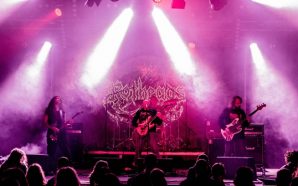
In 2018, Greece saw the rise of a band unafraid to navigate the darker corridors of the human psyche: Calyces. Drawing from heavy prog while venturing into emotional and psychological extremes, the group constructed music where tension, release, and vulnerability coexist in equal measure. Every composition holds portent, every riff and rhythm a deliberate step into the exploration of despair, hope, and the fragile space that lies between.

Official logo
© Calyces

Calyces
© The band’s vault
With SoundArt Festival approaching, I explored with Manthos, Stavros, Christos, and Loukas how this music takes form, how the emotional and conceptual threads are woven, and the care with which these ideas are refined before reaching the listener, ahead of their performances organised by Cavalleria Events in Bucharest [Quantic] and Cluj-Napoca [Machines], Romania.
On the creative process, Manthos explained:
“Our themes are mostly about human beings and the situations and emotions they go through. […] It feels natural for me to write about whatever is on my mind, whatever worries me, or things I want to say but don’t always know how to express in the right way. That’s the beauty of art: you can speak and express yourself exactly as you feel, often without needing to analyse or explain it.”
The beauty of their art will soon be revealed live, but until then we turn to the band members’ insights.
Greetings! It’s a pleasure to finally connect! Before we dive in, I want to start with something simple but revealing: when you step on stage, what is the first emotion you consciously allow yourself to feel?
Stavros: Hello, the pleasure is all ours!
When we step on stage, we allow ourselves to leave behind all the pressure that we might have till this moment and dive into confidence and excitement. Helpful emotions to connect the vibe of the band with the people that have attended our show.
Your music navigates heavy emotional and psychological terrain. Do you need silence, chaos, or isolation before a performance?
Manthos: Personally, before every live show I need a bit of calm and quiet so I can focus on my performance. I also do a bit of vocal warm-up. Of course, all of this can be a bit difficult in certain cases, especially when the venues are small and you don’t really have that option.
That inner emotional state seems central to your identity as a band. Taking a step back from the individual and towards the collective – Calyces formed in Athens, Greece in 2018. How did the band come together, and what necessity made Calyces inevitable?
Manthos: Calyces began to take shape after the breakup of my previous band, Tardive Dyskinesia. I felt the need to move away from bad management and unhealthy relationships from the past and to create something new and fresh, something that would express me 100% as a composer and performer.
Along the way, several musicians passed through the band until the line-up finally took its current form, which is the same line-up featured on our latest album. It’s difficult to find people who share the same vision and a common goal, especially when all of this is sometimes tested under challenging conditions. With the current line-up, we’ve been through that process, and now we’re moving forward strongly.
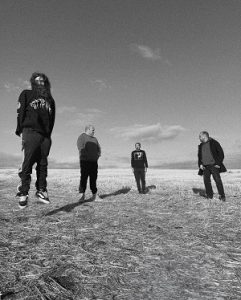
Calyces
© The band’s vault
Athens carries centuries of splendour and ruin, often within the same street. How has this constant co-existence of beauty and collapse influenced your sonic identity and emotional expression?
Stavros: Athens shapes you even when you’re not trying to be shaped. A city like that doesn’t just sit in the background, it seeps into your emotional vocabulary, your sense of rhythm, the way you hold tension and release it. It’s a layer. You don’t have to polish everything. Cracks become texture. Imperfection becomes identity.
Your themes revolve around depression, angst, and personal struggle. Was this thematic direction a conscious choice, or did it emerge naturally?
Manthos: Our themes are mostly about human beings and the situations and emotions they go through. This includes the things you mentioned, but not only those. It feels natural for me to write about whatever is on my mind, whatever worries me, or things I want to say but don’t always know how to express in the right way. That’s the beauty of art: you can speak and express yourself exactly as you feel, often without needing to analyse or explain it.
Going now to the first album entitled “Impulse to Soar”. The full-length from 2020 feels like a manifesto of emotional survival. Looking back, what does this album represent in your personal and artistic evolution?
Manthos: I would describe “Impulse to Soar” as the moment of “conception”, the spark for starting something new, something whose destination you don’t exactly know, but that carries you forward.
My feelings about this album are mixed, but without a doubt, it contains a lot of my soul. There are certain tracks I feel very connected to, which is why they have become an inseparable part of our setlist to this day.
Was this album driven more by urgency or by reflection?
Manthos: I would say both, the urgent need to express yourself through your art, as well as through your own self.
“False Awakening”, from the aforementioned album, revolves around illusion, distorted perception, and fragile consciousness. Philosophically, do you see awakening as liberation, or as the moment we realise how trapped we truly are?
Manthos: This is a deep question that touches on a paradox. Awakening can feel like liberation, but it is often also the moment when we realise how trapped we are. Perhaps because one is born from the other: when you begin to see more clearly, you lose certain illusions, but you gain awareness. And this awareness is at the same time both a burden and a form of freedom.
The lines “Welcome to a place of illusions/Beyond what the eyes can see” suggests that reality itself is unstable. Do you believe truth is something we think we discover, or something we construct to survive?
Manthos: “False Awakening” talks about the experience of thinking you’re waking up, but in reality, you wake up within your dream, continuing it without realising that it’s a dream. Again, I would say that there isn’t, or I don’t have, a clear answer to what you’re asking; it could be either. If you consider that for each person, the truth they experience is different from someone else’s, the question I would pose here is how much my own truth practically affects yours.
Moving to another song from the album we are discussing, namely “Parasites”. That piece is a violent metaphor for moral decay, greed, and psychological contamination. Were you aiming to describe society, personal experience, or the darker mechanisms of human behaviour?
Manthos: I would put it that way, yes. The “human worms” that feed on your fear are everywhere, and sometimes much closer to us than we think, until we become aware of it.
For me, the lyrics of “Parasites” touch on more personal experiences, but if you read them from another perspective, they can easily reflect the society we live in as well.
The idea of “human worms” implies that corruption is internal before it is external. Do you believe the enemy is mostly within?
Manthos: I believe that the enemy can be everywhere, and in some cases, even within ourselves.
The album entitled “Fleshy Waves of Probability”, from 2025, feels more expansive, both sonically and conceptually. What fundamental shift took place between this album and your debut?
Manthos: If our first album was the “conception”, I would describe this album as the “birth”. The most significant change was the addition of our drummer, Stavros, to the line-up. Beyond being like brothers, Stavros and I played together on the first two Tardive Dyskinesia albums, and our chemistry is very strong.
“Fleshy Waves of Probability” is a more complete album and more to the point compared to our debut, I would say.
“Swirling Towards the Light” from the aforementioned release speaks about departure, loss, and transcendence. Do you perceive leaving as an act of hope or an admission of defeat?
Manthos: Lyrically, the song dives into the journey of breaking free and discovering yourself in the unknown. It’s about having the courage to leave the familiar behind, riding the waves of change as we spin into uncharted territory, where home isn’t a place, it’s where you feel alive. So, hope carries the son, the hope of beginning something new, not knowing where it might lead, and even if it might end in failure, in the end it’s the journey that matters, and that you gave it a try.
Giving some time to “Boneshatter”, too. It is a raw confrontation. Who or what is the true adversary in the song?
Manthos: “Boneshatter” is one of the most powerful tracks on the album, and we always have a great time playing it. We privately call it “the pirate song” because of its rhythm and the feeling it creates.
The lyrics speak about the moment someone decides they will no longer let anyone hold him down. It compares the corrupt system and politicians to snakes. Imagine being thrown into a ring full of snakes, each one representing someone who ruins your life every day just because they have power, while your rage has reached its limit!
Moving on, “Lost in Phrase” confronts inevitability, failure, and existential exhaustion. Do you see failure as a collapse, or as a form of knowledge?
Manthos: “Lost in Phrase” speaks about failure, but not in a pessimistic way. Failure is part of the process of living. We often take failure too seriously, as if we should punish ourselves every time something doesn’t go well or we make a mistake. After all, everyone fails, or will fail at some point, and no one is exempt from it. And that’s okay. It’s a part of life.
And what can you tell our readers about “Forked Tongue”?
Manthos: “Forked Tongue” speaks about a certain kind of person we all encounter at some point, those who smile to your face and shake your hand but speak nothing but negativity behind your back. It captures that awkward tension when you find yourself in the same space as them, when everything seems fine on the surface, but you know it’s not.
The artworks you use follow a distinct visual identity. What governs these recurring motifs and colour choices?
Manthos: For us, creating an album is not just about the music. It’s a holistic process where the visual direction and artwork are just as important. Maria Stergiou [my sister], who oversees our covers, creates pieces that take 1–2 years to complete. They aren’t just graphics, they are paintings on canvas, worked with oils, giving form to our ideas. The result is a living dialogue between the music and the visuals.
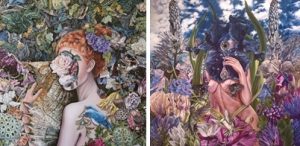
The cover artworks for “Impulse to Soar” and “Fleshy Waves of Probability”
© Maria Stergiou
Looking ahead, which emotional or conceptual territory do you feel compelled to explore?
Manthos: Well, I don’t know yet. And that’s the beautiful thing about the whole process, that we don’t know anything. We’ll see where it takes us when the time comes to seriously compose our new work.
Moving to live performances, The Fleshy Waves Tour 2026 marks an important chapter for the band. How would you describe this tour in a few words?
Stavros: This tour is very important because it feels like the band won’t just perform the songs. Every day we will build something very strong on the road, that as a result will turn every night into something living, into something emotionally charged.
It is a tour where we don’t approach the stage as something like a platform, but as something alive. A living organism I’d say.

Fleshy Waves Tour 2026
© Cavalleria Events
You are soon performing at SoundArt Festival in Romania. What does being part of this event mean to you?
Stavros: It means a lot to share our music with a new crowd, feel their energy, and be part of a very creative festival such as SoundArt Festival in Romania. People come ready to discover something, we are there for the same reason, so it’s very energising. It’s a chance to connect beyond borders. Romania has a fierce alternative community that reminds you that music travels further than geography.
What kind of emotional exchange do you seek with the audience during a live performance?
Christos: Audience interaction is something that is usually built throughout a show, and as an experience it offers a wide range of emotions over the course of a set. When the audience actively participates, they can truly feel what you are trying to convey through the song itself. Yet the experience is different for each individual in the crowd. Someone who is already familiar with the band will most likely experience the show very differently compared to someone attending without knowing us, and therefore without expectations. This is especially rewarding when, after the set ends, this connection continues with members of the audience who may want to support us or listen to us in the future.
After all, we just want to perform something honest enough to last longer than the noise around it.
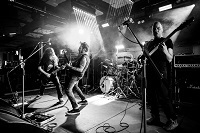
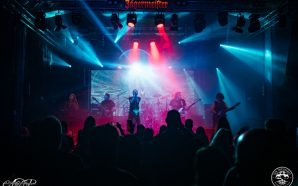
Calyces during a live performance
© The band’s vault
Going further, shattering a bit more the brains, do you believe suffering is a catalyst for growth, or merely an unavoidable condition of consciousness?
Loukas: Believe that humanity has to move away from the dogma that says, “If you don’t suffer you, won’t achieve things, become a better person, etc.”. One has to achieve a great emotional intelligence to revive from past suffering. Why give more?
And despair? Is despair something to confront, or something to learn how to coexist with?
Stavros: Despair isn’t a single‑use emotion. The healthier stance is usually a mix of both. Despair carries information: something hurts, something’s missing, something needs attention. Ignoring it completely can leave you stuck somewhere. You don’t have to solve despair to live alongside it. Co-existence gives you space to breathe and to create. Coexist with its presence, and often art comes out of it.
Do you see identity as stable, or as something constantly rewritten by trauma and experience?
Stavros: Identity is something edited like all the chapters of our lives. You’re the same person you were ten years ago and now, someone you couldn’t have imagined back then. You had identity but as time goes by it’s a game of built and rebuilt. It’s a long negotiation between who you’ve been, what’s happened to you, and who you’re still trying to become.
In a few words, identity may have a core but everything else, except this core it’s changing.
Is hope an illusion necessary for survival, or a genuine force of transformation?
Christos: It could be both, really. The need for hope arises as a way to soften our negative emotions with the idea of relief. However, I believe that it requires balance and moderation. When you hope for too much or for everything, you risk wasting mental energy and time on things you can’t actually change. On the other hand, when you don’t hope for anything at all, everything can seem bleak, and you lose your sense of direction. So, in the end, maybe hope is a blade with two edges.
Do you believe art can genuinely heal, or does it merely help us endure?
Manthos: In some cases, both, depending on which side you experience it from.
When the noise fades, the lights die, and you are left alone with your thoughts, what question returns most often?
Christos: When that happens, as funny as it may sound, there’s usually a rhythm playing in my head and I’m thinking about how it’s counted! Half joking, half serious, because in general I find great comfort in music; it feels like an antidote to all the problems of everyday life.
Most of the time it’s just a simple question: Did I stay true to myself today?