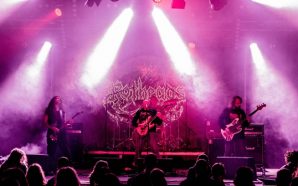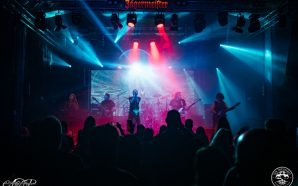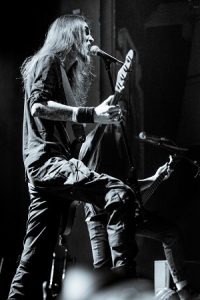
Illia Rafalskyi performing at Quantic, 31 January 2026
© Ștefan Lupașcu
Illia Rafalskyi is a name connected to several projects such as Severoth, Galdur, and Морок. He entered the sphere of black metal and explored other subgenres such as atmospheric black metal and pagan black metal out of a pure desire to convey certain things about his country of origin, Ukraine, about its poetry, and about the landscapes that the country gladly shows to the world.
Later, during wartime, he wished to convey hope through the album “Шляхом світла”, which translates to “By the Way of Light”, released under Severoth in 2024. And if the desire of the person behind these projects was, and still is, to reveal certain things through lyrics and song, my own desire was to speak with him about these themes.
The opportunity arose at Quantic, Bucharest, Romania, in winter, a setting that further fuelled the Severoth atmosphere on 31 January 2026.
My greetings, and thank you for taking the time to answer my questions. Before we enter the topics of the projects you are currently involved in, how are you holding yourself together these days, as a person rather than as an author of sound?
Illia Rafalskyi: Greetings! I am fine, I am trying to balance everything in my life. Maybe it would be disappointing for some people, but I want music to be only a part of my life. I have a family, I have children, a wife, and responsibilities, and that is the biggest part of my life. Nowadays, music is more like a hobby.
Basically, most of the time I am just a responsible adult at home, taking care of everyday things. In my spare time, I make music.
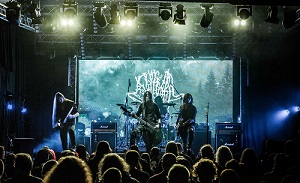
Severoth performing at Quantic, 31 January 2026
© Ștefan Lupașcu
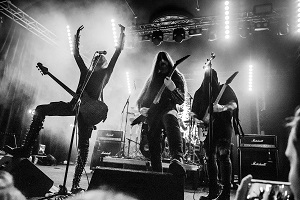
Морок performing at Quantic, 31 January 2026
© Ștefan Lupașcu
When I first started working on multiple projects, my main source of inspiration was simple. When I got into black metal, I wanted to make something by myself. I had played in different bands, and whenever you play in a band, it is always cooperation. You have ideas, but other people may not accept them. In the bands I played in, my ideas were not accepted, so I decided that I wanted to do everything on my own and realise all of my ideas myself.
At that time, I could not really play any instruments, so I learned gradually. I started with drums, then moved on to guitars, just to be able to create something on my own. I knew for sure that I wanted to make black metal, but everything else came more from feeling.
When I started making music, I wanted it to be aggressive, but for some reason it was not aggressive. So I just went with the flow and made several projects. There is something inside this music that is not only about black metal, but also about melodies and lyrics.
The lyrics are inspired mostly by Ukrainian poetry, so the music is more romantic, and that influences the whole atmosphere. At the same time, I still wanted that sense of aggressiveness.
That is why I created Морок. It exists exactly for that purpose, to keep the spirit of old black metal. Obscure music, not polished, not tied to big labels, but something like the underground black metal of the ‘90s, coming from the crypt. That is Морок.
Yes, because Морок is quite different. In a way, it is almost the opposite. That is how I see it in terms of themes, and even the way the music is written.
Illia Rafalskyi: Indeed. When I first started with Морок, I did not really plan things in advance. When I began making music, I was simply writing music, and at that time everything was quite aggressive. But in the middle of the recording process, I wrote a different track, and that track inspired several others.
Because of that, I abandoned the first album and recorded a second one. That second album became Severoth, and the first album later became Морок. So it was just part of the process.
How did you separate the songs?
Illia Rafalskyi: I separated the songs by mood. The more atmospheric material became Severoth, while Морок is more straightforward black metal, with screams and buzzing guitars.
At the beginning of our discussion, you mentioned the move to Poland.
Illia Rafalskyi: Yes, because of the war.
Did that change the way you write music, or the way you sing?
Illia Rafalskyi: In some way, yes.
I moved to Poland about one year after the war started, so I lived in Ukraine for a year under war conditions. It was hard, and it still is. At that time, I actually decided to stop making music. I wanted to sell all my equipment, because it felt impossible to make music in Ukraine.
Not only because of technical problems, although those certainly existed. For example, there was often no electricity, so you could not record anything. But more than that, it was about how you feel. There was a constant sense of depression, because you could not see any hope. Only bad news, only bad things.
You start thinking about how your family will survive the winter, where you will find essential things, and how to cover basic needs. So at that point, I wanted to cancel all my projects.
Then we moved to Poland. In Poland, I decided to continue working on the latest album. I already had about half of “By the Way of Light” written, but it had been abandoned. In Poland, I had the opportunity to continue recording it.
Lyrically, I tried to make it as bright and hopeful as possible, to encourage people, especially in Ukraine. I wanted them to listen to the music and feel at least a small spark of hope, because that is very hard to find.
At the time when I lived there, the environment was extremely stressful and depressive. Not only in my family, but all around me. In my city, and in the country as a whole. I wanted to give people hope and light during that dark period.
You have said that you wanted to give people hope and light during a period that felt heavy and oppressive. Beyond this intention, was there another goal guiding your work?
Illia Rafalskyi: Yes. To be Ukrainian is in the DNA of all my projects. When I started making music, my goal was to have songs about Ukraine; to have songs about the Ukrainian spirit.
I started all my projects with the intention that Ukraine would be known beyond its borders, so that people outside the country would know about it. So that people outside Ukraine could see how beautiful my country’s legacy is. We have beautiful art, beautiful poetry, and so many things. Beautiful nature, mountains, lakes.
I wanted to share all of that with people through music.
Which place in Ukraine inspired you the most?
Illia Rafalskyi: Definitely the Carpathian Mountains. I think you noticed in my discography many tracks about the Carpathians.
For me, it was always a place of force. A place where you recharge. You could say it is an escape from the noise of the world.
I lived in a very big industrial city, Dnipro. It has around one and a half million people. And when I went to the Carpathians, I felt the stillness. I felt the calmness of the forest.
For me, it was very inspiring. Also the Carpathian rivers. There is a river called Prut.
Every time I visited the Carpathians, I went to that river. I believe mountain rivers have energy inside them. You can recharge there.
You give away everything bad, and the river washes it away. You take strength from it.
Beautiful answer. Turning to “Шляхом світла”, in English “By the Way of Light”, from the year 2024, which piece from the album are you most proud of?
Illia Rafalskyi: I am proud of everything. I think all the songs are strong songs.
I worked on them so they would not have weak parts. Every song, part by part, had to have its own quality, its own feeling.
But if I had to choose one, it would be the title track, “Сонце зійде”, which is “Sunrise Will Come” in English. It concentrates everything about the album. The most concentrated feeling of all the songs.
If you want to describe the album with one song, it is “Sunrise Will Come”. It is the most powerful in meaning, in what people feel when they listen to it.
While reviewing the album, that piece struck me as its centre. Did it take more effort to shape than the others?
Illia Rafalskyi: First of all, I read your review and I felt that my message got to the right ears. Secondly, your intuition is good. Indeed, it took a lot of effort.
I am my own worst critic.
It was hard to write, because I criticise everything all the time. I had about twenty-five versions of the song. Different choruses, different first riffs, different everything.
“This is not right, this is not right. Try it again, try it again”, this is how I was talking to myself.
In the end, I shaped it. I tried to catch the feeling.
The result was successful, at least from my perspective.
How do you know when a song has reached its final form?
Illia Rafalskyi: You just feel it.
You listen, and if something is not right, you feel it immediately. Something does not work. Something needs to change.
When I already have several songs, I listen to them and write down what I feel. If something is wrong, I write it clearly: “I do not feel what I should feel here”.
I work until it becomes smooth. Until when I listen to the album and everything is in its place. Until the mood is exactly as it should be, as I wanted it to be.
It is all emotion. This is how I work in all my projects.
I do not know music theory. I write everything through emotion and feeling. If it feels right, it feels right. If it works, it works. I do not care about the technical side.
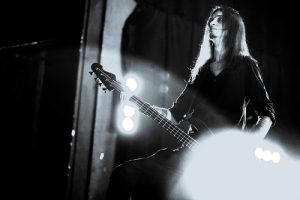
Illia Rafalskyi performing at Quantic, 31 January 2026
© Ștefan Lupașcu
Looking back across your earlier work, is there a song you feel you would approach differently today?
Illia Rafalskyi: It is different with every album.
The first album was not even black metal. It was atmospheric metal, almost ambient music with guitars. Then it evolved.
The third album was closer to that Burzum-type atmospheric black metal, about forests. Later, I started to experiment more, to expand and add new things.
For me, every album is different. I make music only when it is interesting to make. And it is interesting only when there is something new to explore.
I do not want to make the same album twice. Every album taught me something. I experimented with lyrics, style, solo guitars, clean vocals.
It is art. It is not about black metal or not black metal. It is about freedom of creation. I want it to be free from genre borders.
I see. After so many years of working with music, what have you learned about yourself?
Illia Rafalskyi: That I like making music. It is still my passion.
I like discovering new instruments. It is not about how many instruments you can play, but whether it is interesting to play them.
For example, on the track “Вище неба”, which is “Far above the Sky” in English from the album “Vsesvit”, I wanted to use a Ukrainian whistle instrument. I could not play it, so I learned how to play and record it.
It was a fun process. And in the end, I got good results.
I also learned that I am capable of finishing albums. Not abandoning them.
When you start something, you finish it. That is important.
This is one of my mottos, as well, if you start something, you need to try – at least – to finish it.
Illia Rafalskyi: It is very important. Not everyone can do that. It takes patience, time, and work. Sometimes even when you do not want to, you still need to do it.
Once you start working, it becomes fun again.
I have no regrets. There is dedication in it, even if I do not think about it that way. I only know that I want to do it, and I like doing it. So I think I will do it forever.
Your works from Морок, as said, move into different territory. What state of mind guided the lyrics?
Illia Rafalskyi: The meaning is already in the name of the project. It comes from the Ukrainian word for darkness.
It is about darkness, but not physical darkness. It is about the darkness of the world and the darkness of people.
It is intertwined with Ukrainian folklore. Ukrainian folklore has many demonic themes. Sabbaths, witches, dances around fire, sacrifice.
The lyrical themes are metaphysical and metaphorical darkness, and Ukrainian folklore. The darker side of it.
Demons, forest spirits, mountain spirits. I believe these spirits exist among us. They are sleeping somewhere under the mountains.
There are times when they wake up and dance around the fires.
This is such a complex vision!
Illia Rafalskyi: It is. I was always fascinated by these ideas.
You know what? Me too! And I was, recently, fascinated by the idea of you having delivered a live album, from Severoth [“Live in Finland”]. A live album freezes a moment that was never meant to last. What compelled you to preserve this particular performance?
Illia Rafalskyi: Oh, thanks for bringing this out! Playing live is always good for me. I give energy to people, and I receive energy back. It is an exchange. I charge them, and they charge me, like a battery.
The live show in Finland was especially good. Finland is a great country. The sound engineers were very professional, and the people were beautiful.
The atmosphere was strong, and the support was real. It was an enjoyable experience.
Do you expect the same exchange here, in Quantic?
Illia Rafalskyi: Of course.
But people do not give energy just like that. You need to give yours first. I will give one hundred percent.
I am sure I will receive it back.
If there is one thing you would like to bring to a performance here, what would it be?
Illia Rafalskyi: I would like to bring the feeling of standing on the highest mountain.
Far above the sky. Flying over forests like a bird. I want to bring that feeling.
I must say that I also like this country. Of course, we walked a bit today. I am not really a fan of architecture, but Bucharest feels very unique to me.
I have never seen anything like it before. Some places feel almost gothic. There are arches, strange details.
I saw one building where the top looked like it could open a portal to hell. It felt atmospheric.
Maybe it would serve as a place of inspiration, somewhere in time.
Illia Rafalskyi: Yes! Inspiration is everywhere.
You just need to look properly. To notice details. To feel the atmosphere.
I also saw the Romanian mountains from the plane. They were beautiful. I had been many times on the Ukrainian side, but never on the Romanian side.
I hope I will visit one day.
We are more than happy to guest you! But until then, unfortunately, we have to have one more minute for this discussion, so I will simply ask: do you have a message for those who follow and support your work?
Illia Rafalskyi: Great question, once again. First of all, always be yourself.
Never try to follow someone else. Your inner spirit is what makes you unique.
Try to see the beauty of the world around you, even in dark moments. The world is beautiful, and people are beautiful too.
Sometimes you cannot see it. But you have to try.
And to you, special thanks for the time you spent speaking with me. As I said, I have read your review, and I felt we were on the same line. You understood what the latest Severoth album was about.
Thanks!
Illia Rafalskyi: Thank you once more!