Few bands in the metal world command the same sense of grandeur and storytelling as Haggard. Blending the raw power of metal with the intricate beauty of classical and medieval music, Haggard has carved out a sound that’s as unique as it is timeless. Founded in Germany in the early 1990s by Asis Nasseri, the band has evolved into a large ensemble of musicians — from cellists and flutists to drummers and guitarists — all united by a shared passion for epic, historical narratives.
Today, we have the pleasure of speaking with Asis Nasseri, the mastermind behind Haggard’s vision, to dive into the creative world that fuels their majestic compositions, their fusion of genres, and the stories that inspire their unforgettable albums.
DinIntunerec: Hello, thank you for getting on board with this interview. How are you? What have you been doing recently?
Asis Nasseri: Hello and thanks for having this interview with me. I am great so far, recently we were playing a show in Angers/France at Omega Sound Festival and also recording new material.
DinIntunerec: Soon you will play in Romania, headlining East European Rock Alliance, together with Lacrimosa. This marks a return to Romania after a long absence. What kept you away from us for so long? Also, how do you feel about sharing the stage with Lacrimosa, even though on different days?
Asis Nasseri: Yes, this is so awesome! We are very happy to come to Romania again. Finally! As you know Haggard is under great Romanian influence since 2010, which is absolutely awesome. We have and also had musicians from Romania, Catalina (flute), Stefana (oboe), Cosmin (violin/Dirty Shirt), Adela (violoncello). We have been away for a while due to the work of the new material.
I’ve always had deep respects for the music of Tilo Wolff. Even though we never met in person, I saw several interviews of him. I think he is a sympathetic and great guy and definitely an artist who paved the way for so many other bands in the gothic/wave/metal scene.

DinIntunerec: Haggard has always blended classical and metal—how did this unique vision first take shape?
Asis Nasseri: It was looong ago (lol), in 1994, where the first visions of enlarging Haggard came to my mind. In 1995, a piano player named Hans Wolf, an opera singer from Japan, a violin and a violoncello joined us. The style then was progressive metal mixed with classical tunes. We released our Once upon a December’s dawn promo tape. But I felt that there needed to be more classical and symphonic music in Haggard, and a few months later we were 16 musicians. Metal section, soprano, violin, viola, violoncello, oboe, flute, percussion and a few medieval instruments. In 1997 we released the And Thou Shalt Trust The Seer album. I am so happy Hans is still in Haggard, this year is his 30 year anniversary.
DinIntunerec: Looking back, how has your sound evolved from And Thou Shalt Trust… the Seer to your more recent works?
Asis Nasseri: And Thou Shalt Trust The Seer had a bit more medieval/renaissance influences than Awaking the Centuries. Eppur Si Muove got back to these medieval/baroque styles, and Tales of Ithiria was more a widescreen, epic thing. The new album is a bit more intense, but also, again, more into the medieval/renaissance/baroque style.
DinIntunerec: Were there key turning points in your career where you felt the band’s identity shifted?
Asis Nasseri: Of course, when we turned from a 4 musicians band into an 16 people ensemble. But after this, no. We always kept our identity.
DinIntunerec: Each album has a strong historical or philosophical theme—what draws you to these narratives?
Asis Nasseri: I am very interested in historical things. Sometimes I call our style “Histotainment”.
DinIntunerec: Awaking the Centuries focused on Nostradamus. How did you research and approach such a legendary figure?
Asis Nasseri: Nostradamus means multiple persons in one. On the one hand, he was a doctor of medicine, studied in Montpellier/France. The term “doctor”, of course, did not have the same meaning as today. He was into Astronomy, but also Astrology (these two fields were somehow close together in his times). Also, he was not a fan of therapies like bloodletting or mercury treatments. I think he was pretty advanced. On the other hand, there were his centuries. He wrote quatrains with “prophecies”. They were written in a very vague way, so you can interpret a lot into them. In the very end, he is a coin with two sides, but there still is a mystical aura surrounding him.
DinIntunerec: Eppur Si Muove centers on Galileo—what message did you want to convey through his story?
Asis Nasseri: My message with Eppur Si Muove is that knowledge is a precious thing. There were people fighting for it, dying for it. Nothing in this life is for granted. Be grateful for the knowledge we have. I am deeply connected to Italy, it is my love, my passion, the language is music itself, the culture, the history, the food, the old composers, the amazing inventors.
DinIntunerec: Tales of Ithiria broke from history into fantasy. What inspired this change in direction?
Asis Nasseri: I thought it was time to put one of my self-written stories into musical form. I´m still thinking of publishing the story itself.
DinIntunerec: How do you decide which themes or stories are suited to Haggard’s symphonic-metal style?
Asis Nasseri: These themes or stories must enlighten a fire in me. Mostly, I carry the final decision with me a longer time.
DinIntunerec: Do you compose orchestral and metal parts separately, or build them together from the start?
Asis Nasseri: I am a very visual person. Before I compose, I try to imagine the situation/scene before my eyes. How would it look like in a movie? This pushes me. Then, I get a feeling for this current moment that I wish to express musically, and I decide if I start with the classical parts, the metal parts or even the lyrics.
DinIntunerec: Has modern recording technology made your symphonic-metal fusion easier, or do you still prefer traditional approaches?
Asis Nasseri: In the studio, as for the recording equipment, take what is most convenient. Otherwise it wouldn´t make sense. In terms of instruments, I of course prefer real musicians with real instruments.
DinIntunerec: What role does improvisation play in such complex music?
Asis Nasseri: It is great to let your mind flow, improvisation is super important for the creative process, to find variations of melodies etc. By the way, improvisation also was super important in early music a few centuries ago.
DinIntunerec: Haggard features a wide lineup of classical musicians—what’s the biggest challenge of keeping such a large ensemble together?
Asis Nasseri: People play in Haggard because they love to. I do not feel any challenge of keeping Haggard together.
DinIntunerec: How do you maintain balance between the heavy metal foundation and the authenticity of classical instrumentation?
Asis Nasseri: I do not actively balance, it comes when I compose the music, the intensity or sweetness of the music comes through the dramaturgy of the story.
DinIntunerec: Do the members from classical backgrounds approach your music differently than the metal musicians?
Asis Nasseri: No, everybody approaches our music the same, with passion and respect. I know that in general there are musicians of both sides (metal and classical music) who have resentments against the other musical style. When you play in Haggard, you love our style which contains both.
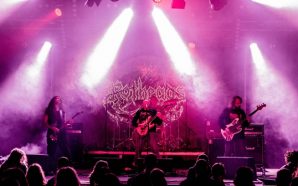
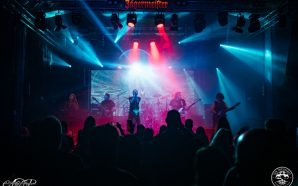
DinIntunerec: Haggard concerts are massive undertakings—how do you translate your complex studio work into live performances?
Asis Nasseri: Mainly there are a few more musicians playing in the studio than when we play live. So, we try to adapt the studio work to the live instruments. Sometimes, lines are taken over by other classical musicians, depending on the situation. We have no playbacks or something like this.
DinIntunerec: Are there particular countries or audiences that resonate especially strongly with your music?
Asis Nasseri: Yes, Latin America (here especially México and Colombia), Turkey and of course Romania are the countries with very crazy Haggard fans. But, there are so much more that support us in an unbelievable way in all parts of the world. China, US, many countries in Europe, and of course in Germany. We are so grateful for this!
DinIntunerec: What’s been the most memorable live moment in your career so far?
Asis Nasseri: I cannot tell, there are so many.
DinIntunerec: Fans have been waiting for new material—can you share updates about upcoming albums or projects?
Asis Nasseri: In short, the reason why it took so long is me. To name a few of the reasons, there were private ones, change of partners and structures, also the pandemic. The release is scheduled for 2026 under my own record label Nattvind Records. I now that fans are craving for it. I cannot thank enough.
DinIntunerec: Looking ahead, where do you see Haggard’s journey going in the next decade?
Asis Nasseri: In the next decade from now, I imagine Haggard being still on stage and playing concerts and having the same fire and passion as in the last 36 years. I will continue with Haggard until my dying day, or at least until the day I stop being physically and mentally capable of doing what makes the fans happy. Music is my life and passion, and I am very grateful that I and we have the possibility to do what we are doing. Music is my motor that drives us, and I hope it will be longer than one decade more. As I said before, nothing in life is for granted.
DinIntunerec: What was the best or worst, an unforgettable incident, a memory that happened while on tour or during a live show?
Asis Nasseri: There are too many good ones, and honestly only a few bad ones. If you live a bad moment you should learn from it and not let it come too close in the future. The good moments I remember nearly every day. For example, over the years, we’ve had quite some marriage proposals on stage. Sometimes I think about them and about how they are today. One of the most amazing things is to be in contact with the fans, e. g. on social media, and then meet them at shows all over the world. During shows I sometimes spot them from stage and I am happy they attended the concert. And after the show we mostly hang around and talk. Awesome!
DinIntunerec: What is the most important life lesson that you have learned so far?
Asis Nasseri: Nothing in life is for granted. Be kind. Be grateful for what you have. Help others.
Support those who have less. Don´t eat animals!
DinIntunerec: Thank you for your time, any final words for our readers?
Asis Nasseri: Love goes out to our fans from Romania during the decades! Thanks for the opportunity of doing this interview, we are happy to come to Romania, so see you soon!!!

DinIntunerec: See you on stage!
As our conversation with Asis Nasseri comes to a close, it’s clear that Haggard’s music is far more than a blend of metal and classical — it’s a bridge between centuries, a dialogue between power and poetry. Nasseri’s passion for history, emotion, and authenticity continues to shape Haggard’s unmistakable sound, reminding us that true art transcends trends and time. Whether through thunderous riffs or haunting symphonic passages, Haggard remains a testament to the beauty of ambition and the enduring spirit of storytelling in music.