Some voices linger long after the sound fades. Ste Ge, the Romanian vocalist behind Apa Sîmbetii and Kistvaen, stands among them. Both projects trace separate routes through the same dusk – Apa Sîmbetii driven by experimental metal with black metal, progressive metal, and jazz influences, and Kistvaen steeped in depressive black metal. While Apa Sîmbetii explores themes of antitheism, existential reflection, and the search for transcendence, Kistvaen presents a stark meditation on human misery.
As both bands have left their mark on me, a conversation about creation, endurance, and the space between silence and expression felt necessary. It took place under the roof of Quantic, in Bucharest, Romania, during QFest Day VI, more precisely on 4 October 2025, when Ste Ge also appeared as a guest vocalist for Hangover in Minsk.
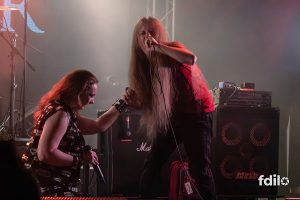
Ste Ge [Apa Sîmbetii, Kistvaen] performing with Hangover in Minsk at Quantic, 4 October 2025
© Florin Diaconescu
Ste Ge: Hi, thanks for having me for this interview, and for starting it with this question.
It’s a long story. I started singing after going to a few rehearsals with friends, which must have been around seventeen years ago. Through them, and my girlfriend back then, I met the mastermind behind Apa Sîmbetii, Mihai Dincă.
We clicked instantly, and he asked me to join the band. We did a couple of rehearsals, and I was basically what they needed. We’ve stuck together since then.
For Kistvaen, I got in touch with another friend of mine who was personally acquainted with the guys from that band. At some point, their vocalist left.
I don’t know exactly how that friend of mine figured out that I could also do black metal vocals, but she recommended me to Fenrir. A few days after that, he contacted me.
I went to a rehearsal to check if they were okay with the type of singing I could do, and they liked it. The rest is history, as they say.
Very interesting! Let’s tackle both musical projects separately, as each deserves its own moment to shine. Turning to Apa Sîmbetii, which evolved from Smoke and Ash and Unmade – how did that journey shape the band’s sound and identity?
Ste Ge: I had only been with the band for a short while before we decided to change the name a third and final time, so I can’t comment on the years before that point.
For the rest, I can say that perception and intent can change a lot as time passes. We were more or less “children” who had quite diverse musical tastes but bonded over the idea of bizarre and complex compositions, of polyrhythms, of sonic experimentation.
We went through quite a few phases and styles [as our early songs no doubt show], members came and went, ideas were implemented or discarded, all adding to what would eventually become the Apa Sîmbetii of today.
In the end, we settled on an identity we all would have wanted to pursue, with the notion that we could, maybe, bring something interesting to the metal scene.
I see. The name “Apa Sîmbetii” means “Down the Drain”. What does this concept mean to you in the context of your music?
Ste Ge: We wanted to choose a name that would easily connect the band to its country of origin, inspired at the time by one of our favourite bands, Negura Bunget. On top of the local mytho-folkloric significance, existential nihilism has always been a part of our music and had to somehow be reflected in the name, as well.
Looking back at “Nihil Sapient”, released in 2013 – what was the vision for that record, and how do you feel it holds up today?
Ste Ge: I don’t think we had a particular objective for the record, other than just collecting what we thought were our best works.
Composition-wise, I’d place “Nihil Sapient” somewhere at the beginning of the band’s stylistic transition, as it has tracks which come close to our last known vision [“Primitive Future”, “Nihil Sapient”] as well as songs which were written back when we were trying out different things. Naturally, that means there’s quite a leap in terms of sound [quality and otherwise, especially since the album was remastered in 2017] but I personally don’t hold any strong negative opinions about it. On the contrary, I look back fondly on all our past experiences and how they shaped who we are today.
The aforementioned album itself reads like a scathing commentary on humanity’s arrogance and self-destruction. Was this written from a purely philosophical standpoint or from personal frustration?
Ste Ge: The latter. It’s safe to say that most [if not all] of the philosophical themes in our music have been approached through the lens of our personal experiences at the time. Opinions may have changed since, but we never touched upon a subject without at least partially agreeing with it.
What the “Moon Brings”, from “Nihil Sapient”, described a surreal and almost transcendental experience of separation from reality. How did this song take shape and what drew you to this theme?
Ste Ge: I cannot speak of the thought process behind the creation of the track, as it was not I who wrote the lyrics or the music. But I can talk a bit about the track itself.
“What the Moon Brings” was our second “love song”, built over a jazz-heavy instrumental, with lyrics inspired by H.P. Lovecraft’s short story of the same name.
I see. Time to dissect a bit “Imortalistul”, your second album, released in 2019. It feels heavier and more visceral than “Nihil Sapient”. How did the writing process differ between the two albums?
Ste Ge: With the changes in our surroundings and the passing of years, we gained a clearer vision of what we wanted to achieve, further developed the skills to support it, and came upon extremely talented people who could assist us. “Imortalistul”, structurally, was 90% where we wanted Apa Sîmbetii to be.
“Demiurgul cel Rau” introduces a cosmic, almost gnostic darkness – the image of a malevolent demiurge waiting in the shadows. What inspired this track, and how does it tie into the album’s larger themes?
Ste Ge: “Demiurgul cel Rau” was inspired by two of the most prominent themes in our lyrics: antitheism and Emil Cioran’s philosophical pessimism. These concepts are echoed throughout several other songs on the album, yet stand in strong antithesis to the title track, which puts forth the idea that humanity must transcend its physical form, for the soul is immortal.
That’s quite compelling. As much as I’d like to dive deeper into this, time is limited, and I’d like to touch on Kistvaen as well. You joined the band in 2012, two years before the release of “Desolate Ways”. Speaking of that, what was the inspiration behind the album?
Ste Ge: It was more or less throwing our struggles out there – mine personally, and what I learned from the other band members. It’s a presentation of human misery, so to speak, if I were to summarise it.
Why human misery? Why choose that theme?
Ste Ge: Music is an outlet for a lot of us. That’s how the band perceives the world around us. That’s why we adopted this genre. You don’t just come and play this kind of music if you haven’t had these experiences – these lived experiences – behind you.
Talking a bit more about Kistvaen, “Morningstar” from the album “Desolate Ways” invokes powerful imagery of rebellion, enlightenment, and the breaking of spiritual chains. What drew you to these concepts, and what do they represent to you, personally?
Ste Ge: In an amusing coincidence, “Morningstar” was the result of lyrics I had already written, which happened to perfectly match the song’s mood and structure. Its themes deeply resonate with me and serve as loose guidelines on my path through life.
There’s a clear undercurrent of defiance and spiritual liberation in “Morningstar”. Do you see it as a personal manifesto, a critique of religion, or something more symbolic?
Ste Ge: In my opinion, the message, clear as it may seem, is ultimately too reductive to be seen as a true manifesto. The critique of religion is certainly there, but the real meaning behind the track can only be understood by one familiar with the symbolism used. Or perhaps by simply unconsciously immersing yourself in the composition.
“The Deepest Cut” from the very same album, shifts from cosmic rebellion to intimate pain and isolation. What was the state of mind when Kistvaen wrote it?
Ste Ge: It’s been so long that I cannot recall the exact circumstances. But it would be safe to assume that, at least in my case, the lyrics of each song reflect the frame of mind I was in or deliberately stepped into when they were written.
Talking a bit about your influences. When you joined Kistvaen, were you inspired by acts like Shining, Psychonaut 4, or Lifelover?
Ste Ge: When I joined them, I was very interested in Shining. And yes, we had a collaboration with them. We did a cover for the second album, and I worked with Shining when they came to play during the second album launch. My band mates also had a song with Niklas on the first album, but we never actually played it together, unfortunately.
Now that you’ve brought up the collaboration with Shining, I have to ask – how did it come about?
Ste Ge: I don’t fully remember – maybe through their manager or through Doru, the man behind Dark Bombastic Evening. They got in touch, and we did the cover. Fenrir kept in contact with Niklas. We sent him the track – he liked it. We proposed they headline the second album launch concert, and Niklas agreed.
That collaboration marked a key moment for Kistvaen, no doubt about it. Years later, you found yourself in a similar space of creative connection, this time stepping on stage with Hangover in Minsk for a guest appearance. What can you tell our readers about this one?

Ste Ge [Apa Sîmbetii, Kistvaen] performing with Hangover in Minsk at Quantic, 4 October 2025
© Florin Diaconescu
I, too, have been listening to them since they first appeared with Dymna Lotva. Very good act. Now, changing a bit the registry, you’ve been a part of Romania’s depressive/post-black scene for years. How has the scene changed since you got yourself into this realm?
Ste Ge: Our country, I think, has always dabbled in black metal, pure or otherwise blended with various genres. We’ve also consistently had bands which I’d consider either depressive, DSBM-adjacent or having post-black metal leanings: Sigismund, Man Among Stars, Fogland’s “Scholomance”, Katharos XIII, even some early Argus Megere. Some of them disappeared but others carried on and were joined by projects such as Kultika, Autumn, Leaves, Scars, Váthos, Gerrar, Pâenil Era, Sylvanshine, Kult of Dead, even the random Bacovia with “A Potrait Made of Stars”.
We’ve routinely done well in this regard and should be seeing even greater improvements, as gear, technology and software become more accessible and thus, more widespread.
Indeed, I’ve listened to some of the bands you’ve mentioned – for some, there was, and for others, there still is, a lot going on in their music. And here’s a question you might not be asked very often – how does solitude shape your approach to music and performance?
Ste Ge: It’s not always the case, but I tend to prefer isolation and silence when writing. The same goes for music, as I greatly dislike being interrupted when listening to a newly released album or trying to dissect a particular song. None of these, however, have any bearing on performance.
Do you consider your music a form of personal therapy, a philosophical statement, or both?
Ste Ge: Both. Music allows me to unwind while also serving as a conduit through which we share our passions, ideas, and sorrows with whomever is willing to partake.
Finally, do you see your music as a reflection of who you are now, or as an exploration of who you could become?
Ste Ge: I like to believe that every word I’ve written or song I’ve sung has, at one point, been a part of who I was. Some have loosened their grip, others have buried themselves deeper. To what end and for how much longer? I do not know.
Many thanks for having me and for such thoughtful questions!
Thank you for your time, Ste Ge!