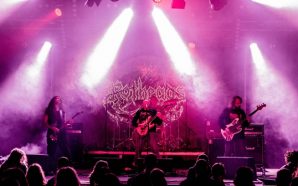
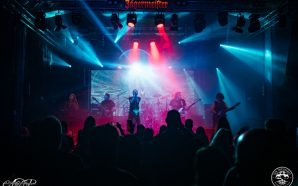
Steffen Kummerer carved his path through the German underground in the early 2000s with his progressive/technical death metal band Obscura. Yet not one to remain in a single lane, he also gave life to Thulcandra, exploring melodic black metal while maintaining a distinct identity. Two bands, different approaches, and a long road ahead. Across the years, Steffen has toured internationally, refined his approach to composition, and created music that is both intricate and deeply personal.
With his return to Bucharest, Romania, for Obscura’s concert on 18 September 2025 at Quantic Club, Steffen opened up about his musical background, the challenges of those early years, the milestones achieved, the albums crafted, and collaborations along the way – from working with Fredrik Nordström at Studio Fredman, to artwork contributions by Timo Wuerz, Ulrich Landau, and Eliran Kantor. He elaborated as follows.
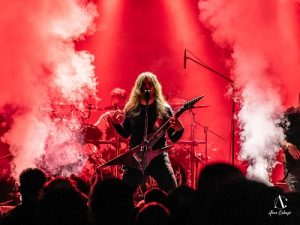
Obscura performing at Quantic Club, 18 September 2025
© Anca Coleașă
Hello, Steffen, and thank you for taking the time to speak with me today. First of all, how are you feeling?
Steffen Kummerer: Hi! I’m doing fine. We are in the first week of our Evenfall European Tour, and this time, we are focusing on Southern and Eastern Europe.
So, it was meant to be a return to Romania, as well as to your neighbours – Bulgaria. It’s been really cool so far. The turnouts are great, and people are happy.
We’re playing a special setlist on this tour. We’re presenting our new album, “A Sonication”, and the vibe has been splendid. Tonight, we have Bucharest. Now, we’re sitting down for this interview for which I am very thankful… The sun is shining today – what more could you want?
Very glad you are feeling great here! Let’s begin with you, Steffen – you’ve proven to be a very talented and driven musician. Could you tell me how your musical journey started?
Steffen Kummerer: I started playing piano and singing, and I attended a boarding school for many years where, well, you’re trained to sing in a choir, so you pick up a bit of knowledge about music theory.
But that was from the age of nine to twelve or thirteen, and I realised quite quickly that with a piano you can really rock out. When I was a teenager, I dived into black, death, and thrash metal. At sixteen, I just bought a guitar and started from scratch.
That was cool. I think it’s the same story for everyone – as soon as you discover this kind of music and it hits you, you just want to make your own songs, your own albums, everything, and that’s how it started.
Half a year after I picked up the guitar, we founded Obscura. So this is still my first band. Everything you see, from the first demo to where we are now, is exactly the story of myself and all the other guys evolving as musicians.
Fascinating. Did you have a mentor – a band or a particular artist – who drew you into this world?
Steffen Kummerer: I would say, when I started playing guitar, it was Chuck Schuldiner, from Death. He was just amazing, and the songs from Death are cool, technically demanding, yet still melodic.
In fact, it’s not just technical but also memorable, and that combination still attracts me today. Aside from death metal groups, some black metal bands have been a big part of my influences too – bands like Dissection, maybe Children of Bodom, stuff like that. Basically, all the music we grew up with. When I was 14 or 15, all my friends were listening to Death, and of course you share things with each other, and that shapes your style.
Nowadays, how much time do you dedicate to your passion?
Steffen Kummerer: Nowadays, how much time do I dedicate to my passion? Well, I’m a full-time musician. But I still don’t really see it as a job.
It’s a huge passion that has also become my job, so to speak. I love travelling, visiting other countries, playing music, and sharing the stage with different bands. On this tour, for example, we have a band from Greece, Suicidal Angels, a band from Italy, Sadist, and a whole international crew with us.
All of this is just amazing. And, of course, playing music in front of people who’ve probably never seen you before – that’s incredible. I just love what I do.
To sum it up, that’s it: I dedicate as much time as I can to my passion – because no matter how many hours you spend on something, if you love what you do, that’s what truly matters.
Beautifully put into words. That passion clearly drives everything you do, and that commitment seems to carry over into every aspect of your music. Speaking of which, let’s delve into your songwriting, especially the lyrics. Your words often explore vast and profound concepts, from the mysteries of space to philosophical ideas. What drew you to these themes?
Steffen Kummerer: When I was about 17 or 18 – and we started writing slightly more serious music – we thought about adding authentic lyrics. Of course, there were bands like Cannibal Corpse – they write about rotting corpses, splitting heads and breaking bones. But we didn’t feel comfortable with that – we weren’t really into horror movies or anything like that. At the time, I was more into reading philosophers, studying engineering, maths – all the myth behind it. Somehow that just fed into the lyrics.
To keep things a little less abstract, I also added personal stories and ideas. But the lyrics have shifted over time. The first five albums we did were very abstract because – to be honest – I’m not a native speaker of English.
I struggled with the language. If you can’t easily express yourself in small, precise details, you tend to be more abstract. Now I’m more confident with the language – so I can break things down better.
The last two albums still follow the same outlines – a bit of philosophy, a bit of astrophysics, some space, some religion – but they’ve become more and more personal. Again, with more confidence in the language, it works much better.
And I think it also comes with growing up – you go through certain experiences, and you want to express them.
Steffen Kummerer: Indeed. That was a very nice question, thank you for that!
Glad it touched you. Since we’re speaking about the albums – how was it to compose “Retribution”, your very first album, released in the early 2000s?
Steffen Kummerer: Oh, another great question! That was actually completely different to today. When we started as teenagers, we had a rehearsal room – and we even had to renovate it ourselves.
It was kind of fun. It was in an old youth centre in our hometown. Back then it was really tough to get a room because there were so many bands and every hour was already blocked and booked.
So they told us, “Well, there’s the old cinema”. It was completely purple, super dark, and you could hardly see anything. We were given a room and a tiny budget, and we basically painted the entire place ourselves.
We ripped out all the old furniture – and you have to remember, we were only 16 or 17 at the time. So it wasn’t really an adventure – more of an experience, something that showed us that if you work hard, you can achieve something. And when you’re 17 and you rebuild a whole space into a rehearsal room, it’s really cool – it feels like something to be proud of.
In that rehearsal room, we met once or twice a week – usually on Wednesdays and Fridays – and we just rehearsed. The entire first album was created in that space. Then I bought a cassette recorder with four channels and recorded everything.
But at the time, you couldn’t edit. Unlike today, there was no cut, copy and paste – like in Cubase, where you record a riff once and copy it ten times. Back then, you had to play everything straight through.
If you made a mistake in the last part of an eight-minute song, you had to start again from scratch. But that was how it was – and I enjoyed it very much.
I still have the tapes at home.
I can see why it would mean so much on a personal level.
Steffen Kummerer: I just want to keep it, you know – it’s a tiny souvenir from back in the day. I don’t have the tape recorder anymore.
I got rid of that, but I still kept the tapes. The entire album was written, I think, in 2003 or early 2004, and it was released in 2004.
Then it got re-released twice. But the very first release was in 2004, and it has a special meaning to me.
It’s like your first child. And you know what they say – the first one is always the one that stays closest to your heart. You remember every little detail, every struggle, every small victory.
Steffen Kummerer: Yes, yes! This is precisely why that album will always have that special place for me.
What did you hope to achieve with it?
Steffen Kummerer: Oh, we didn’t really have a plan – we just hoped to release an album with our own music and play a couple of shows. What we learned quite early on is that nobody gives you anything.
People may help you, but you have to work very hard on your own. Even with the first demo, we organised our own tours. Imagine: 16 or 17-year-old kids saying, “Okay, nobody wants to book us – then we’ll do it ourselves.”
We organised national tours we called “Blasting Bavaria Tours” – that’s a Land in southern Germany, but you already know that, since you’ve told me before starting the interview you’re not only a journalist, but a geographer too. We even started inviting other bands. In total, there were four bands, and each one organised a show. Everyone played in every city, so it became a proper tour. That turned out really cool, because it was like a community – sharing gear, sharing fun, sharing drinks, learning how it all works. Then we did the same with the debut album.
When we released our debut, no label was interested in it. So again – we did it ourselves, DIY. We started looking into tours – nobody wanted us – so we did it on our own. We invited Suffocation and booked an entire European tour. That was our first international experience.
And then we did another one in 2007. We worked together with a band from Bosnia and Herzegovina, and we booked more than 20 shows – from Greece to France, and all the Balkan cities in between.
Our biggest experience at that time.
Bold of you to do that!
Steffen Kummerer: Yeah, that was one bold move.
We just wanted to make things happen, and we found like-minded people. That was really, really cool. And that actually stayed with us up until today. We still have friends from back then who will show up tonight – which is amazing.
It really is a good community. That’s why I love this part of the environment, so to speak.
Couldn’t agree more. It really is a good community. Remaining on the topic of your debut album for just one more question… The artwork for “Retribution” fits the atmosphere of the album perfectly. At what point did you realise that this specific artwork was the right visual to represent the record?
Steffen Kummerer: I was looking for an artist who didn’t only do death metal covers. That’s when I found an illustrator – also a book cover illustrator, who went by the name of Timo Wuerz. Great individual!
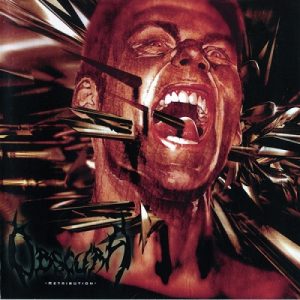
The official cover artwork for “Retribution”
© Timo Wuerz
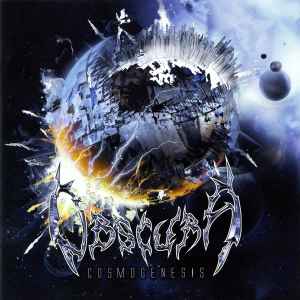
The official cover artwork for “Cosmogenesis”
© Timo Wuerz
He had done artwork for comics and was quite a versatile person. He actually did two covers: the first for “Retribution”, and another for our second album, “Cosmogenesis”.
When we signed to Relapse Records, we started working with different people, but the idea of a series continued. For the first album, I think we just sent him all the lyrics we had, and he came up with the artwork. We also showed him a few reference pieces, I think from Suffocation’s “Pierced From Within”. I believe that’s why you see all those nails – but presented in a more abstract, futuristic way.
That was over 20 years ago now, but if I remember correctly, I still have the original artworks at home, including those on the CDs. I’ve kept most other artworks as well, even from other bands we’ve worked with – many oil-painted pieces.
I collect all of this; I have quite a big archive. My entire apartment is full of memorabilia and souvenirs – just so I don’t forget.
I love that you’ve held onto all of this – it really shows your dedication and connection to your music. Given the fact you mentioned your second album, released in 2009, tell me – what changed when you started recording that?
Steffen Kummerer: Well, there are actually five years between the first album and the second.
We learned so much during that time. After releasing the first album, we started touring internationally, taking things a bit more seriously, playing more shows, and also wanting to record differently. In between, we had a few line-up changes, and the technique and gear we used changed completely.
I’d say half of the second album was still written in the rehearsal room. But then we started working with Guitar Pro – like sheet music. I’m not sure if you’re familiar with it, but it’s basically a way to write music in tablature or standard notation. That helped us a lot with working on tempos.
The first album was kind of loose when it came to tempo changes, whereas the second album was much more thought out, because we had to bridge writing music in the rehearsal room with recording in the studio.
The process became: write all the music in the rehearsal room, notate it, let it rest a bit, and then work on chord progressions and details. That made a big difference. The second album really blends the best of both worlds – the spontaneous ideas from the rehearsal room and the careful thought you can put into music when working alone at home at your desk.
I think that’s what made the record quite unique. A lot of people liked it, and we still listen to it now – which is good.
It’s a really solid piece of work. One track that really stuck with me is “Desolate Spheres” – I’d call it a masterpiece. What inspired the imaginary world you were aiming to create there?
Steffen Kummerer: “Desolate Spheres” actually has a few different versions. There’s some live footage out there from before the line-up changed to the recording line-up at the time.
The drum beats were completely different, but the riffing was entirely inspired by Chuck Schuldiner and Death. Over the years – the song is fairly old and had been around a couple of years before we started recording it – we kept changing it.
We worked on it in the rehearsal room, adjusted the beats, tweaked the tempos, everything. The song has quite a history. But how it ended up on the record? It was way more brutal than it was originally meant to be.
If I remember correctly, the first edition didn’t have any blast beats. The second version altered that a bit. The riffs stayed the same, but the rhythmic approach changed a lot.
Some people prefer the first version, some the recorded version. For me, it’s the same song. And I think it is a pretty good one. We had a lot of fun working on it. Good times. Thank you for asking me that, it’s great to bring those memories into the conversation.
Thank you, too, for the detailed answer. Jumping ahead to “A Valediction”, from the year 2021, what was your goal with it? Even though the early days were pretty spontaneous, by then you were already grown-ups with focus and intent.
Steffen Kummerer: Oh, I can tell you quite a lot about that album. “A Valediction” is actually a big turning point for the band.
Before that, we released five albums for Relapse Records. And if you just lean back and look at those five albums, we had the same engineer, same producer, used the same studio, worked with the same label – Relapse Records – and collaborated with the same artwork creator, Orion Landau.
It was a closed cycle, so to say.
Then, with the new one, we signed to a new label, Nuclear Blast Records. We started working with Eliran Kantor for the artwork, began working abroad for the first time, recorded with Fredrik Nordström at Studio Fredman, in Sweden, among other things. So it was basically a big turning point. At the same time, though, we kept the band’s whole identity.
The idea was to be a little more human and relatable. The productions before were very clear, but for my taste, they had become a little too polished. I like to keep the essence of the musicians. I don’t want things too rigid or overproduced. Same with the artworks – the composition itself is similar.
We always have that sphere in the centre on all the records. But with Eliran Kantor, there’s a bit more of a human approach. He still combines different techniques, and it feels more handmade. The first impression is that isn’t photoshopped – it’s like, “Oh wow, that’s a piece of handmade art!”
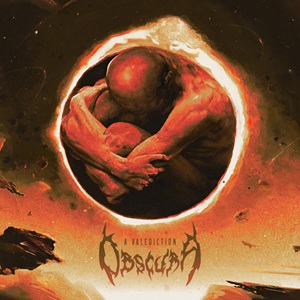
The official cover artwork for “A Valediction”
© Eliran Kantor
The same goes for the production. Fredrik Nordström produces very intuitively. He’s unbelievable. He has so much experience – he’s seen so many big bands, small bands going their way. I really like his productions because they’re timeless. He’s not trying to put a production on top of a band’s sound; it’s more the opposite. He tries to dismantle the identity of every band. That’s really cool.
With “A Valediction”, it was basically a farewell to everything that had happened, but also something positive to look forward to. So it’s very much a turning point. The album turned out really cool, opened many doors, and was very successful. It still is. Up to today, we play a few songs from that record – which is brilliant.
Out of all the songs on “A Valediction”, which one is the dearest to you?
Steffen Kummerer: Hmmm, I think the opening track, “Forsaken”.
Why did you choose that one?
Steffen Kummerer: Because it’s a storytelling song. It has so many turns and points, but at the same time, there’s a strong chorus that always brings you back. You can enjoy it even if you don’t play an instrument. I like those ideas that sit somewhere in between.
If you just want to listen to a cool metal band on stage, with presence, it works. But if you play guitar yourself, there’s also so much to explore.
So I just like that approach – that it’s attractive for all kinds of minds. And especially this song, with the acoustic guitars, the dynamics, the clean sound, and the different vibes in between.
I mean, you have the jazzy fusion middle part, the big heavy metal climax at the very end, and it starts and ends with the same acoustic melody. I really like that.
It’s a seven-minute, whatever, long song, but it feels like three minutes.
This is when you really like something – time feels precious for real. Moving to your latest creation, “A Sonication”, released this year, I’m just curious for those who haven’t had the chance to listen to it: how would you describe the album in one sentence?
Steffen Kummerer: Within the Obscura discography, this might be the most introverted album.
It’s very melodic and has a different production approach.
It’s not as clean as usual – it’s more like a wall of sound. If you listen on headphones, there’s so much to explore, there are so many hidden layers.
And it’s definitely the album with the most personal approach of all.
Why? Can you detail that?
Steffen Kummerer: Lyrics, first of all, but also the state of mind. Every album somehow reflects where you are as a human being, as a character in a certain state.
When we recorded the first two, we were kids – we didn’t think about anything. Now I’m 40. I think about much more, and that also blends into the music. There’s a certain vibe.
Even if you don’t read the lyrics or understand English, it doesn’t matter. If you just listen to the record, there’s a certain feeling in your gut. That really transcribes the record.
What inspired the track “Evenfall”, from the aforementioned album?
Steffen Kummerer: That’s a very good question. You see, on “A Valediction”, we had Björn Strid from Soilwork as a guest singer.
The idea was to have one special singer on each of the three albums we were going to record for Nuclear Blast Records. I actually wrote this song especially for Peter Tägtgren.
He was supposed to be on the album as a guest singer, but he had a last-minute commitment – a live festival production or something – so he couldn’t do it. I had to do it myself.
That’s why this song leans more into Swedish death metal or Hypocrisy. I wanted to blend that with all the vocoder sounds we’ve been using for 15–20 years, and I think it turned out really well. On the album it’s nice, but live it’s even better – one of the fan favourites on this tour. It is… a really cool song. You can just cheer along, sing along…
There are some references to “The Sound of Perseverance”, yes, but that is because I like that track very much. I think that’s a great song. It’s a little more demanding because it’s faster.
“Evenfall” has the power to really stir the crowd, but do you feel there’s another song in your setlist that has an even greater impact live?
Steffen Kummerer: Yes. I think the best live song we’ve played so far is the opening track, “Silver Linings”. That just works so well. People like it, and to be honest, it’s also fun to play on stage.
Intriguing. Staying with the recent material – and I know we’ve already discussed artworks quite a bit, but bear with me for one more question. I follow your YouTube channel, and at one point you mentioned that the artwork for “A Sonification” is, in a way, a continuation of “A Valediction”. Could you expand on that for the magazine readers?
Steffen Kummerer: That’s actually the idea of Eliran Kantor. He put out a lovely video where he explained the concept in full.
So basically, if you see the main character of the artwork, you have the sound, the headphones, and the belly button. Music can move people a lot. And here we are back at the multi-level lyrical approach – because if you just see the headphones and belly button, it’s more like a personal thing.
Sometimes you wake up and have a terrible day, but if you listen to the right music, it can turn your mood around. Music can move you. But from a physical or engineering point of view, “sonication” means moving things physically with air waves or sound waves, so to speak.
So both intentions are packed into the same picture, and that’s quite philosophical. I really like that idea. It’s pretty much a continuation of the double meaning of “A Valediction”, where you also have this poetic idea of being connected but disconnected at the same time.
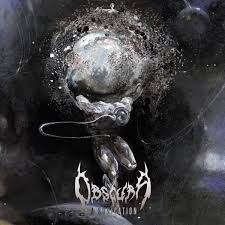
The official cover artwork for “A Sonification”
© Eliran Kantor
That’s such a rich and layered concept – both poetic and grounded in something physical. I really like how it ties back to your earlier work while opening new dimensions. Speaking of dimensions, let’s move from the visual to the stage: you played in Cluj-Napoca just yesterday. How was that experience for you?
Steffen Kummerer: Cool! There was a special venue, built into the football stadium. Hmmm, I don’t remember playing in a football stadium before. Another new thing to add to my list of experiences, I suppose.
People were super nice to us – fans and crew alike. As a band, you always see much more than just what happens in the venue, and that was great. It was our first time in that city, I think. For most of the bands too, maybe Suicidal Angels played there, but all of us felt very welcome.
The show was cool. Lots of people enjoyed it. We also talked to a couple of very young fans who showed up with their dad. They drove six hours from the far eastern part of Romania. They were so happy to see the band, and that’s awesome!
Oh, that’s some real devotion – six hours on the road just to catch the show. It says a lot about the bond your music creates. And now, shifting from Cluj-Napoca to Bucharest, tonight you’re playing at Quantic Club. How do you see the venue?
Steffen Kummerer: I’ve been here before. I think at least once, maybe even twice. Last time was in 2020. I’ve played Bucharest a few times. Once in Arenele Romane, with Death to All, in 2016, and probably even earlier at some point.
But the last time was 2020, and the venue is improving all the time. If you visit the same city or venue every couple of years, you notice the progress.
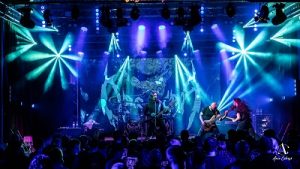
Obscura performing at Quantic Club, 18 September 2025
© Anca Coleașă
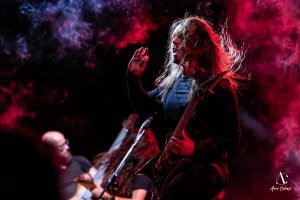
Obscura performing at Quantic Club, 18 September 2025
© Anca Coleașă
People here are wonderful, and the place itself has a great reputation. You get little things like food, a warm coffee, a smile – everyone’s happy.
It is also very big, and it has more of a festival feeling, with outside seating and friends who have moved to Bucharest, plus regular visitors just coming for shows or the beer garden. It’s a nice downtown spot.
I also walked around a little earlier – one university is nearby.
Yeah, the National University of Science and Technology “Politehnica” Bucharest. There is also Cotroceni Palace nearby.
Steffen Kummerer: Yes, and a nice botanical garden. Beautiful area.
What are your hopes for tonight?
Steffen Kummerer: The last time we played Romania, it was super loud. Of course, I hope for the same tonight. It’s September – not sure if all students are back yet.
Hmmm, some of them are already here.
Steffen Kummerer: Great! I see that everyone inside the venue is happy. I think it’ll be a full venue, and a really good show. We’ll see how it turns out. We’ll stay a little longer – leave around 3 a.m. Hopefully, we can hang out with a couple of friends and see how the night goes.
Why not? It will be a warm night, perfect for discussions and sharing some ale. But before you engage in those talks with the crowd, let us open one more topic – namely, Thulcandra.
Steffen Kummerer: Oh, my other project. You did quite a lot of research. I am impressed.
Actually, I was listening to your music long before I even knew I would have the opportunity to interview you. What led you to start a second project? It seems quite different from Obscura.
Steffen Kummerer: It is quite different from Obscura, that is true.
Both bands are almost the same age. We founded Obscura in 2002, and Thulcandra in 2003 – more or less with the same people. When we started, everyone in the band wanted to add their ideas.
But we were so mixed: a black metal guy, a thrash metal dude, one more into death metal, another a prog head. We had to find our own style.
All of us grew up with black metal – especially the Swedish scene, early to mid-90s: Dissection, Sacramentum, Marduk. That had a big influence. We decided to separate. One band turned into a more proggy, technical project, while the other one kept its sound.
I love both styles. I haven’t played in other bands. This is the only thing I’ve done for over 20 years, and I love both.
The difference is, aside from music, Obscura is a full-time professional band. Thulcandra is more selective – the other three members have regular jobs and kids. So it’s not a touring band. If Thulcandra tours, it might be once in five years. I like the balance. I don’t need anything else. I’m super happy with both projects, and it’s still fun after all these years.
Compared to Obscura, what is the most demanding or challenging aspect of the second project? Apart from the members having families, and regular jobs.
Steffen Kummerer: Actually, there’s nothing challenging, apart from that. It’s just fun and a different approach. The gear is similar, but there’s a bit more of a rock’n’roll approach – which is kind of cool. Different people, great music, great vibes. I love it.
I really enjoy hanging out with all these people – not only the band but also the crew, and I really love traveling, rehearsal rooms, show dates.
That sounds like a very healthy balance. Since you clearly enjoy both worlds – the full-time dedication of Obscura and the more selective, rock’n’roll approach of Thulcandra – what do you see coming next for each band?
Steffen Kummerer: A strong question. With Obscura, we just released a new album, in February, this year, and this is tour number three, out of many, many more. We are going to tour until 2028.
And Thulcandra just finished many shows. A month ago we were in Brazil, in January we did a very, very small European tour, and in July we played in Asia for the first time. So I think it’s time for a new album with Thulcandra, followed by more concerts next year. But for Obscura, the plan is to add more shows in Latin America, the United States, and Scandinavia.
Nice. Can you give me a sneak peek into the new Thulcandra album?
Steffen Kummerer: We’re still at the very beginning, just collecting ideas. But the general idea is to add a little bit more heavy metal – especially the twin harmonies, which everyone in the band is enjoying at the moment. They also translate really well live. That detail sets us apart from many other black metal bands. A lot of black metal is melodic, but those twin harmonies you hear from Iron Maiden or Judas Priest are much rarer, so we’re trying to incorporate that more.
During this conversation, you’ve mentioned quite a lot of bands. Now I’m curious – I suppose you still keep in touch with new releases. If you were to recommend at least one album you’ve listened to recently – whether in death metal, progressive metal or black metal – which one would it be?
Steffen Kummerer: The bands I’m listening to at the moment are Lik from Sweden, which is a fantastic band in the old-school Swedish death metal, and Between the Buried and Me, the American progressive metalcore group. Then there’s Yoth Iria, a band from Greece I discovered about a year ago through some friends – really cool. And the new record from The Haunted is fantastic, absolutely brilliant Swedish melodic death metal.
So, to answer your question: “Necro”, from Lik, “The Blue Nowhere”, from Between the Buried and Me, “Infernium”, from Yoth Iria, and Darkest Oath, and “Songs of Last Resort” by The Haunted.
Nice picks! As time runs short, do you have a message for everyone who follows your journey – whether they’ve been with you from the start or are just discovering your music?
Steffen Kummerer: Absolutely. I just want to say thank you to everyone who’s been following us. It’s incredible to know that what we do resonates with people in so many different places. For those we’ve played for, it’s amazing to share the energy live. And for those we haven’t had the chance to reach yet, I hope we can meet you one day, whether on tour, at a festival, or even just through the music itself. Every connection counts, and that’s really what keeps us going.
And on a personal note, thank you for this lovely conversation. It was really enjoyable – made me think, made me smile, and it didn’t feel rigid at all. It was more like a proper chat than a traditional, scripted interview, which I really appreciated. Thank you!
See you on stage!