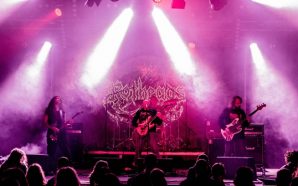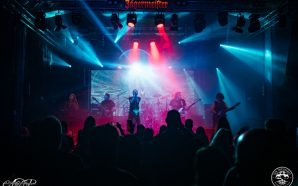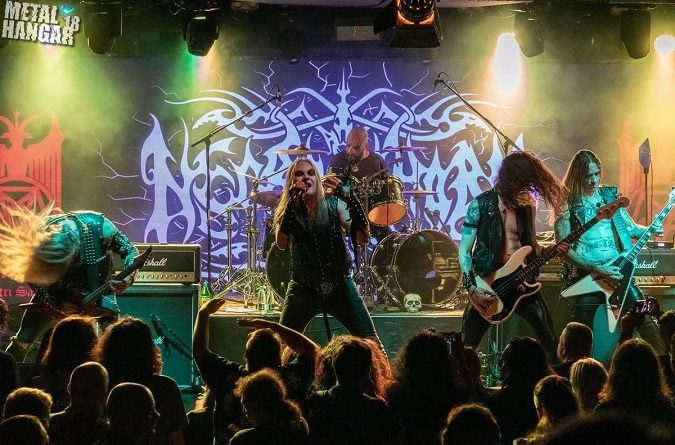
With a longstanding career spanning over 35 years, the Swedish iconic blackened death metal band Necrophobic headlined the last day of Metal Gates Festival. The occasion was perfect, so we grabbed the chance and invited the band’s bass player, Tobias Cristiansson, to sit an interview. Dismember and Grave‘s former bass player, Tobias spoke about Necrophobic‘s recent album, the creation process, but also his life experiences as an artist and his commitment to music.
DinIntunerec: Hello, welcome to Bucharest. Thank you for taking your time to be here with us and to answer my questions. Also congratulations for the amazing new album. Necrophobic has been active since 1989… How do you maintain the relevance and the freshness of your music after 35 years of existence, while still staying true to your roots?
Tobias Cristiansson: That’s a good question because not every band can last for more than 30 years. It’s quite remarkable, I think. You need to have a lot of dedication because over that long period of time it goes up and down. Members come and go. Things are happening in your personal life. A lot of the guys have children. It can be hard to maintain focus. So I think you need to always try to look forward to the next thing and try to always improve yourself a little bit while also staying true to your roots. Like you said, you need to have a foundation to stay on musically and artistically.
I think it takes dedication and devotion. I don’t know if there’s a specific recipe for that.
You also need to get along well as a group because if there’s too much tension people don’t get along and in the end somebody will leave. When that happened with Necrophobic, of course members have left and things have been happening. In such a long period of time it would take a miracle not to be any change. People change over years. Everybody changes. It’s natural development maybe. Somebody who was dedicated earlier, might lose the interest. Especially when having family… It can bring your attention to other sides of your life, which is natural. Even musical taste and orientation can change.
DinIntunerec: In the Twilight Grey is the band’s tenth full-length album. In what way has the creative process evolved over the years and what influenced its direction?
Tobias Cristiansson: I think this album (compared to the previous ones) is maybe a little bit more epic, more grandiose. The songs have more epic structures. Yet, it’s pretty much the same style as it was before so it’s not a drastic change. It’s just small changes in that aspect. And the inspiration comes the same as always. You have your background influences. Everybody in this band grew up in the 80s. A lot of heavy metal stuff came out back then. Iron Maiden, Dio, Ozzy Osbourne, all that. Combine that with the death metal roots when Necrophobic started (the early death metal scene of the late 80s). Also, the style has pretty much developed to a style of our own.
Necrophobic has a unique style which combines the melodic parts with more straightforward death or black metal. So, I think it has evolved to a formula where you can really hear that this is Necrophobic style of music. So, we’re still continuing on that path. It’s not necessary to fix something if it’s not broken. Except for the very early releases when the band was trying to find its form it has been pretty much like a set way of writing the music. There are some changes from album to album, but not radical ones. The new album is more epic, I think.
DinIntunerec: The album’s artwork is intriguing. Can you speak about its symbolism and the way it conveys the concepts in the album?
Tobias Cristiansson: This time we didn’t want to have a painting. So, this one is based on photography. We have a photographer called Jens Rydén. He’s also the singer of a band called Thyrfing. He’s doing our promotion photos and everything. We asked him if he had a photo that we could use and he showed us some different photos. The original one is a photo of a lady with a dress but we wanted to change it a little bit to make it more grim. Along the way we gave him different directions… for example this person has chains that look like thrown out. That idea came from Dio‘s album Holy Diver where there are chains.
At the end of the chain there is this hourglass, which represents life… As life is running out like that hourglass. Then we added some more stuff in the background that wasn’t there in the original photo… some crosses in the background and some birds flying. I think the main symbolism connects to this person who looks like the death figure which has the hourglass that represents life that is slowly running away.
DinIntunerec: There is an interesting mix of different styles from blackened death metal, to atmospheric, with melodic touches. How did you balance the dark atmosphere and the brutality when you created this album?
Tobias Cristiansson: It comes from the influences of all the members of the band: melodic music in general, heavy metal and more melodic black metal maybe. So, you take an element and you put that on top of death or black metal. It creates this sound. I think Necrophobic is not pure black metal and it’s not pure death metal either. It’s like a combination of the two. That is what we’ve created.
The typical sound of Necrophobic is blackened death metal. So, you put those two ingredients together and there you have it.
DinIntunerec: How does the title In The Twilight Gray reflect the themes developed in the album?
Tobias Cristiansson: The title comes from one of the songs. I’m not the one responsible for the lyrics so I can’t really say. I don’t know what it is about really.
DinIntunerec: Who is responsible with the lyrics?
Tobias Cristiansson: Mainly Sebastian, the guitar player, and the singer. On this album, Sebastian made most of the lyrics.
Dinntunerec: But, there is a song on the album which is based on a poem. I think I read this somewhere…
Tobias Cristiansson: That’s correct.
DinIntunerec: Two songs of the latest release caught my attention both in terms of composition and lyrics. I’m talking about Clavis Inferni and Stormcrow. Can you speak about these songs a little bit?
Tobias Cristiansson: Actually, I started writing Clavis Inferni… I came up with a lot of the ideas for the music. I made a couple of demos before we started the process on the album and I sent them to Sebastian and he continued to work on those ideas. On that particular track we wanted to have more straightforward old school thrash-death metal vibe. It’s more double bass drum which makes it more aggressive.
DinIntunerec: I really like that track. It’s really cool. That’s why I’m asking about it.
Tobias Cristiansson: It’s nice to hear that. It’s cool, because some of my riffs are in there and it is always nice when you hear the final product. I started out writing at home and it’s very simple but then you continue to build on it… It’s nice to hear the final product came out really cool. Unfortunately we haven’t played that one live yet. I don’t know if we will.
DinIntunerec: So, you’re not playing this song tonight?
Tobias Cristiansson: Not that one. Unfortunately, not. About Stormcrow… well, Sebastian did that one. He created it as more of a straightforward song. It’s one of the shortest songs on the album. That one is not specifically epic like I told you some of the songs are. It’s more like a straightforward song. So when that one was finished we felt like this could be a good first single from the album. So, we chose that as the first song that would come out to promote the album and we also made a video. It’s made by a guy called Claudio Marino, a Swedish guy who has been working with Marduk.
I think he also did a documentary about Nergal of Behemoth, that came out a few years ago. He’s really good and he never likes to work with effects on the computer. He creates everything on spot. You just added light, but then everything else you build up from scratch basically, which is cool. So it’s more like you create it with your own hands. We went to an abandoned house in the forest basically. Somebody had lived in that house before, so there were traces of a man who had lived there and put up weird stuff on the wall. Everything was like really bizarre in there. So, it was a cool environment to film a video in.
DinIntunerec: How was the band in its early days? Can you tell us some things about how the band came about? I mean as far as you were told…
Tobias Cristiansson: Well, as you know, I wasn’t there from the beginning so I don’t really know much… It was created by Joakim Sterner, the drummer, and the guitar player at that time, David Parland who later called himself Black Moon. They started the band. They were friends from school and they had shared a common interest in music and wanted to play. They started out like kids do, you know, just jamming along and trying to come up with song ideas… and later evolved to a band. I think from the start it was just the two of them.
DinIntunerec: When did you join?
Tobias Cristiansson: I’m the latest guy in the band… I was first a replacement bass player and then I joined officially some years ago. Before Necrophobic I played with Grave and even before I played with Dismember… I’ve been playing with lots of bands and I was live member for a few others… So I’m new in Necrophobic, but I’ve been around for some time with other bands.
DinIntunerec: How does the creation process work with Necrophobic? Do you create the music together or do you work individually, or maybe the guitarists work together and then share with the rest of the band? How does it work?
Tobias Cristiansson: We work individually first. I make a demo of ideas, riffs and stuff and I send it to the others. I know Johan, the other guitarist also did a bunch of riffs and send them. Sebastian is the main composer… He puts everything together. He uses some of our ideas and creates something from that. When the structure is ready, then we talk about it, if we want to change anything… But he’s really good, so we rarely change much from the original idea he’s constructing. That’s how we do it because nowadays it’s harder to meet up, sit together and jam… Because of people’s family commitments and full-time day jobs it’s hard to find time. I don’t live with somebody, so I guess I have the most time to devote to music but the other guys have kids.
DinIntunerec: What inspires you to create music?
Tobias Cristiansson: Well, it can be when I hear a song or a specific drum beat and then I want to see if I can do something on that… Mainly it’s due to other stuff that I listen to that makes me want to see if I can come up with something. So, everything starts from the music I listen to.
DinIntunerec: Does it start with sound or does it start with a feeling? Which builds later in sounds…
Tobias Cristiansson: It’s just basically that I sit down with a guitar. Most of the times when I write it’s on an acoustic guitar for some reason. So it doesn’t sound at all like it does in the final product so I just try out some ideas or see what comes up first. Most of the times I move on but sometimes I find something that I can use.
DinIntunerec: Can you name an album that you believe is the most representative for Necrophobic. Can you explain why?
Tobias Cristiansson: I think the latest one is very representative, it has all the elements that Necrophobic has. Also, an older album came out I think in 2006 called Hrimthursum with a blueish cover that is iconic. I wasn’t in the band back then but I remember when it was released it was like a new push for the band. Because in the early 2000s, generally for death metal, there were not very good years. I don’t know a lot of bands to release much music at that time… But then, in the mid 2000s, things were starting to happen again and Necrophobic released that Hrimthursum album which gave them a new kick. That album is representative for the band. We always play a few songs from that album live.
DinIntunerec: What makes you feel more excited working on new music or playing live?
Tobias Cristiansson: Playing live, definitely, that’s what I love the most in my whole life. I don’t have any other interests that I devote to I don’t have a family with kids, so playing live is my passion, totally. I really love being here, seeing new places, even though it’s raining today so I can’t go out. Otherwise, I like to see a little bit of the city where I am.
DinIntunerec: Apart from music do you have any hobbies?
Tobias Cristiansson: No, not really. I’m interested in history, let’s say. I like to listen to history podcasts and stuff or maybe watch a documentary about some historical events., I’ve gone through different phases of different historical times but I don’t have any other hobby I don’t like to go fishing and stuff. I don’t know, I work out a little bit, but it’s not a hobby of mine it’s just something I do to stay healthy and be in shape.
DinIntunerec: You mentioned something about having regular jobs. What line of work are you into?
Tobias Cristiansson: I work with handicapped people, like taking care of handicapped people in wheelchairs and persons in need I’ve been doing that for many, many years now. It’s a different thing. It’s another side of me. It’s a big contrast to being on stage… But I think it’s good to have those contrasts in life.
DinIntunerec: Let’s take a step back and look into your past. Can you walk us through some of the defining moments that shaped you as an artist until this point? I don’t mean necessarily with Necrophobic… Also with all the other bands. What are the main things that shaped you into what you are today?
Tobias Cristiansson: I started playing when I was around 14, 15. I played covers with friends. Then, when I got a little bit older, I wanted to improve my playing. So, I started taking lessons and I learned how to read music. A few years later I went to a music school in Stockholm and I was a full-time music student. I was pretty good at reading music… I haven’t done that since then and I kind of lost it. After that, I’ve just been playing around in Stockholm in different bands… Different styles of music as well.
But then, one thing that changed my musical career was when I had the opportunity to join Dismember.
I was 26 at that time. I remember I did the audition and I thought it went not so good, but they called me a few days later and said, ‘you’re in and next time you come here bring your passport because we’re going to Australia‘. I was shocked. I’ve just been playing small gigs in Stockholm and now I was to go on tour in Australia in just one and a half months. I got a big list of songs I had to learn and I was kind of stressed. It was tough but also very nice and after that we started touring all the time… I recorded music and I was quite busy with Dismember so that was a defining step. Since I played with that band, it helped me to get contacts…
That’s why I’m here basically, because Dismember opened my career path… We ended the band in 2011, then I started playing with Grave also doing a lot of touring. I got to know the guys from Necrophobic because I met them when going to concerts, so they knew who I was and later, when they needed a bass player ( first as a temporary replacement) they asked me and I accepted. Now I’m a member of this band.
Dinntunerec: What were the main obstacles that Necrophobic had to overcome all this time?
Tobias Cristiansson: I think member changes in the beginning, especially since the main songwriter, David Parland left in 1996. So then the main composer of the band was not there anymore… That must have been quite a difficult thing, but then Sebastian joined the band and then he stepped in, starting to write. Another thing was when Necrophobic lost their previous vocalist. His name is Tobias just like my name… There was a lot of turbulence going on there… I don’t want to go into that too much, but he was left out from the band I think in 2017 or something like that and then Anders came back. He’s the guy who sang on the first album. So, he came back to the band…
But Tobias had been singing since 1996 I think so he was the frontman and it’s always difficult to replace a frontman. Anyway, since Anders was the original vocalist from the first album, he had a foundation from the beginning in the band, which made the transition kind of smooth, instead of replacing Tobias with a new face. It was more like a comeback, actually, and since then the band has been taking off which is nice.
DinIntunerec: Have you ever been tempted to quit?
Tobias Cristiansson: No, not in any of my bands. I’m very dedicated to what I do and I love doing this. It’s like my most precious thing in life, so I never thought of that. Of course, even if you like music and touring, it’s also about the personal chemistry in a band which is super important because you travel as a group you stay at the same hotel… It’s a lot of time that you spend together. If things don’t work out fine, it’s unbearable. If somebody in the band is behaving in a way that you don’t like it can affect the whole atmosphere.
DinIntunerec: Was the band perceived differently in the past? Let’s say… in the beginning. I’m referring more to the past generations, you know, people that are our age now.
Tobias Cristiansson: I think luckily for Necrophobic, the band has gained new audience since around 2018. So, there’s a lot of younger people who like the newer records which are maybe their favorite albums. Which is kind of cool for a band that’s been around for such a long time because some bands are praised only for the first two or three albums and then… Some people even though they were there from the beginning like the new stuff as well.
DinIntunerec: Can you share a special moment a special interaction with fans? Something that made an impact on you on a personal level?
Tobias Cristiansson: Of course! My first experiences are definitely the ones that have stuck with me the most. My first experience with bigger events was with Dismember. We did a lot of things for the first time together. I went to the United States with Dismember for the first time, and I visited a lot of countries.
With Necrophobic I also did some cool stuff that stands out. For example, two years ago, we played in Turkey, in Istanbul, at a festival. The festival was located on the beach by the ocean, so it was a really nice setting. From the stage, you had a crowd, but behind them was the beach and the ocean. It was so beautiful when it got dark; you could see a ship on the horizon. The crowd in Turkey was fantastic; it was really cool. Afterwards, we needed to have bodyguards because they were totally maniac! That was an exciting experience.
Playing in South America was always fantastic; I loved that. The people there are very passionate. This year, Necrophobic played in April—first in Mexico, then we went to Colombia. Playing there is always special. People wait for you at the airport, often with gifts. Somehow, they figure out which flight you’re on and come to the airport to greet you. It’s really nice and very special.
DinIntunerec: What would you say is the most interesting or unusual reaction you’ve had from fans?
Tobias Cristiansson: Hmm, I need to go through my memory bank. For me, it’s weird when I meet someone who is nervous to meet me because I don’t understand how they can see me as a big star. It’s strange when someone is shaking, or visibly nervous. I think to myself, that I’m not that important. I don’t see myself that way. Sometimes, people get emotional, and it can be due to their own psychological perspective. Some people are introverts, and for them, meeting someone they value—like a band member from a band they admire—can be a big deal.
DinIntunerec: How do you see the underground metal scene nowadays? Apart from quantity, do you think there’s quality too?
Tobias Cristiansson: There is quantity for sure, because nowadays, it’s easier for a band to release something on platforms like Spotify. When I started listening to extreme metal or death metal, you could listen to every band that released an album, and those albums were probably good. Back in the early ’90s, there weren’t that many bands around, and the albums that came out were quality stuff. Today, there are just too many bands. However, I think at least in Sweden, there’s a good young generation that really likes extreme metal music. There’s this small club that hosts gigs every weekend, giving a lot of young bands the opportunity to play there, which inspires other kids. It’s nice to see a group of 18- to 20-year-olds going to shows. Metal is not dead—absolutely not! That’s encouraging.
Let’s hope they don’t all try to copy Lorna Shore, which is what many bands are doing nowadays. Actually, there are some pretty cool bands from Sweden, like Eternal Evil, which plays more of a death-thrash, early Kreator style. They are really good musicians too. It’s hard to be original these days unless you want to be Lorna Shore, but they already exist, and then there will be copies of them, which can be boring. It’s super difficult to be original.
DinIntunerec: What is the most important life lesson that you’ve learned so far?
Tobias Cristiansson: That’s a big question! I think it’s very important to treat people well and with good manners. If I have a good attitude, I will probably receive the same back. This lesson comes from my parents: to have a positive attitude and treat people nicely. Respect is crucial. Everyone is different in their own way, and you need to respect that.
DinIntunerec: Is there anything regarding your musical career that you wish you had done differently? Not necessarily something you regret, but perhaps something you have seen with different eyes later on?
Tobias Cristiansson: I wish I had practiced more when I started out—absolutely. When I started, I remember I was around 15, and I went to a music school teacher and asked him to teach me how to play bass. He wanted me to play House of the Rising Sun or some other track. At the time, I thought it was so boring. I thought, “Forget that! I want to play Slayer!” So, I didn’t go back for any more lessons. But now, in hindsight, I wish I had started taking lessons earlier. It took me until I was about 20 before I started to take lessons… because I wanted to get better. At that time, I was a little more open-minded; maybe I could have learned something from playing House of the Rising Sun. But back then, I was stubborn.
DinÎntunerec: With all the touring you’ve done, what was the most exciting band you’ve toured with?
Tobias Cristiansson: I remember when I was new in Grave, we did a lot of touring, mostly headlining tours with opening bands. When I joined Grave, we had a tour with Obituary, and they were a band I admired during my teenage years. So, when I first stepped on the tour bus and thought, “I’m going to spend five weeks with these guys,”. It was amazing. They were so down-to-earth—no rock star attitudes at all. It was nice to hang out with them. At that time, the guitar player was Ralph Santolla, who unfortunately passed away. I got to know him during those weeks, and we even hung out a lot in Stockholm after the tour. Meeting a band I had only seen in videos as a teenager and having them treat me like a normal person was a wonderful experience.
DinIntunerec: If you were to go on tour again, what three bands would you most like to tour with?
Tobias Cristiansson: Wow! If I had to choose, I’d want a good tour package. I can’t choose bands that I like, like Deep Purple or Whitesnake; it wouldn’t be a good match, and people would walk away if we started to play! I remember a few years back, we were offered a tour that we didn’t take, but it was with Abbath and Watain. I think that would have made for a good mix—Abbath being a big name in the scene and Watain having a lot of respect. I also think Necrophobic would have fit well in that tour package. Unfortunately, it didn’t happen, and I can’t recall why.
DinIntunerec: Thank you for your time! Any final words for our readers?
Tobias Cristiansson: I’m always impressed when people want to check out new music, just like you do. If you have that drive, it’s very good for the scene. Always checking out new releases doesn’t even have to mean new bands, but at least being interested in music is important. For those who do that, I have a lot of respect. Keep on doing it!