In every life, there comes a moment when certain words can no longer be withheld, not out of revenge, nor in pursuit of justice, but because silence itself begins to corrode what remains unspoken. For the French black metal group Malhkebre, that moment surfaced in 2002. What followed was not a matter of choice, but of necessity.
Malhkebre did not linger in hesitation. By 2004, that inner pressure had already taken form in the demo “In His Name”, a first manifestation of something that had been gathering weight beneath the surface. The years that followed marked a steady unfolding: 2006 and 2009 brought forth an EP and a split, each release sharpening intent rather than dispersing it.
The tension did not subside. It accumulated, layer upon layer, until 2014, 2019, 2023, and 2025 bore witness to a succession of works that did not merely extend the band’s trajectory, but reinforced its core. Each release stood as further confirmation that Malhkebre do not operate within the confines of progression for its own sake, but through an ongoing necessity to give form to what refuses to remain contained.
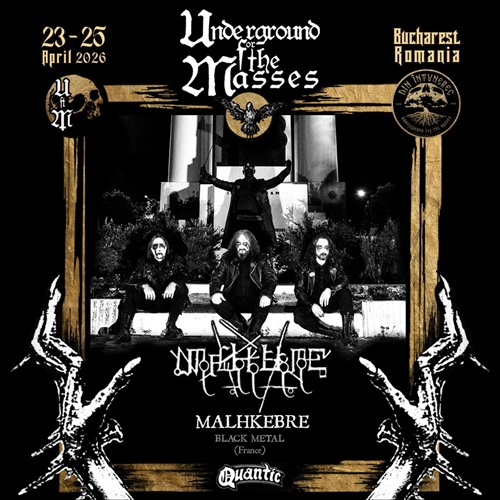
That same necessity now turns towards the stage of Underground for the Masses III, set within the walls of Quantic in Bucharest, Romania, where it will assert itself.
As they state it plainly:
“This is where black metal still lives. Events like this remind us that black metal still exists beyond trends and superficial consumption. Not as entertainment, but as necessity. That is why we will be there.”
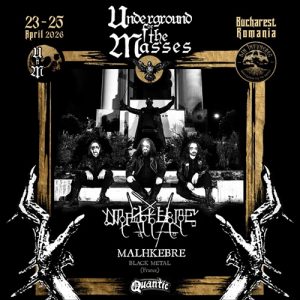
Where necessity screams… Malhkebre at Underground for the Masses III, Quantic, Bucharest, Romania
© Anca Kivart
And with only a few weeks remaining until Malhkebre take the stage live, I deemed it only fitting to sit down with the band for a conversation.
Well met, and thank you for your time. Before delving into your discography and the path it traces, let me ask you this: when a pact is yet unspoken and no note has been struck, what stirs within you at the threshold of creation?
Malhkebre: Before anything exists, there is tension. Something that must be expressed or it turns against you. MALHKEBRE was never a choice, it was a necessity. The pact is not made at the moment of creation, it already exists. We only give it form.
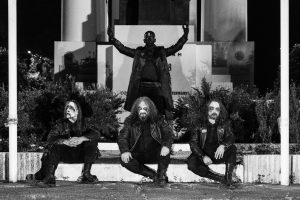
Malhkebre
© Julia Andy
Your first demo, “In His Name” [2004], laid the foundation for Malhkebre’s dark intent. Looking back, was this a declaration, or the emergence of something that had been quietly festering?
Malhkebre: Emergence. We released something that had been growing in silence. No strategy, no positioning, just the need to make it. It was an eruption. Something that had been growing silently for years finally found a way to manifest.
At that time, we did not think in terms of positioning or message; we acted because we had to. Looking back, it was already fully aligned with what MALHKEBRE would become: no compromise, no calculation, only the need to express something that could not remain contained.
On the EP “Prostration” [2006], the music bows to ritual and hatred alike. Did the structure of the songs arise naturally, or was it imposed to serve a greater design?
Malhkebre: When the intent is strong enough, the structure follows. What you hear is not constructed, it is revealed.
The 2009 split “The Truth Through Salt” channels confrontation and provocation. Was collaboration a source of refinement, or a spark that ignited unforeseen chaos?
Malhkebre: Collaboration could bring both, and it was the case. Confrontation always brings clarity. Either you stand firm, or you disappear. We stood firm. Collaboration is always a confrontation. It forces you to stand your ground or to collapse.
In this case, it reinforced our identity. There was no dilution, no compromise. If anything, it sharpened our edges. Chaos is always present, but it is a necessary element; without it, there is no tension, and without tension, there is no black metal.
“Revelation” [2014] stands as a turning point in your work. When shaping it, did you move with clear intent, or did the record reveal its own design as it unfolded?
Malhkebre: Both. We moved forward with direction, and the album revealed more than we initially saw. It was a turning point where instinct and intent aligned.
The full-length “Satanic Resistance” from 2019 stands firm in its purpose. Would you say that this record consolidates your vision, or did it drive you further into harsher ground?
Malhkebre: Consolidation of our foundations. Escalation in our expression. Less introspection, more assertion. It consolidated our foundations, the refusal of compromise, the faith, the direction, but it also pushed us into a more confrontational stance. A statement, not a question.
The demo “B.A.M.N.” [2023] brims with impending violence. When writing it, did you focus on structure, atmosphere, or the immediacy of raw expression?
Malhkebre: Immediacy, always. Everything else comes after. If the core is not alive, nothing matters. The urge to come back and to reboot correctly. “B.A.M.N.” was written in a state where control is secondary. It had to be direct, almost instinctive. There was no room for hesitation.
And “B.A.M.N.” is about to become a full-length soon enough. 30 April 2026. Can you describe the atmosphere you intend to summon, and the emotional terrain you wish the listener to traverse?
Malhkebre: “B.A.M.N.” is the embodiment of endurance and resurgence. It carries the weight of everything we have been through since “Satanic Resistance”. It is darker, heavier, more grounded, but also more resolute. The listener is not invited to observe, but to endure. It is not about escape, it is about confrontation, with oneself and with the world.
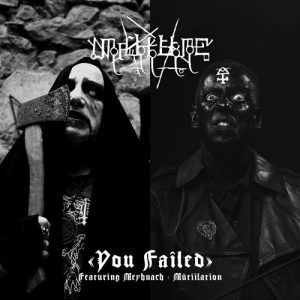
Malhkebre and Meyhnach working on “You Failed”
© The members’ archive
The collaboration with Meyhnach of Mütiilation on “You Failed” draws from three decades of shared ground, conflict, and endurance. When shaping this track, did you approach it as a reckoning with the past, or as a declaration aimed squarely at the present?
Malhkebre: Present. The past is only useful if it sharpens the present. This track is not nostalgia, it is a statement.
Remaining on the topic of “You Failed”, I must remark that it carries a message stripped to accusation and verdict. In giving voice to that sentence, were you driven more by memory of those who stood against you, or by the necessity to mark, once and for all, who remains?
Malhkebre: Necessity. Memory can fade or distort, but necessity does not. There comes a point where things must be said, not for revenge or even for justice, but because silence becomes a form of weakness.
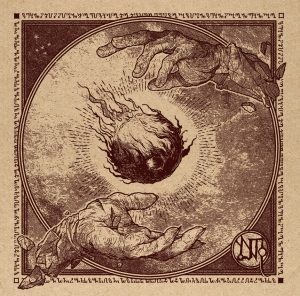
The official cover artwork for “To Those Who Forged Us”
© Roy de Rat
Going a bit back, because I feel compelled to speak about the EP “To Those Who Forged Us” from 2025. It appears as an offering to the past and a signal to the future. How do you balance homage with innovation in your compositions?
Malhkebre: No opposition. Without roots, there is nothing to build. This was not nostalgia, it was recognition. To move forward, you must know where you come from. This EP was a pause, a moment of recognition. Not a step backward, but a grounding.
Album artwork often carries a symbolic heft. Across your releases, do these images guide the music, echo it, or exist as their own unrelenting statement?
Malhkebre: It is part of the same entity; sound and image serve the same intention. Different forms, same source. The Almighty everywhere.
Malhkebre’s themes delve into Satanism, faith, self-mutilation, worship, and hatred. Do these subjects arise as reflections of inner struggle, a commentary on society, or both simultaneously?
Malhkebre: Both. There is no separation. The world shapes the individual, and the individual reflects the world. Our themes come from that collision under His will.
Live appearances have long been a proving ground in black metal, where intent is laid bare before an audience. When you take the stage, do you approach it as an act of confrontation, communion, or something that defies both?
Malhkebre: All of it. The stage is confrontation with the outside, and communion with those who understand. Something real happens there, something that does not exist elsewhere. Those who have been touched by His grace know.
Underground for the Masses III, set within the walls of Quantic in Bucharest, Romania, gathers those who still seek this music with purpose rather than habit. What are your thoughts on stepping onto this stage?
Malhkebre: This is where black metal still lives. Events like this remind us that black metal still exists beyond trends and superficial consumption. Not as entertainment, but as necessity. That is why we will be there.
In the French black metal scene, do you see the community as a sanctuary, a proving ground, or a theatre for philosophical confrontation?
Malhkebre: A battlefield. Nothing else. As on all battlefields, you have allies and enemies. You endure or you disappear.
When the lights dim and the echoes fade, what question or thought returns to you most persistently about the music you create and the audience it touches?
Malhkebre: Was it true?