20–21 February 2026 was set in stone for Rift of Hades. The second edition of the festival organised by Romanian Thrash Metal Club once again took place at Quantic in Bucharest, Romania, thawing the audience both literally and figuratively. Heavy metal was delivered by the book, death and thrash metal stirred constant movement, black metal demanded unrelenting headbanging, while blasphemy found its tongue even through doom metal. Old friends crossed paths again on this occasion, some right at the festival’s threshold, others deep within the churn of the mosh pit. New alliances were forged, and the generous merchandise stands became unavoidable stops along the way.

Official event poster
© Official Romanian Thrash Metal Club
Day I: When the Gates of Hades Were Unbarred
At 17:00, Hades saw fit to unbar his gates for mortals. Or rather, Romanian Thrash Metal Club ordained the moment, guided by seasoned instinct rather than divine whim. They appointed as their opening heralds Teufelsmaul, an ambitious Romanian act rooted in death metal and grindcore, a band that never misses the chance to prove that passion for music runs thick in their veins.
Teufelsmaul are not the kind of group to scatter their story across every available surface. On the contrary, they prefer to let their compositions speak on their behalf. And, judging by what unfolded on 20 February, they relish delivering those messages from the stage.
They possess their own way of asserting dominance before the crowd and provoking immediate reaction. This is not music built for stillness, no matter how hard one might try. The guys opened the second edition of the festival in precisely the manner it required.
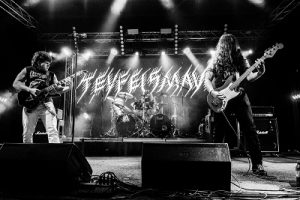
Teufelsmaul opening the event, 20 February 2026
© Ștefan Lupașcu
Such a beginning demanded a continuation of equal resolve. And Sons of Hades approached the task with due seriousness.
It did not take the Greeks long to draw us into their thematic domain, drawing heavily from their recent album [2025] “Tombs of the Blind Dead” [spin it at home, too, you won’t regret it!]. What stands out in their case is the way they braid black and speed metal into a single current, but beyond this, there is also that hunger to savour every moment spent on stage. They spoke to the crowd, unsettled the masses, and kept the exchange alive throughout.
A clear mark in their favour came from the vocal performance, forceful, sharp-edged, and delivered with the kind of conviction that leaves little room for doubt. Everything about their presence suggested intent.
I was glad to finally catch them live, and should another opportunity arise in the near future, I would not hesitate to return.
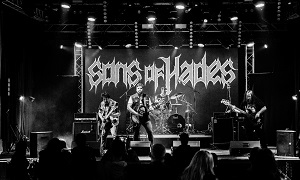
Sons of Hades performing at Quantic, 20 February 2026
© Ștefan Lupașcu
After a brief spell spent gravitating around the merchandise stands, it was time to meet Terravore. Our neighbours from Bulgaria brought forth a strain of thrash metal anchored in themes of apocalypse, war, violence, politics, science fiction, torture, and life’s persistent struggles. A discography of respectable depth allowed them to move freely across their catalogue, binding past and present into a coherent live narrative.
On stage, they shifted seamlessly between moods, at times recalling vintage Metallica, only to erupt moments later into flashes reminiscent of Kreator. Yet it was those venomous vocals that propelled the band beyond mere homage, nudging them into black-thrash and even death-thrash territory. I applaud the guys for the mix of extremity and melody, a balance that kept the set fluid, dynamic, and constantly alert.
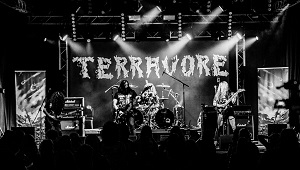
Terravore going through their set, 20 February 2026
© Ștefan Lupașcu
Equally deserving of applause was the performance delivered by Visteria, who followed immediately after Terravore. Hailing from Poland, with a modest discography but ambitious designs, they set out to demonstrate precisely how Polish speed metal ought to be played, adding a sharp punk undertone to the formula.
Each track they unleashed felt like a creature with its own temperament, driven by direct messages of excess, decay, defiance, and vengeance. Stories of blurred vision, nights drowned in alcohol, reckless abandon, betrayal, and the hunger for retribution collided in a barrage that left little room for indifference.
Their vocalist embodied that turmoil fully: energetic, resolute, and relentless in her determination to bridge the gap between stage and floor. She coaxed the hesitant forward and compelled those already near the barricade to raise their voices alongside hers. It was the kind of mid-bill performance you never knew you needed, yet would have sorely missed had it not been there.
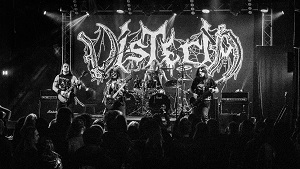
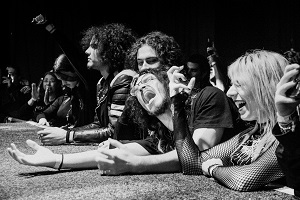
Visteria agitating the masses, 20 February 2026
© Ștefan Lupașcu
From there, the path led inevitably to Avenger. They set foot on Romanian soil for the first time after forty-four years of uninterrupted devotion, a span of persistence that stands as a feat worthy of respect.
Loyal to the spirit of the New Wave of British Heavy Metal, the English veterans made no effort to hide their enthusiasm at finally standing before a Romanian crowd.
With carefully chosen tracks drawn from the records that shaped their legacy, they offered everything they still carry within them.
Communication with the audience never faltered, and by the closing moments, they had rekindled that distinct sense that NWOBHM remains not only alive, but steadily growing in cohesion. Warfare, life, and struggle unfolded in their own particular register.
I found myself wishing for more, already certain that I would welcome their return with open arms.
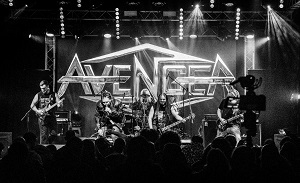
Avenger performing for the first time in Romania, 20 February 2026
© Ștefan Lupașcu
After Avenger further stoked the embers left glowing by those before them, the time came for Dead Congregation. I had long known that the Greeks excel at devastation, so seeing their name fixed upon the Rift of Hades II bill brought with it a keen sense of anticipation. Death, darkness, blasphemy, Satan, destruction: these are not mere motifs when their name is spoken, but living components of their craft.
There was something deeply personal in witnessing that force unfold at such close range. The vocal delivery cut through the hall with austere authority, while the instrumental work surged beneath it, dense and merciless, particularly during “Teeth into Red”, from “Graves of the Archangels” [2008].
From the first note to the final decay, I remained pressed against the barrier, unwilling to relinquish a single second. I could not have done otherwise.
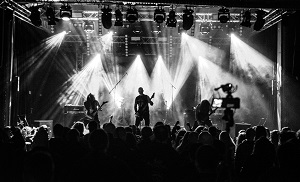
Dead Congregation closing the first night of Rift of Hades II, 20 February 2026
© Ștefan Lupașcu
Day II: Deeper into the Rift
As with the first day of the festival, the second began under a local banner, with Diavol stepping forward to set the tone. Several friends had already marked them as essential listening, so I set off early towards Quantic to catch the full set. It proved a wise decision.
Diavol fuse black and thrash metal into a tense, volatile compound, disciplined in structure yet feral in intent. Their catalogue may be lean, but what exists is carefully honed, each piece flowing naturally into the next, forming a compact and coherent whole. There was purpose in every passage, and no wasted breath.
The band clearly relished their time on stage, unleashing the heavy artillery from the opening moments and pressing forward until the crowd could no longer remain still.
A special mention belongs to the drummer, whose work was faultless throughout the set. I even remarked to a friend that he does not merely play the drums, he lives for them.

Diavol kicking off the second day of RIft of Hades II, 21 February 2026
© Ștefan Lupașcu
Both the audience and I lingered a while longer within the black and thrash metal sphere, as the next act to take the stage were Brüdny Skürwiel.
The Poles wasted no time in laying bare their purpose, drawing heavily from “Silesian Bastards” [2024] and delivering a sound as coarse, abrasive, and blasphemous as their name suggests.
There was nothing veiled in their message, nor in their approach: direct confrontation, sonic filth, and a wilful embrace of excess. The crowd answered in kind, feeding off the band’s provocation, while the band pushed back with equal fervour.
It was chaotic, confrontational, and thoroughly alive. In short, it left a mark.
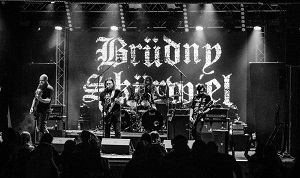
Brüdny Skürwiel spreading their “Fuck Christ” messages, 21 February 2026
© Ștefan Lupașcu
From there, the passage led naturally towards Witchtower. From open defiance, we turned the wheel of time, and crossed into darker territories, with the help of the Spaniards.
Their heavy metal arrived at precisely the right moment, delivered with measured authority.
Drawing from a more substantial discography, built around witchcraft, and inner struggles, Witchtower chose their material with care, shaping a set built on momentum rather than ornament.
The vocals cut through cleanly, while the instrumentation pressed forward with controlled force, holding everything together without slipping into disorder.
Nothing was wasted, nothing overstretched. It was a performance that stood on precision and cohesion, and it carried both to the end. Witchtower were visibly at ease on a Romanian stage, whether in front of long-time followers or those only now discovering them. The enthusiasm was present from the opening moments to the closing notes, as was the clear wish to return before too much time had passed.
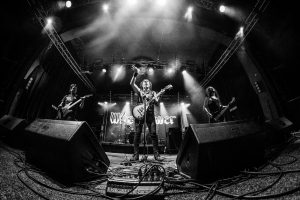
Witchtower performing at Quantic, 21 February 2026
© Ștefan Lupașcu
Angel of Damnation followed, and with them the landscape shifted yet again. The Germans brought forth a doom metal steeped in Satanism, blasphemy, and tragedy, tinged with heavy metal accents, and delivered it with such force that drifting towards the front of the stage felt inevitable.
Their discography, generous in scope, allowed them to sculpt a set that showcased both depth and range, each selected track granting space for individual prowess to surface. Guitars carved slow, deliberate lines, the rhythm section anchored the weight, and the vocals carried a sombre authority that bound everything together. There was gravity to their presence, a sense that each note had been weighed before being released.
And beyond all this, there was another element that elevated their performance: the frontman’s humour. The final track was set to be a lengthy one, and he wasted no time in making light of that fact, easing the wait with dry remarks and a knowing grin. Technical issues were present too, but rather than fracture the moment, they became part of it. He handled the delay with composure, filling the pause with wit, keeping the exchange alive, and allowing the audience a glimpse beyond the stern façade. It mattered. It reshaped the atmosphere. For such moments, nothing short of full respect is due.
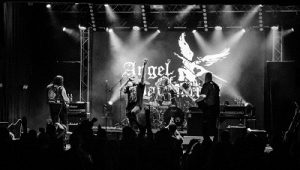
Angel of Damnation on the Romanian stage, 21 February 2026
© Ștefan Lupașcu
And the night was far from over. Mere minutes later, Denial of God stepped onto the stage, assured, composed, and carrying themselves with the kind of poise earned through long familiarity with chaos. It did not take the Danes long to adapt to Quantic’s layout and draw the audience towards the front lines.
Denial of God operate within the realm of black metal, a sullied, abrasive strain that leaves no room for misinterpretation. Their messages are explicit, and on stage they are constantly reinforced by the ritualistic theatrics of the vocalist, whose movements gave shape to themes steeped in Satanism and horror.
Delivered with conviction, the songs struck their mark. Headbanging followed, verses were shouted in unison, and the set closed amid thunderous applause. It could hardly have unfolded otherwise. Appreciation flowed both ways, and the band seemed reluctant to abandon the stage, as though the moment itself were worth prolonging.
For me, it stood among the greatest black metal performances I have had the chance to witness live, and I was genuinely glad to finally catch them in action. Another name firmly etched onto the personal list.
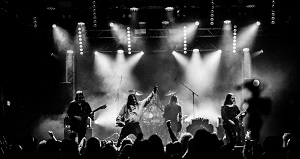
Denial of God bringing their set to Quantic, 21 February 2026
© Ștefan Lupașcu
Denmark, however, still had more to offer. And so, Artillery were brought before us. Not merely brought, but unveiled through a special show marking forty years since the release of “Fear of Tomorrow”. Anticipation swelled accordingly. Thrash metal anchored in social themes, delivered with urgency and bite.
When speaking of Artillery, one speaks of a force difficult to contain. The years have not dulled them, nor have they softened their edge.
The vocal delivery cut sharp and commanding, shifting effortlessly between accusation and rallying cry, carrying urgency. There was clarity in every phrase, but also grit, the kind that comes only from decades spent on stage.
Instrumentally, the band operated with machine-like cohesion: twin guitars slicing through the air in tightly locked patterns, bass anchoring the charge, and drums driving everything forward with unyielding momentum. The execution was precise, but never sterile. It breathed, surged, and struck.
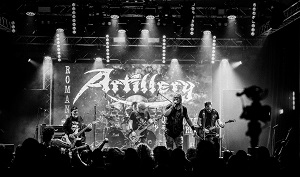
Artillery sealing the gates of Hades with a special show, 21 February 2026
© Ștefan Lupașcu
About the Public Because – Hell Yeah! –, It Deserves a Special Mention
Though I scattered small observations about the audience throughout, here there is far more to recount. Rift of Hades II gathered people deeply committed to this music. From the opening act to the closing notes, I did not glimpse weary faces, nor regret over the choices made. The bands were met with energy and gratitude: mosh pits churned, voices rose together, and horns cut the air. I saw and heard fellow countrymen, local artists, visitors from abroad, and a shared sense of solidarity among all involved. I lost count of those wearing Rift of Hades or Old Grave Fest shirts, quiet proof that quality is recognised when it appears.
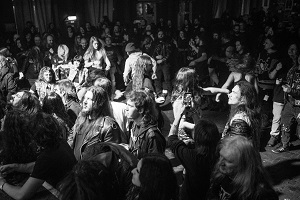
The agitated crowd at Rift of Hades II, 21 February 2026
© Ștefan Lupașcu
A Few Final Words Before Drawing the Curtain
This year’s edition arrived bearing its own visual emblem, crafted by Anuța Ogefescu. A collector’s piece, carefully wrought, built upon a singular concept where colours converge in balanced harmony. Worthy of admiration.
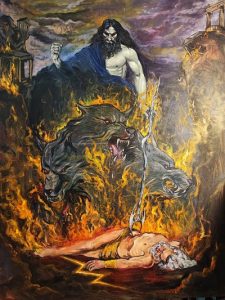
The painting for Rift of Hades II
© Anuța Ogefescu
All in all, one can only hope that such details persuade Hades to return to our lands next year, with Cerberus standing watch and Romanian Thrash Metal Club making the impossible happen.
Till next time! Horns up!