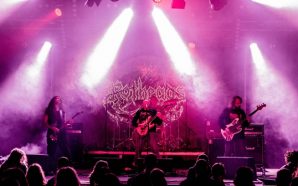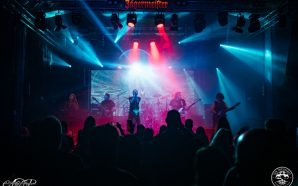
Australian thrash metal band Hidden Intent have released their fourth album, “Terrorform”, earlier this year, and with their first Romanian show at Posada Rock Festival 2025 behind them, it seemed like the perfect time to get their thoughts on the new record, the live performance, but also on their early beginnings and the influences that shaped their sound.
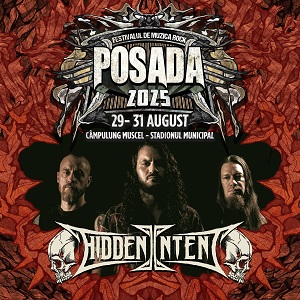
The official announcement poster
© Posada Rock Festival
Greetings, and thank you for taking the time to speak with me. How are you feeling?
Phil Bennett: Good! We’re feeling good, here, in Romania. Very tired because of our touring schedule, but it’s a nice vibe here; good energy. We had a really great time on stage. It’s a very well-run festival.
Chris McEwen: Yeah, it’s great! The people are awesome: you’ve got some amazing crew and staff that come out and help you. Beautiful community.
Glad you’re enjoying your time here, especially since it’s your first show in Romania. Before we get into that, I’d like to go back to when you first started the band, in 2011. What is the story of that beginning?
Chris McEwen: I basically saw him [pointing to Phil Bennet] on stage with a rock band, and I felt he was really out of place. He had a Megadeth shirt on, a Jackson King V in his hands, and he was playing in a hard rock band. Just imagine that! So, after a few days, I met him and said, “I want to start a band with you, mate”.
Phil Bennett: Yeah, Chris used to work in a supermarket, and one day I went in there and we caught up. He just said, “Oh man, do you want to start a three-piece thrash metal band?”
And now here we are, playing in Romania. It feels a bit mind-blowing when you think about it!
Haha, definitely got you! Why thrash metal?
Chris McEwen: Why thrash? Because it has the best riffs, in my humble opinion. All the best riffs in metal are in thrash, if you ask me. It’s got the hooks, the energy of punk, but blended with metal… it is just something else! It’s the perfect combination, really.
Phil Bennett: Yeah! I love metal guitar – the down-picking, the chugging, the fast playing, the solos –, not to mention the double-kick drums… And I think thrash metal is just more fun. You get more circle pits, and people turning up in colourful shirts and hats. It’s not just all black clothes and taking things too seriously. There’s a lot more fun in it.
So when Chris said, “Do you want to start a thrash metal band?” I thought, “Yeah, this is like a challenge. I enjoy playing fast all the time, but I also want to have fun with it”. My old hard rock band was a bit too serious. Not that we’re not serious in this band, but it’s definitely more fun, and I think it complements my playing more.
Since thrash metal felt like the natural fit for you – with its mix of speed, hooks and attitude – I’m curious about where that comes from. What were your earliest influences when you first picked up the instruments and started shaping your style?
Chris McEwen: For me, when we started the band, it was bands like Coroner – especially being a three-piece – as well as Testament and Slayer. Megadeth, Metallica, Anthrax, Onslaught, Overkill, too.
That was it for me personally. But I’m sure you [pointing to Phil Bennet] had other influences that you brought to the table on guitar.
Phil Bennett: Yeah, I was more of a shredder guy. Really into Steve Vai, Joe Satriani, Yngwie Malmsteen, Van Halen – all that kind of stuff. But at heart I’ve always been a Metallica guy. Megadeth, too – Dave and Marty during the “Rust in Peace” era probably had the biggest influence on my guitar style and the way I approach playing in this band.
You’ve mentioned everything from Coroner and Slayer to Metallica, Megadeth, and even shred icons like Steve Vai and Joe Satriani. After soaking up all those sounds, you went on to record your debut, “Walking Through Hell”. How did that first album come together?
Phil Bennett: We don’t really talk about our first album – we keep that one quiet – but since you’re interested in it… let us speak about it!
Basically, when Chris said, “Hey, let’s start a thrash metal band”, I just said, “Yeah, sure”. He came over and we threw together all those ridiculous riffs and stupid songs like “Good Friday Thrash”. It was an album full of solos – we didn’t take it very seriously.
Then we started touring, and I thought, maybe I should’ve taken this more seriously.
Chris McEwen: Oh, one more thing: when we were writing that album, his partner [pointing to Phil Bennett] was about to give birth in the other room while I was trying to learn the parts of the album. I was like, “Mate, your missus is about to have a child!” And then he came to me and said, “Oh yeah, bro, I am having a boy”.
Now that’s quite a story! After the first album, “Walking Through Hell”, how did things change for you as a band when it came to “Fear, Prey, Demise”? Was it a step up?
Phil Bennett: Yes, definitely, because that’s when Paul Lewis joined. He not only raised the level of drumming but also brought a strong songwriting element to the band. He’s sort of taken over the writing, arranging, and producer role now – we call him “Producer Paulie”, because he took what we were doing and made it not suck.
Chris McEwen: We trimmed the fat, structured the songs better.
Phil Bennett: A lot of the material was written and played live over a long period, so we honed it in before recording. We toured Europe, America, New Zealand, Japan, Southeast Asia – so by the time we got into the studio, we already knew how the songs worked live. I’m really proud of that album; I think it’s a solid representation of us at the time.
On that album, there’s a track I’m particularly fond of – “Seeds of Hate”. What sparked that song?
Phil Bennett: Probably Machine Head, and Pantera. Songs like “Seeds of Hate” and “Petrified” came from nights after gigs when me and Paul would be about 50 beers deep, blasting “The Great Southern Trendkill” from Pantera, or something, saying, “Mate, we need riffs like this”. So that’s how those darker, heavier songs came about. The darker, heavier songs bring a bit of balance, stopping the album from being flat-out speed all the way.
After that, you moved on to “Dead End Destiny”. In your view, what was different about this record?
Phil Bennett: It’s a shorter, more to-the-point album. We wrote most of it in a weekend of jamming, and then COVID-19 hit, so we sat on it for a while. It’s got two cover songs and a bit more of that “Australian humour” with tracks like “Dead End Destiny” and “Get a Dog Up Ya”. It was us steering away from the style of the first couple of records.
On “Dead End Destiny”, there’s the track “Breaking Point”, which has some intriguing lyrics. Who took the lead on that side of things?
Phil Bennett: That was mainly Chris. He comes from a youth work and social justice background, so that’s where the inspiration came from. It was something different – you can’t just keep writing about drop bears, kangaroos, and beer. It’s good to explore real-world topics that people can connect with.
And now, fast forward to 2025 – congratulations on the release of “Terrorform”! Something tells me there’s a story behind the recording process. How did it all unfold?
Phil Bennett: Oh, yeah! The recording process was very long and drawn out – lots of pre-production, lots of back and forth. We did some writing at a farm in the middle of nowhere, then worked individually at home, sending files back and forth.
In the studio, we really pushed ourselves – new strings for every song, retuning guitars every few minutes, digging deep to make everything perfect. Honestly, it was tedious, and I don’t want to make an album like that again. We’re stoked with the result, but I’d like to go back to a more relaxed approach next time.
That sounds like a really intense process – from the farm writing sessions to all the back-and-forth and the painstaking attention in the studio. Out of everything you went through, what turned out to be the biggest challenge on this album?
Phil Bennett: For me, the solos. I didn’t want to just repeat myself or copy other guitarists. There are so many places you can go with pentatonics or sweeping, so I had to dig deep to find new melodies.
Sometimes Paul would even hum ideas to me and I’d work them out on guitar. That was the toughest part – keeping it in my style, keeping it Hidden Intent, but still fresh.
On that album you have the song “The Ruins”. What’s the story behind it?
Phil Bennett: That was all Paul’s idea – he wanted more of a Swedish death metal vibe in the structure and riffing. We just wanted to do something different and break out of the straight thrash mould.
And “The Loss”? It feels quite personal.
Phil Bennett: It is. Most people don’t know it was fully written by Paul – we just recorded our parts in the studio.
Musically it reflects going through something heavy, like losing a family member. Of course, it’s open to interpretation, but that’s where it came from compositionally.
It took a lot of work, especially recording the acoustic parts over and over again.
Out of all the songs on “Terrorform”, which one is dearest to you?
Phil Bennett: Probably the title track, “Terrorform”. Lyrically and vocally it pushes us into a territory we haven’t explored before, and I think it shows how far thrash metal can go. But I also love “Dyssomnia” – the riff is heavy as hell.
Chris McEwen: It’s hard to pick one, but “Terrorform” stands out, especially now we’re playing it live and finally getting comfortable with it.
Speaking of live shows, you’ve just played at Posada Rock Festival 2025. How did it feel to be on stage there?
Phil Bennett: We had an absolute blast! First time here, and the stage, the sound, the crew, the way we were looked after – everything was awesome! And of course, the best part was seeing new fans discover us and genuinely enjoy it. I mean… They might not be right up by the stage, but you can still catch their eye, give a nod or a smile, and see in their faces that they’re really enjoying it – like, “Wow, these guys are awesome”.
Chris McEwen: Lots of people came to our show, and afterwards, plenty of them approached us wanting us to sign albums and other merch. It’s just really rewarding.
Of all the songs you played today, which one did you enjoy performing the most?
Phil Bennett: Honestly, all of them. The whole set flies by so fast – you get on stage, start playing, and before you know it, it’s over and you’re like, “Can we keep going?”
I truly liked being on this stage. Romania’s been great. It’s my first time here, and I’m definitely keen to come back.
We’d definitely love to have you back here too! Since we’re on the topic of future plans, I have to ask – what’s next for the band?
Phil Bennett: Well, we’ve just released “Terrorform” and been touring extensively, hitting all the major cities in Australia – also the small towns from there –, and now Europe. We’ve done club shows in Finland, Sweden, and the UK, played festivals in the UK and here, and even went to Serbia for the first time.
Next, we’re heading to Spain, and we’ll likely continue touring with “Terrorform” for a while.
We’d love to get to New Zealand, Japan, and possibly Southeast Asia again.
Also, Europe always feels like a second home to us, so we’re planning to come back next year.
I don’t think we’ll be working on a new album until after that, so over the next 12 months it’ll mostly be touring – probably another European tour.
Out of all the countries you’ve performed in recently, which one won your heart?
Phil Bennett: Oh, it’s hard to say. The UK’s been amazing – this is only the second time we’ve played there, and it’s been going really well. Romania was awesome, too!
And… there are still so many places we haven’t played – Germany, the Czech Republic, Italy, France… I honestly love all of Europe. Serbia was great, Sweden was great, Finland was great.
One thing is certain: everywhere we go, the people are fantastic and they always make us feel welcome.
Staying on the topic of touring, if you could choose, which band would you love to tour with?
Phil Bennett: Depends if we’re talking underground bands like us or big names. Touring with friends is always fun – we’ve done tours with Lich King, and Shrapnel, and it’s always a blast.
If we’re talking huge shows, then the list is endless: Anthrax, Megadeth, Metallica, Pantera, Machine Head… it would be incredible to play on a massive bill like that.
I see! Fingers crossed for many more amazing touring experiences. Before we wrap up, do you have any words for the people who are following you and supporting the band?
Phil Bennett: Thank you so much for your support. It really means a lot, we couldn’t do this without you. We appreciate every single one of you.
And thank you for giving us the opportunity to share our stories and messages – it’s been a really great experience doing this interview.
Thank you, too!