Romanian band The Thirteenth Sun formed in Brașov in 2011, shaping an ambient/progressive metal sound through jam sessions, a mutual fascination with space, and a refusal to follow trends – musical or otherwise.
After performing at Quantic Pub in Bucharest, Romania on 24 June 2025, Radu Barna [vocals, guitars] and Septimiu Hărșan [drums] shared insights on the early local scene, the chemistry between band members that drives their creative process, and their approach to live performances. They also gave a glimpse of the new album, emphasizing how it reflects their growth without losing their core sound.
Hi, guys. Thanks for taking some time to answer my questions. How is life in your part of the country these days?
Radu Barna: Hey, thanks for reaching out! Things are fairly quiet in our part of the country these days. And luckily, not as unbearably hot as it is on your end!
I see. Before delving into the topic of the recent performance, I would like to step back in time. From what I know, you officially started the band in 2011. What was the scene in Brașov like?
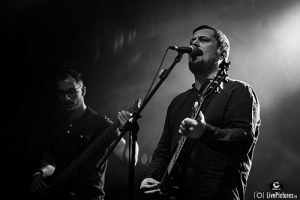
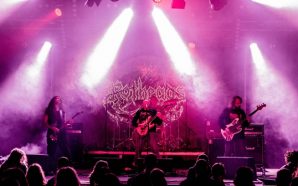
The Thirteenth Sun performing in Quantic Pub, 24 June 2025
© Paul Voicu [LivePictures Ro]
We were all involved in multiple projects at the time. One example is Indian Fall; for instance, I was in that band before deciding to step back. But when I did that, I already had this idea in my mind – this strong urge to start something new. Even the name – “The Thirteenth Sun” – was already stuck in my head.
So, I started working with Marius Muntean. It was a bit under the radar at first – we just began with a few demo tracks. Honestly, we didn’t know exactly what we wanted to create. But I had a concept in my mind – I wanted to explore themes about the universe, about storytelling through music, that sort of thing. That’s really how it began.
Septimiu Hărșan: Yes – the scene back then was somewhat different to what it is today. Maybe more bands were active, but a lot of the same people played in lots of different bands. For instance, I played with almost every band in Brașov at one point.
A lot of them were metal – and I don’t think there was anything atmospheric happening at the time, really. Indian Fall, perhaps, had some elements of that, especially if we think of the album “Pathfinder”. But even so, The Thirteenth Sun was heading its own way stylistically.
Radu Barna: Back then, the scene existed largely because of Rockstadt – that space brought us all together. I’m referring to the earlier location. I think that played a key role in energizing the scene and giving bands a platform – it was a space where you could actually perform.
There were also a few smaller venues – essentially basements. Quite difficult conditions to play in. But even in those places, the music came together – connections were made.
With so many bands already part of the scene, and this new drive building inside you, did you also feel the urge to bring in something genuinely different?
Radu Barna: To be completely honest – I didn’t approach it from that perspective. I didn’t feel like I had to contribute something specific to the scene. I just felt this need to play in a new band. It wasn’t driven by a trend or a movement – it was something very personal.
I knew, to a certain extent, what I wanted. It came from within – a need to express something. The fact that the scene already existed, and that we knew one another – that helped immensely in terms of finding the right people for the band. But no – the main goal was just that I felt something internally, and I wanted to give it form. And I’ve always been fascinated by how things work – the cosmos, the structure of the universe, scientific discoveries…
I was going through a period when I was reading Carl Sagan and similar writers. And somehow that inspired me – I wanted to translate that personal experience into music. That’s where it all started. Of course, each member of the band was open to exploring a sound that was – I wouldn’t necessarily say “progressive” in the strict sense – but certainly different from what was popular at the time.
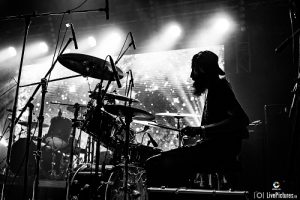
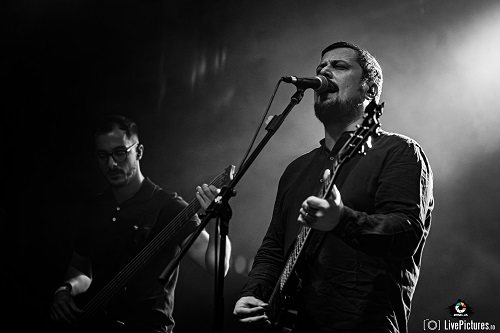
Septimiu Hărşan performing in Quantic Pub, 24 June 2025
© Paul Voicu [LivePictures Ro]
At the same time, of course, we all came into this group already shaped by the bands and musicians that influenced each of us – some of them common, some from pretty distant corners of the stylistic spectrum from each other. Each of us brought our own background into the project, and that played a part in forming the sound we eventually developed. I guess I naturally brought in a lot of prog influence. Well, prog-fusion, if I were to speak about the drums specifically.
And it ended up like something that really didn’t exist in the Brașov scene before – or even, I would say, in Romania at large. At least not in the way we were doing it.
Radu Barna: I wanted to convey something – to express something from deep inside – and secondly, the group of people who came together around this idea had so much in common, on both musical and personal levels. Even if we didn’t know exactly what we were going to create – and we didn’t – when it’s something that comes from the soul, it rarely arrives fully formed. You start with a rough idea, and then you begin to shape it, discover it over time.
I remember when we recorded our first EP – even then, the songs weren’t fully defined. We didn’t know exactly where they were going to lead. It doesn’t mean there wasn’t a guiding idea.
Septimiu Hărșan: Yes, making music isn’t necessarily as much of a rational process. I’ve always loved this idea – I think Matthew Shipp said it and it really resonated with me – that the musician isn’t the creator of the music. The musician is the instrument, along with their musical instrument, and the music actually comes from somewhere else.
And I believe that’s true – because when you sit down and start playing, things begin to emerge. If you’ve got even a vague concept of what you want to express – a direction – you don’t need to overthink or force it out. You don’t need to be too rigid or programmatic about it, nor try too hard to be something someone else is or isn’t. Music comes from somewhere within – or beyond, which I would say is the same thing – and if you have enough [or the right] skill to express it through the instrument, it flows seamlessly, it’s almost got a mind of its own. Your limbs just have to follow it while your own mind has to learn to let go.
That’s a beautiful way of looking at it. You mentioned earlier that the name, “The Thirteenth Sun”, was already in your mind. Why that name?
Radu Barna: Yeah. That ties back to the period when I was still active in Indian Fall and I was reading a lot of Carl Sagan and Arthur C. Clark and everything that had to do with our exploration and understating of the Universe. At one point I was thinking about the nearest star systems near to our solar system and some of their names such as Epsilon Eridani which was a target of the SETI program remained stuck in my head and somehow after counting stars in my head the number 13 struck me as meaningful. I’ve always been drawn to that number. “The Thirteenth Sun” already sounded like a journey, something cosmic. It felt like a fixed point – a marker – for the entire idea we were building.
That’s where the name really took shape for me – it became something meaningful. And in fact, the piece we opened the evening with – “Epsilon Eridani” – refers precisely to that star system that ignited my search that resulted later in the bands name. That’s essentially where the whole concept began. At the time, I didn’t even have lyrics – we didn’t have any lyrics at all. We found ourselves in the studio asking “Alright, what next in terms of lyrics?”
Just imagine that: we were in the studio, we had already recorded the instruments, everything – and suddenly, it was time for vocals. Everyone turned and looked at me. Since I’d initiated the whole project, it was assumed I’d have something. It was brutal – I had no idea where to take it.
Septimiu Hărșan: When you’re in the studio, you hear in great detail what you really sound like. That type of environment can uncover limitations or weaknesses you weren’t necessarily aware of before going in. It can be a bit of a shock, especially if it’s your first time having to be a lead singer in that situation, with a limited amount of time on your hands to come up with the lines and the right way to sing them all.
Radu Barna: It can be quite a shock, realizing you’re creating from scratch in an environment like that. But for me, that star – that point of light – represented a kind of curiosity. It felt like a starting point for the project. Because when you think about space travel – satellites, missions, whatever it may be – there are always reference points.
You need something to navigate by. Anything launched into orbit has to be guided by some sort of fixed point. And for me – that star became just that.
It became a reference for exploring the universe. I simply adopted it.
Maybe it was coincidence. Maybe it was just… something that clicked.
Septimiu Hărșan: And of course, we enjoy the idea that “The Thirteenth Sun” might be difficult to pronounce. Like, “What should the audience shout in a live situation for an encore, especially after a few beers?” “The Thirteenth Sun! The Thirteenth Sun!”.
Radu Barna: Another interesting moment was after we released our first EP – we started collaborating with Costin Chioreanu on the artwork. Initially, we asked him if he could come up with a logo – just something visual.
And when that logo was created, it really felt like it gave the band shape – a visual identity. But more importantly, that reference point – the star – was a kind of origin. A point from which we were setting off. You always need some kind of marker before you start a journey, right?
And in this case, it became a launch point – not just for exploring the universe, but also ourselves. After all, we’re part of the universe, too.
Septimiu Hărșan: But it all carries a spiritual or human message as well.
It shouldn’t come across as though the band is all just about scientific discovery in the dry, academic sense. There is symbolical value to all the scientific language that we’re using and it’s ultimately got to do with the individual internal experience of interacting with matters [that at least appear to be] bigger than one’s own self. Or, maybe, just with reminding people that certain matters do exist.
Radu Barna: Often, our lived experiences – the things we see, feel, or go through every day – become part of this journey. Through that process, we learn things, understand things, uncover things – and ultimately, we discover a great deal about ourselves.
So it’s not just about traveling through the universe – it’s about how we relate to it. That, I would say, is the core idea that launched the entire project.
Given that your work isn’t driven purely by scientific discovery in a strict, methodical sense – but still draws on science – how do you handle the research side of things?
Radu Barna: Well, yeah, it’s not necessarily about scientific accuracy in the strictest sense. The idea isn’t to spout nonsense either, obviously. We do try to avoid saying anything misleading.
Last year, I went to see Professor Brian Cox live stage show Horizons in Bucharest – at Sala Palatului. By the way, he also had a fairly successful career in music.
His speech was very inspiring for me – he explained concepts like black holes, gravitational waves, and recent discoveries in astrophysics. It was truly fascinating. I find stories like his inspiring – stories of people who say, “Look, this is what we’ve discovered in the particle accelerator or through this huge telescope that sees into the early beginings of our universe”, and they contextualise it all. That’s what we currently know about the universe.
So those kinds of voices – those scientists, those storytellers – they’re often where I turn when I write lyrics. If I’m writing about a star, or a celestial body, or something that serves as a reference point in a solar system – I try to ground it, at least loosely, in the current scientific understanding. These are things people have discovered, documented, and shared with the public. That’s where it begins for me.
And sometimes the research just happens – naturally, almost instinctively. It’s part of what I’m interested in, so it comes with the territory.
One more thing: Brian Cox had a similar presentation I think at Sydney Opera, where he had a live symphony performing during his talk – all while he spoke about black holes and the universe.
That’s exactly why I think music and scientific research complement each other so well. It’s a perfect example of how one can inspire the other. When someone presents a black hole – the physics, the implications – everyone in the room begins imagining something in sound.
Any powerful image – if you stare at a landscape, for instance – some people hear piano in their head, others hear black metal… others, something else entirely.
We all have a musical background that shapes how we interpret the world. We all “hear” something, instinctively. And it resonates deeply with us.
And with that in mind, let’s take a look at “Genesis” – the EP from 2012 – what did it help the band achieve at that stage?
Radu Barna: I think the first thing “Genesis” allowed us to do was define the band. To some extent it could be seen as the genesis of the band.
It gave all of us a clearer sense of – “Right, this is more or less our sound”.
It helped unify the different personalities in the group – we started to see what kind of chemistry we had together. That was the idea behind releasing that EP in the first place…
Like a photograph of the band in a particular moment. A snapshot. A reflection of who we were then.
Septimiu Hărșan: Everything came together quite naturally. We are jam-oriented musicians, Radu Barna and I – and the rest of the band as well – we just tend to sit down and play, and then things come naturally.
The guiding force is just the spontaneous inspiration that you are able to put in motion at that moment in time to make use of your musical vocabulary and to express something that makes sense, at least to the individuals in the room, through it. It’s a very special – and rather deep, I would say – type of non-verbal communication that usually makes certain musicians, who have this capacity and a feel for what it means, stay together in the long run.
Musically, I do believe a lot in improvisation and spontaneity – music that takes birth that way feels different, it’s a lot more organic and a trained ear can clearly identify that quality to a song or an album or a band. You can tell when songs come from jams or when they come from bits of recordings or written notes that the musicians are just emailing each other from their homes. Not that the other approach would be wrong in any way [I also practice it with many other bands, especially with the ones where members live in different countries], it’s just a very different one from playing together in a room. And this “online songwriting” has become a lot more prevalent with bands nowadays, for obvious reasons. Well, at least in this sense, The Thirteenth Sun is a bit more old school for sure, we do the jamming.
Radu Barna: And I believe we, as musicians, evolved quite a lot. It’s natural, after all.
In the beginning, we were more raw and exploratory. Now, we have more control, more experience, and a clearer idea of what we want to express.
Our sound has become richer, deeper. We try to create landscapes, emotions, stories.
We still want to keep that sense of mystery and space, but also bring new elements, sounds, and textures.
We experiment with different instruments, production techniques.
It’s a continuous process – we never want to repeat ourselves.
I think your first full-length from 2017, “Stardust” stands as clear evidence that you’re not interested in repeating yourselves. How was it this time around? If “Genesis” represented a kind of origin point for the band, what was different in the way Stardust came together?
Radu Barna: Yeah. “Stardust” came quite naturally. After “Genesis”, we just kept collecting songs, one after another. At first, we didn’t feel ready for a full-length – but at some point, it clicked. If we kept going, there was a thread forming. Things were tying together into something that looked like an album.
“Genesis” gave us the initial push, and “Stardust” simply followed from that. It was the obvious next step.
I think only one track was ever rehearsed without the full band present, and the first time all of us actually played it together was when we had to record it.
Which track?
Radu Barna: “Universus”. It was kind of a result of a multiple jam sessions – and in the end, we felt it was one of the strongest songs on the record. That’s why we made a video for it. I wouldn’t necessarily say it’s the best track, but it was definitely the most natural one to introduce the album with. A good entry point.
But in the end, “Stardust” was a natural step forward – something we all felt needed to happen.
There was a lot of effort involved, of course – especially the recording part, which we did in Timișoara, just like the EP. And back then, it wasn’t that easy to get there.
We spent a lot of time with that album. But it was a normal continuation – we felt we had something, an idea that deserved to become more than just a few demos. And anyway, it was time for a full album – you can’t just keep releasing EP after EP.
Got you. “Universus”, the aforementioned track, has a lot of interesting lines. Some that definitely remained in my mind were “There will be no sound/There will be no ground/Into the dark we fall/Before the coming dawn”. How did you approach writing the lyrics?
Radu Barna: Those lines came from this mental image I had – imagine you’re in space. Not just floating, but existing in that interplanetary space. It’s so dark. So sensory-deprived. You start at zero – total emptiness – and slowly you begin to feel things. To see things. That’s where it started for me.
It’s this duality – silence and intensity, taken to the extreme. And a way of detaching from the familiar, to try and see the universe around you. That’s what I was thinking about. And I have to say – Costin Chioreanu did an incredible job with that astronaut concept in the video. He really grasped what the lyrics were about.
Just think about the distance between two planets. We can’t even fathom it. The scale of the universe, the scale of our solar system – we don’t really understand it. So the idea was – imagine you’re floating somewhere, between everything and nothing, and from there you begin to explore. Of course, the lyrics go deeper into emotional and inner experiences too – but that’s where I wanted to start. A clean slate.
Like a blank canvas?
Radu Barna: Exactly. And from there, the words just came. Of course, a lot of it is personal experience – but I always try not to write about a specific person or situation. I want the listener to feel like they’re exploring something themselves. I don’t say “you” or “me” – the perspective is open. The lyrics are personal, but I try to make them universal.
Everyone has their own internal film, their own way of experiencing things. And that’s the space I try to leave in the lyrics – for people to find themselves.
I noticed you use rhymes in your lyrics, some schemes being A A B C C B, A B B C D and so on. Did it also emerge through improvisation?
Radu Barna: Yeah. I never sat down and said: “Right, now I’m going to rhyme this with that”. It’s not about rules or structure. We don’t even use choruses in our songs.
When I started writing lyrics – and I’d never been a vocalist before – I didn’t want to follow some kind of template. I just wanted the words to serve the music. That’s always been the aim.
Septimiu Hărșan: There’s another important point about The Thirteenth Sun that Radu just alluded to – he discovered himself as a vocalist through this band. He started from scratch, and he’s been growing into the role ever since. It’s the first time he’s fronted a band like this. Before The Thirteenth Sun, he only sang certain parts in certain songs.
Radu Barna: Yeah, The Thirteenth Sun is my first real band as lead vocalist. So I’ve had to find my voice – literally – and shape it as we go. That’s why I feel like every new material we release will be better and better.
First time being lead vocalist, involved in many musical projects, and, from what I know, working in IT. How do you balance all of these?
Radu Barna: Right now, The Thirteenth Sun is my main project. The other bands – older ones – are more or less inactive. Occasionally I’ll help out if needed, like I did in the past with Indian Fall, but this is my focus now.
And yes, I’ve switched from engineering to IT. I’ve also got a family – a little girl, three years old. She keeps me busy. But I take her to rehearsals sometimes – she’s very happy when she’s hitting the drums. And my wife’s incredibly supportive – very understanding. We actually met at a gig, so she totally gets it and she gives me an incredible support in going forward.
So I try to balance things as best I can. And because of that, I want to concentrate on this band. Even if I would have more free time available, I’d still put it into The Thirteenth Sun. It’s my main project.
That’s a lot to juggle, but it sounds like you’ve found a good rhythm with everything going on. Turning now to you, Septimiu, I know you’ve recently rejoined The Thirteenth Sun. How was that return?
Septimiu Hărșan: It was really smooth. Honestly, it was expected. It’s not like we parted ways on bad terms anyway. Personally, I had a feeling it was just a temporary break. Maybe it didn’t seem that way, at first, for everyone in the band, but I kinda knew it wasn’t going to be a permanent thing.
As I was saying earlier, I think one of the things that really define this band is how jam-oriented the creative process is. In terms of composition, that’s fundamental for us. And to write songs that way, at a certain level, you need to be that kind of a musician. You need to be capable of meaningful improvisation, of bringing constant ideas to the table, balancing them out in real time. That’s not something a lot of musicians are necessarily trained or gifted for.
But we’ve always had that kind of chemistry. I’ve said it before: music is a very special kind of communication among people. Jam sessions, improvisation, spontaneity, playing together – they’re at the core of how we work. And I think it’s a big part of building relationships, between musicians, that last.
So yes, was pretty much waiting for the invitation to come back to be issued, haha! And it was, eventually.
Radu Barna: There was a specific period when things shifted. Part of it was because Septimiu had other projects that demanded a lot of his time. We tried to make it work without him, just to keep things going. We worked with some excellent drummers – genuinely talented people we’re still very grateful to – and they helped us a lot. But in some cases, the physical distance made it tough. And in others, as Septimiu was saying, that essential chemistry was just missing. That jam-based synergy that defines The Thirteenth Sun wasn’t there.
It became really hard to move forward. There are plenty of bands that manage to compose remotely – we even did it to a degree ourselves – but The Thirteenth Sun simply doesn’t work like that. This band requires a very particular kind of creative process.
This chemistry is clearly visible on stage, I can assure you. Speaking of which, how do you approach live performances?
Radu Barna: If you ask me, the stage part has always been difficult for me. It still is.
So tonight’s gig at Quantic Pub put some pressure on you.
Radu Barna: Yes. In a way, it did that. That is because I’m a control freak. A lot of what we do, we do ourselves. We don’t have roadies, we don’t have a crew traveling with us. The issues we mostly freak out and panic about are things like, “Is this thing in place? Is the cable where it’s supposed to be? Are all the things where they should be?”
Septimiu Hărșan: And usually… at least one isn’t [laughs].
Radu Barna: Obviously.
That’s just how it goes. It’s stressful. But usually, after the first or second song, I manage to sink into the moment, and things start falling away – I stop thinking about all that. Still, if I had to define it, I’d say the live setting is something intense.
There are moments when I wonder: are people really watching us? Are they connecting, or what’s going on? At the vast majority of our shows, we’ve noticed this thing – like, we’d look out at the audience, and everyone was just staring at the visuals. All of Costin’s projections.
It feels like the music puts people into a meditative state. And that’s sort of the point of the lyrics, right? And the music itself.
Septimiu Hărșan: It’s not music you dance to. I’d call it reflective or something. Though sure, there are headbanging parts here and there.
Radu Barna: Definitely.
Once I feel – and see – that some people are having that moment of reflection, that’s when I start feeling good. That’s when I feel okay on stage. But I don’t think I’ll ever get over the nerves. Especially not when we have a truckload of gear, spare cables, and so on.
That whole stress – I think it’s more of a personal thing for me, being a control freak. I wouldn’t say the same about Septimiu – he’s more stable in that sense.
Septimiu Hărșan: Sure, because I play live a lot, with so many bands in so many places. At this point, getting on stage feels about as natural and simple as walking into my own home.
But yeah – live shows are really great when you hit that zone. Today, for example, I felt like we did hit some sort of a zone. We also set up the drumkit differently this time, with me in front of the stage and the side of the kit towards the audience, so I could see and hear and feel the people in front a lot more. Very untypical for drummers, kinda feeling like a frontman. I actually thought, “Wow, this feels right!” There’s a lot more communication and connection and a sharing of “the zone” between me and the audience with this kind of a setup.
In typical circumstances, when I’m behind the kit, behind the band, in the back of the stage, I can’t see anything. The stage lights are usually in my eyes, between me and the public, so all I see beyond them is darkness. Add in the headphones and their extreme isolation, and I end up usually not perceiving much of the feedback from the crowd. I can’t see faces, I can’t get much of a feel for the audience’s response. Not until I step offstage and go have some beers with them – which tends to happen rather often around here.
The tricky bit with this type of music is that people don’t act the same way they would at a death metal show, for example. There, you see it – they’re headbanging, there’s a circle pit, it’s wild, it’s intense and obvious.
Here, people are a lot more still and you have to do a bit more guessing about whether they are being moved or not.
Radu Barna: Yeah, today I really felt we hit the zone. Like something clicked in the room. And truthfully, if what we do on stage sparks a moment of reflection in even one person’s mind, then I think we’ve done our job.
We’ve fulfilled our purpose.
What was your favourite track to play tonight?
Radu Barna: I’ve always had a soft spot for “Torment of Existence”. From the start, it’s been a meaningful one for me. The lyrics go deep into my own inner torment, too. So that one always feels okay – more than okay, actually. I don’t know why, it just sits right.
Septimiu Hărșan: Well, you can tell you’re getting old when you’re more into ballads as a drummer, like I feel now, haha! I tend to like the softer tracks nowadays.
That’s why I really enjoy playing “Epsilon Eridani” – the opening track. It’s instrumental, but it’s just… simple and spacious. Finally, a track where the drums breathe a little. I can relax more and focus on the music rather than the notes. I’ve realised that when things get too complicated, it’s fun for other people maybe, but you don’t get to enjoy the music while playing it because you have to pay attention to so many things at once.
Did you face any big challenges with tonight’s concert?
Radu Barna: The biggest one was not having Marius on keyboards. That was definitely the hardest part. Everything happened quickly after we got the show confirmation, and we had to improvise fast to adapt.
We ended up recording Marius’ parts and running them on a backing track.
He had to record all the keyboard parts in a rush, just days before the show.
Septimiu Hărșan: But what you heard tonight was him playing live – just a week ago, in the studio, not with us today,
Radu Barna: That was the logistical challenge. And it’s always strange when a core member is missing, especially for the first gig of a new cycle. It’s not going to be the norm – this was a one-off. But even so, we’d already been thinking of using more backing tracks to enhance the live set.
Marius uses a lot of keyboards. He’s a fan of 11.000 keys – and so are we, most of the time. Sometimes, I think we try to fit in too many synth layers. We end up asking, “Where do we even put them all? You’d need ten hands to play everything!”
So, for tonight, we said, “Alright, let’s go with some backing tracks. It lets us bring more of those elements into the live setting.” We don’t want to overdo it, of course. But there are sounds that just fit. It’s something we’ve already considered for the future, just to make life easier.
Septimiu Hărșan: With backing tracks, there’s a sweet spot – they can work really well up to a point.
Go past that, though, and it starts to feel fake. So you have to find the fine line – where it still feels like live music. You want to enhance the experience artistically, but you also have to not rely on that kind of thing so much that it really full-on replaces the whole job of a band member, cause then it feels a bit fake to me.
But of course, we all have only ten fingers and two hands, so anything past that, in Marius’ case, has to go to the backing tracks.
I agree with you, this option might serve you well in the future. Talking about the future, I heard there’s a new album in the works. Apart from that, are there other plans for the bands?
Radu Barna: To be honest, the new album is the goal right now. It’s been a long time since we released “Stardust”, and we’ve already written a lot of material. But now, with Septimiu back, we’re reworking some of those tracks from scratch. So it’s going to take some time.
But this is our first wish.
Our second wish is to play live as much as possible. We went through a difficult period where that just wasn’t happening – pandemic and all. And not just the pandemic. Even after “Stardust” came out, we still struggled to book shows. We wanted to play more, much more. But somehow, the gigs just… didn’t come together.
Why do you think things unfolded that way?
Radu Barna: We’ve never really pushed for shows either – not actively.
Septimiu Hărșan: And maybe we should. We do have contacts. Maybe now’s the time to start reaching out more.
We’d also love to take the band beyond the Romanian border a bit more than we’ve done thus far.
The Thirteenth Sun already played before – for instance, at ProgPower Europe, but I guess we should do more.
Radu Barna: That’s something we truly want – to be more present on stage than we’ve managed so far. Maybe it’s also because we’ve focused so much on the music itself.
Personally, I’m not the type to handle gig bookings. And none of us in the band really take on those responsibilities. I think that’s a downside for us.
We’re all more creatively inclined than logistically or managerially minded. None of us really… I guess we need to learn how to do that part too. I’m afraid we’ll have to take that burden upon ourselves.
So yes, the top priority is the new album. But the second most important thing is playing more live shows.
We also need to start promoting our music a bit more. There were so many times we delayed taking a decision to play this or that show because we felt like, “We still need to rehearse, or we still need to finish a part from that”.
Septimiu Hărșan: And to be honest, it was also because I was in a dozen bands at the time – when gigs were still happening. One of them was Pestilence. I had about 100 shows a year with that band alone, so it was always easy to get scheduling conflicts with the rest of my bands.
Radu Barna: Now we share the same goal. We want The Thirteenth Sun to grow, to play more shows. And I think we’re finally ready to do that. We’re even ready to come out with a new album that, in my opinion, could surpass “Stardust”.
Septimiu Hărșan: And we won’t release it until it does.
Radu Barna: We just want to feel that what we’re releasing truly expresses what we want to say – and that it’s different from the previous album. If our music can spark even a single moment of reflection in someone, that’s extraordinary. That’s our purpose.
Septimiu Hărșan: “Surpass” in the sense of: “we’ve grown”. That’s the goal. Not necessarily to impress anyone – I don’t think that’s our aim. It’s a mistake, I think, to start from what the audience wants – from a “target audience” you want to convince. To me, music is always more like a message in a bottle that you’re sending out into the world, and then just let things follow their natural course – if someone resonates and finds meaning in it, great. If not, that’s just how it is.
Can you give us a sneak peek into the new album?
Radu Barna: We’ve only played one new track live so far – I think it was last year, or maybe earlier this year, in Cluj-Napoca. I can’t remember exactly. Right now, there are around six tracks – or rather six ideas – in various stages. We’ve started working on some of them, but we need to go back and take each one apart, piece by piece. A lot of these ideas are old. Some go back three or four years, maybe more.
They were created at a time when I was doing the drum parts – just programming everything. It wasn’t the right vibe. So we need to refurbish them.
The core ideas are there, but we need to return to how we used to do things. Jamming together, all of us in the rehearsal space, building the songs so they settle into each of us properly. That’s the only way to really bring them to life.
Some solid starting points exist – they just need to be fleshed out.
Best of luck! Given your determination, I trust the goal of surpassing “Stardust” is in good hands. To wrap things up – what would you like to say to those who’ve followed your journey so far?
Radu Barna: From my side – I just hope they still have the patience to wait for the next album. It’s taken a long time. But I can say with certainty that we’ll do everything we can to release it as soon as possible – and as well as possible. I hope it won’t just be a continuation, but something more than what came before.
Septimiu Hărșan: I’d just say: stay true.
That, to me, is essential in today’s world, which seems more and more to be built on fakery, superficiality, and all the issues that don’t matter in the grand scheme of things. Faking it and stopping there, rather than making anything for real. That’s become the norm in music too.
But we’re going back to basics. We jam. We play. We try to replace sounds in the studio, although it’s become “the industry standard” and some people might think you sound or play bad when you don’t do it. We don’t do what everyone else does to match “industry standards” – abusing drum sampling, fixing everything, quantizing every note. We want that real band vibe, where what you play is what people hear.
It shouldn’t sound like a computer. It shouldn’t be so edited that you’re not even sure if real people play the music or if it’s all technology and production tricks.
We want listeners to become aware of this. The current industry standard is not normal – not for underground music. Maybe it should be normal for pop. But that attitude has crept into the underground in a really dissatisfying way. And because of that, underground has become very insincere. It’s lacking depth and humanity. So learn to identify that and get a feel for what’s real and what isn’t – and why something sounds and feels plastic and fake and shallow. Surprise surprise: because it is all of that.
So that’s why my message is: stay true.