Groza

INTERVIEW: P.G. of Groza on Memory, Creation and Return to Quantic

“The biggest pressure comes from ourselves, from wanting to make something new and not repeat ourselves. We’re writing the fourth record right now, so we’ve already done quite a bit.” [P.G.]

P.G. has devoted the greater part of his life to music. After spending his early years in other bands, the German artist went on to establish Groza, a project that would become the vessel for his creative vision.

Groza

Official logo
© P.G.

Alongside the black metal band Groza, P.G. had already crossed the threshold of Quantic in Bucharest, Romania once before. Four years later, on 9 June 2026, he returned with a different record, a different chapter in the history of the band, and a new audience waiting before the stage.

Amid the hours surrounding that performance, a conversation took place about his life as an artist, the road that led to Groza, and the reflections gathered along the way.

However, as the interview progressed, I came to discover something else too: the man behind the band; a passionate individual who initially composed for himself, who later experienced the loss of a friend, Mike [R.I.P.], and who found within himself the strength to carry on.

Greetings. First of all, welcome back to Romania. How does it feel to return, and what thoughts accompanied you on the road back here?

P.G.: Hi. Thank you for this interview.

As for the first question, well, it’s always great to come back to Romania. We were just here a couple of weeks ago with my other band. I play in Antikvlt as well. It’s a project of Chris from Harakiri for the Sky. I play bass there, and we played Quantic, I think, about six weeks ago.

Yeah, that was a great time. And I think the last time we were here with Groza was in 2022.

So, my thoughts about coming back were mostly that it would be great to see Romania again, catch up with familiar faces, and play for the crowd here. We’ve always had a good time whenever we’ve come over. Apart from that, though, there wasn’t really anything specific on my mind.

When it came to crossing the border, honestly, there were no thoughts at all.

You have been coming to Romania for years now, and you have some albums under your belt. So, I’d like to go back to the beginning and talk about your debut full-length, “Unified in Void”, released in 2018. What was the very first image, feeling, or idea that sparked its creation?

P.G.: I wrote that after I found Mgła, basically. Mgła put out “Exercises in Futility”, and that record really changed my whole perspective on black metal. It just flicked a switch. I wanted to make something like that myself. That’s when I started writing it.

It was a lot of motivation coming from listening to that record over and over. It made me want to be really productive, and I wrote a lot in a very short time. I remember that period as a very focused, productive time because I was so excited about this new type of music that I had found. That’s what I remember most.

Do you still recognise yourself in that album?

P.G.: Yeah, I think so. We’ve changed quite a bit since that record, but the core is still there. The basic elements of the music and the fact that it’s melancholic and emotionally driven have always been there.

Was there a major challenge during the creation of “Unified in Void”?

P.G.: No, not really. There were no expectations or anything like that. We were not really a band when I started writing the songs. I was just writing for myself because, as I said, I was so fascinated by Mgła and so motivated to do something in that vein.

I didn’t know if I was ever going to release it or anything. There was no plan to make something of it. It was a couple of years later. I started writing in 2016, I think, and it took me two years to decide that I really wanted to make a band from that material.

There were no expectations or fears about how people might perceive it. It was very free. I felt very free writing it because nobody gave a shit about it at the time except me, which was really cool.

It’s different now because there are expectations and you think about them. But with the first record, it was really a unique time.

Thank you for asking me about that. Usually, people, journalists, or whatever, are not so interested in dissecting these parts.

You’ve mentioned expectations, and I can’t move past that without asking: do you feel those expectations are verily growing on you now?

P.G.: Yeah, you can feel expectations, and you think about them during songwriting. I’m not going to lie. But the biggest pressure isn’t from the expectations or from what people might think.

I think we’re beyond that point. The biggest pressure comes from ourselves, from wanting to make something new and not repeat ourselves. We’re writing the fourth record right now, so we’ve already done quite a bit.

It’s always a challenge to keep it interesting for ourselves and not repeat ourselves too much. That’s where most of the pressure comes from, not so much from outside expectations.

I see. Before delving into your future plans, can we revisit your second album, “The Redemptive End” from 2021? What does that full-length mean to you personally?

P.G.: That record? A lot of things. But what comes to mind first is that it’s the record where I feel we became a real band.

As I said, “Unified in Void” was mostly my material. With “The Redemptive End”, we really started writing together a lot more and wrote as a band. That’s when Groza matured from being a solo project, or whatever it was, into an actual band where everybody was involved in the songwriting.

So, that’s what it means to me in terms of our development.

Did your relationship with that album change over time?

P.G.: Not really. I still feel pretty much the same about the record as I did when we wrote it.

Some songs have taken on a different meaning because our bass player, Mike, is no longer with us, and he was on that record. When I listen to some of those songs now or when we play them, there is a different emotion attached to them.

But the songs themselves haven’t changed. I still feel the same way about them.

On that album, you have “Homewards”. It’s one of the pieces that touched me the most. I can’t hide it. And I’m curious, what does the word “homewards” mean to you?

P.G.: “Homewards” means… it’s not a physical place. It’s more of a state of mind.
The word represents hope to me. It’s something to work towards. No matter what the circumstances are, you can always focus on that goal, whatever it may be for the listener.

I’m not going to give my exact personal meaning behind it, but it represents the idea that there is always something waiting at the end of the tunnel.

In that song, you have the hemlock reference. Where did it emerge from?

P.G.: I think I was reading an article about Greek culture, and the cup of hemlock was mentioned in it.

I thought it was such a fitting metaphor. The song talks about being fed up with the outside world and feeling overwhelmed by everything. The cup of hemlock represents a way of escaping all of that.

We all have different ways of doing that in our lives. That’s what the cup of hemlock represents to me: a means of escape.

That’s also what “Homewards” is about. It’s aiming towards a place of peace after going through difficult things.

Thank you for your insights. I always wanted to ask you those questions. I still want to ask you more, and this time we will go to “Nadir”, your full-length from 2024. When did you decide on it as the name of the album?

P.G.: It was pretty late in the process. I think most of the songs were already written when we chose the name. I can’t even tell you where I found it, I’d have to think about it.

It just came up somewhere. I read it somewhere and then I looked up the meaning of the word. Just as a word on the page, it looked interesting to me for some reason, I remember that. And then I found out what it means, and it has multiple meanings depending on the context.

But it was pretty late in the process. I think we still had one song that wasn’t finished when we chose the name, but most of the record was already done by that point.

Which song was that?

P.G.: I think the last one we actually wrote was “Deluge”, if I’m not mistaken.

The title was chosen towards the end of the writing process, when things were already different from the beginning. So it was pretty late in the process, I would say.

From “Deluge”, the fifth song on the aforementioned album, let us go to the second one, “Asbest”. What was the inspiration behind it?

P.G.: I was interested in writing something in German at that point, because it was something we had never done before. It’s one of the few songs in German. I think it’s the only one, actually.

We do have another spoken-word part, like a sample-type section in a different song, but “Asbest” is the first one we deliberately wrote in German.

The inspiration came from reading a lot of 1920s poetry. There’s this Expressionism, writers like Georg Heym and others. They often deal with the anonymity and brutality of the metropolis, of big cities.

That was fascinating to me. I remember my brother moved to Munich around that time, and I kept thinking about how I would deal with living in a big city like that, because I live in the countryside. For some reason, I was thinking about it a lot.

But yeah, that’s where the lyrics originally came from.

Of course, I cannot hide the fact that the language played its role. When you speak in German, there’s a different level of connection. Some things are harder to express properly when it’s not your mother tongue.

I didn’t hear about Georg Heym as an influence for a long time. Another point I wanted to ask you about is “Daffodils”, the latest song from “Nadir”.  What is the full story behind that song?

P.G.: Difficult one. We lost our bass player in 2023.

He was sick for quite some time before he died. I remember visiting him in the hospital. It was during Easter time, or springtime, when he first got sick. I remember driving with my wife to the hospital, and it was kind of a long drive.

It was such a beautiful sunny day, and the daffodils were blooming on the side of the road. It was just so insane to me in that moment, how everything could become so dark from one day to the next, and still the daffodils could be this beautiful thing.

Nothing changes in the world. It feels like the sun is shining either way, you know what I mean? And that just stuck with me.

I chose that metaphor to express that feeling and that process of losing someone in that way.

The whole album is dedicated to him.

P.G.: Yeah, correct.

It was a hard time for you and the other members involved. But how did you think about continuing?

P.G.: As I said, he was sick for a long time. But there was never really a question of whether we would continue or not. Even when he was sick, he was always pushing to work.

When he first got sick, I asked him what to do. We still had a couple of shows planned, and I was like, “Yeah, what are we gonna do now? Should we wait for you to get better? Or what are we doing now?”.

And he was always like, “No, no, no, don’t wait. Do it. Play the shows. Continue.”.

That’s what really sticks with me. To this day, I think about it quite often, actually. He was always so enthusiastic about the band continuing.

And yeah, it still sticks with us. Of course, it wasn’t easy. There was a rough period of adapting.

Continuing without him being present on stage was a challenge to navigate and all of that. But there was always this understanding among us that we had to continue. Because that’s what he would have wanted.

Even after his passing, I still felt that way. He was proud of what we achieved, and he was really invested in the band.

To not continue would also have been some sort of statement of giving up, and he wouldn’t have wanted that. That’s always what I tell myself when it comes to that.

When you think of him now, beyond the musician and beyond the band, what kind of man comes to mind?

P.G.: To describe him? There’s no way we could talk about this in just this short amount of time. He was great, man. Unlike anybody I’ve ever met in my life.

I met him at a time when I was 18 or 19, so he was a little bit older than I was. But he was also so influential on me while I was growing up and maturing from being a teenager.

I learned a lot from him, and I looked up to him quite a bit as well.

He taught me some stuff. I’ve never told him that. I always wanted to play it cool, you know what I mean? But I respected him a lot, and I looked up to him a lot as well.

I learned a lot about how to deal with shit from him, and I’ll never forget that about him.

He was, indeed, a remarkable person. Since we have spoken about Mike and the mark he left on both the band and “Nadir”, I’d like to follow that thread a little further. Some of those songs found their way to the stage at Ragnarök Festival, and in 2025 you chose to preserve that moment through “Live at Ragnarök”, your first live album. Why Ragnarök Festival in particular?

P.G.: I don’t know. It’s just a nice festival. It’s really cool, and the stage looks good.

We had the opportunity to use pyro and fire on stage and stuff like that.

That being said, we figured we’d choose a festival where we knew it was going to look good on video.

Also, Ragnarök Festival is almost always sold out. There are always a lot of people there, which also helps with the energy of the band. It makes you play a little bit differently, you know what I mean?

It was a really intense show, and that’s why we chose to do it there.

Which was the track you enjoyed playing the most there?

P.G.: Definitely “Daffodils”.

Because we had Matthias from Harakiri for the Sky joining us. He was there in person to join us on stage and that was really special.

Matthias was very close to Mike. Having him there, on that song, which is especially about Mike, meant a lot.

It was a very cathartic, emotional release. It felt very freeing to play that song.

In fact, it always does. But when the guys from Harakiri for the Sky join us, it’s always on another level. It always feels a little more special and emotional when it comes to that.

That’s also why we chose to record that show. We knew we had the opportunity for him to join us, and I’m really happy we documented it.

Touching. Thank you for sharing that with me. Some memories are not easily put into words, and I appreciate your openness.

Now, turning from remembrance to the road ahead, tonight brings another return. You’re already familiar with Quantic. I remember the time in 2022 when you played here. A few years have passed since then, and every return comes with its own atmosphere. Did you arrive with any expectations?

P.G.: Oh, you were at that show as well? Great!

To be honest, there are not any expectations. These days, we were just looking forward to coming back to Quantic.

It’s a really nice venue. The crew is always very cool to us. Very professional.

Everything is cool here at Quantic; the reception is good, the technical aspects of the stage are great and all of that.

So it’s always something to look forward to.

We’ve played Romania even outside of Quantic. We did a Balkan tour in the past, and we played other cities in Romania too.

It was always a good time.

Having spent time performing here and observing different audiences, how would you characterise the Romanian crowd?

P.G.: I think when it comes to most of Eastern Europe, not just Romanians but also Greeks and Poles, the market here isn’t as saturated with bands coming from Germany or elsewhere in Europe.

I feel like people are a little more passionate here when it comes to that.

Because when you play in Germany, German crowds are tough in the sense that, if you live there, you could go to a black metal show three times a week. It’s nothing special anymore.

There are so many bands touring in Germany. You can basically see any band touring through Germany.

But here, especially, I feel like that’s not as much the case.

I think people appreciate it a little more when you come here, and I think it shows in the reaction of the crowd.

It’s an interesting perspective, especially when it comes to how that energy feeds back into the performance. And since we are still on the topic of gigs, which songs are you most eager to perform tonight?

P.G.: We’re playing the whole of “Nadir”, “Elegance of Irony” and “The Redemptive End” from the 2021 album, and “Unified in Void” and “Ouroboros” from the first album.

I think that’s it.

Nice. That brings me to another aspect of performing live. When a mistake happens on stage, are you the kind of musician who gets frustrated with himself, or do you simply move on and keep the momentum going?

P.G.: It’s changed a lot over the years.

Especially at the beginning of the band, I was really perfectionistic about small details and stuff like that. I used to get upset after I realised that I made a mistake.

But the more you play, the more you learn.

Where I’m at now, I’d rather fuck up a part in a certain song and still have the energy, you know what I mean, than have it the other way around.

When you’re so focused on perfection and playing everything perfectly all the time, you can’t really go full on. You can’t really be that outgoing with the show anymore.

I’d rather have the attitude and the energy where I want them than hit every note perfectly.

That’s changed a lot.

But still, you always try to play as well as you can.

I’m not getting mad anymore if I fuck up something or forget a lyric. As long as the energy is there, it’s fine.

Would it be fair to say that you’re more relaxed about these things nowadays?

P.G.: Yeah, I feel more relaxed than in the past.

I used to get really upset about small details going wrong.

But there’s also so much stuff you can’t change. You don’t have any control over it.

And if shit like that goes wrong, you can either choose to get upset about it, which isn’t going to change anything, or you can choose to be easy-going about it and still have a good night.

And I choose to have a good time now.

Time has a way of sanding down the rough edges and teaching us which battles are worth fighting. Speaking of things that stay with us, I’ve noticed a lot of tattoos on your body. Which one carries the greatest meaning for you?

P.G.: Oh, the “Yggdrasil” one. I think it was the first one I ever got too.

Even before Groza became a thing, I was always obsessed with the visual of the Yggdrasil. I mean, we don’t use it as the classical Northern mythology type thing, but I’ve always loved the image and it’s always meant so much to me.

That’s also why I started using it for Groza. And I think it’s one of the most important ones.

Some things take root long before we recognise what they will eventually become.

That leaves me wondering about the man standing before the first stone was laid. If you look back to the years before Groza came into existence, who do you see?

P.G.: Interesting question.

I was always in bands, but I mean, I started writing for Groza when I was like 19 or something. I was basically just a teenager playing in local bands, but I had one metal band before Groza.

It was weird… I don’t even know how to describe it anymore. It was like a mix of everything, basically.

We were just trying out different stuff, and it was the first actual metal band where you learn how to write a song and how to play on stage. We played all of the tiny clubs.

But it was really important because that’s when you really learn what it’s about and how to be on stage and what it means.

But yeah, before that, I was just…

I haven’t really changed. It’s just that I play a lot more with my band now, but still, even before Groza, I felt the same way about music and had the same approach to it.

So nothing really has changed that much.

Alright. 

Who do you think you’ll be in ten years’ time?

P.G.: Hopefully I’ll be an alive being and still playing music.

But apart from that, I really don’t care. You can’t control it anyway. That’s what I’ve learned.

Life has its own way of doing things, and you can never really control it or direct it in a certain way. So, I just go with the flow, and I try to have a good time as long as I can, and that’s basically it.

Life may follow its own path, but every man has his refuges beyond the road. Music, for you is one of them. Apart from that, what occupies your time when you’re not writing or performing on stage?

P.G.: Not a lot, really.

I love hanging out with my wife and my family, for sure. But there’s really not much interesting I could tell you. Groza and music take up so much space in my life.

It’s the main focus. And there’s really not much time to do anything else on that level of being invested in it.

But I love… it’s very boring. I mean, I love watching a good movie, I love listening to music, but who doesn’t, you know?

Yeah, there’s not much else outside of music. The main focus is Groza. And I still love playing music, and I’m grateful that I still love doing it.

That’s basically it.

Since music remains at the centre of it all, it’s worth looking back at what first shaped that path. Which artists would you say influenced you the most, apart from Mgła?

P.G.: There’s a few, but I guess my favourite will always be Black Sabbath, I think, just because they really got me into playing guitar.

That was one of my early loves, one of the bands that I really loved. I guess that’s the most important one.

They made me want to pick up a guitar, and that’s when my life really changed.

Last but not least, if you would only have a word to describe the band, which word would it be?

P.G.: That’s a tough one.

Yes, I spared it for the final.

P.G.: It depends. For me it’s “cathartic”; it is what I connect with Groza. We function as a means to an end, a way to release all the bad shit on my mind.

That’s why I started Groza, and that’s still the main focus of Groza for me, to help me deal with shit, basically.

So, I guess “catharsis” is what it means to me personally, but to some it means different things.

Intriguing. Thank you, once again, for your time.

P.G.: Thank you very much!

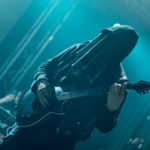
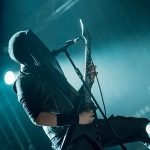
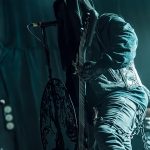
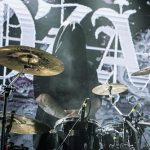
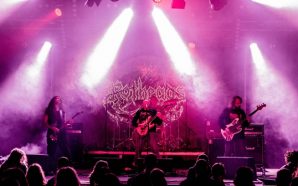
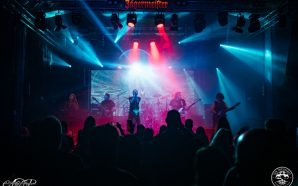
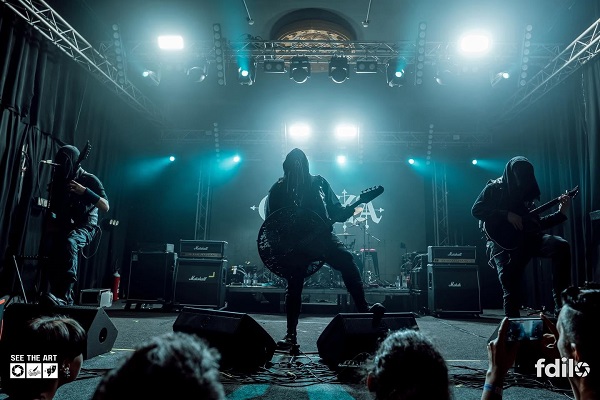
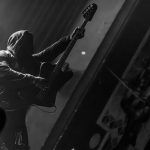
Groza live at Quantic [9 June 2026]

© Florin Diaconescu

Categories
Interviews
No Comment

Leave a Reply

*

*

This site uses Akismet to reduce spam. Learn how your comment data is processed.

RELATED BY