Sometime around 2019, things were stirring in the Romanian post-black metal sphere. Everything that was moving at the time would come to bear the name Mauna Sol. The effort largely belongs to Marius Licu, also known from The Thirteenth Sun, to whom other passionate artists were added: George Costan, Ionuț Cățeanu, Andrei Rențea and Bogdan Itu.
These people turned towards themes concerning self-knowledge as revelation, where inner exploration becomes a passage through an empty, unmarked terrain, far from others, a space stripped of bearings and witness alike, where temptation, anguish, doubt, and the slow labour of reconstructing one’s identity no longer remain abstract ideas but solidify into lived presences, endured alone, in silence, without reprieve.
After they felt their compositions had reached the threshold they set for themselves, the members of the group released “The Calling” on 15 May 2026 via Loud Rage Music. “The Calling”, which contains eight tracks, was also the subject of discussion in the interview, conducted just before the concert at Quantic in Bucharest, Romania, on 9 June 2026.
Hello, and thank you for agreeing to this interview. It has been a while since we last spoke, and a great deal has happened in the meantime. Most notably, the discussion surrounding your debut full-length released on 15 May 2026, “The Calling”, an album that now stands as the first complete signal of Mauna Sol taking form.
How does it feel now, seeing your work exist not just as isolated pieces or ideas but as a fully realised album that can be heard, followed, and returned to?
George Costan: Hello.
Yes, a lot of things happened since our last interview.
Well, what can I say, the feedback for the album was positive, so I’m grateful for that. Now, I’m thirsty to hear the feedback live.
Oh, yes, I can imagine. Before we leave the album behind and venture into matters of the stage, I’d like to dwell on it a little longer. Why “The Calling”? What did those two words carry that no other title seemed able to grasp?
George Costan: I think Marius [n.b. Licu] chose it.
Because I’m an overthinker, and whatever title I would come up with, it just didn’t feel like it ticked all the boxes. So he made the call, and it was called “The Calling”. It felt like it resonated perfectly with the overarching theme of that inner drive of somebody trying to go on an insane journey without a very clearly defined purpose.
And that drive could be called “The Calling”.
“The Calling” centres around a hermit as its main protagonist. Why did you choose to build the songs around this figure?
George Costan: There are two layers here.
The first one was that I had this interest from my university days in trying to understand hermits and saints and different divine personalities while they went through insane journeys throughout deserts, mountains, or jungles. And I was very obsessed with the idea of somebody trying to do that and having this drive to do it.
It felt irrational, but at the same time it felt like it served a higher purpose for them.
The other layer was that I made a very long story, basically made up of different short stories. And one of them was basically the end of the journey, which at the same time is the beginning of this person’s journey throughout the desert.
As for why he became a hermit, that is to be discussed in the future.
That means, we all can expect the hermit to return in the next album.
George Costan: Yes. Let’s call it a prequel.
From what I can say for now, it will be different. But at the same time, it will have this connection with this album.
You’ve made me curious, but I’ll save questions about future material for later. Going back to “The Calling”, is there any untold story from the recording process?
George Costan: I’m not sure if this was told, but we basically split the recording process into two stages: one in the studio and one DIY at home.
It took a lot of time. But, you know, people in the band all have jobs and get sidetracked by different things, especially financial ones. This was troublesome to do on short notice.
We could have had the album ready on paper much, much earlier. But due to different constraints, it got pushed this far.
I see. And how was the songwriting process?
George Costan: The songwriting was effervescent, from what I can say.
It was during the pandemic, most of it, the bulk of it. And, you know, some people complain about that period of time. But when you’re stuck in one place, it can be a choice. You either struggle and try to irrationally fight the situation, or you just make the best of it.
And if you cannot, let’s say, leave a certain space to do whatever, the best place to seek refuge and travel is inside your own mind.
One of the first journeys inside your mind led to “A New Life”, the opening track on the album. What emotional and personal space were you in when you began writing the song?
George Costan: I was barely healing from a very nasty depression, which almost got me. I think I was in a place where I had to take some time off work as well.
Since it was the pandemic and I was saving money to buy my own house, my own place, I started writing. At first I started writing something very different, which I’m not sure will end up on a Mauna Sol album or not.
Then I just sat down and wrote “A New Life”. I just became an apartment hermit, staying in my own bed for hours and hours, just listening to the same riff for, I don’t know, even two hours continuously, trying to get into it and connect the story with the music.
After warming up with different stories and with the whole personal context, it felt like something came out of me, and it felt very right.
At that specific time I wasn’t in the band anymore. It was like a four- or five-month hiatus.
And I know that by the end of the week or something like that, Marius told me, “Please come back”, basically. I was a bit hesitant because I still felt like my wounds were fresh. But when we pieced together the lyrics with the instrumental, it stuck.
So yeah, like 95% of what I wrote back then is present now on the album, in the song.
Do you still feel that “A New Life” resonates with you?
George Costan: Yeah.
The way I insisted on writing the lyrics was that they should not have one singular explanation.
They should serve the story first and foremost. And then, like these types of stories have been written throughout history, they should resonate with people on an individual level.
So, okay, there is, let’s say, a canonical explanation or interpretation, but every story, every fable, every hagiographical work should have a personal interpretation.
Something that the reader or listener connects with on their own level, in a way I’m not aware of.
You mentioned that your lyrics are meant to leave room for personal interpretation, but there is still a canonical reading behind them. With that in mind, I’d like to ask about “Mirage”. I’ve always felt that the song contains more than it immediately reveals. What is the story at the heart of it?
George Costan: That was…
I’m starting with that stereotypical thing that’s promoted everywhere, that at the end of the year everybody starts thinking about what has passed and how they will become a better person the following year. You know, starting to lose weight, starting to learn something, or just, I don’t know, smiling more.
So, from my point of view, it was the same year I basically rejoined the band.
It felt like being on a beach. The sun hits you and it feels cosy, it feels warm, it feels like you’ve just had a shower. But it wasn’t really a shower, it was like a shipwreck, and you had just survived a very strong, powerful storm.
And you’re just enjoying the breeze, the warm breeze, and the sun after that survival process.
It felt like I had a lot to tell, but at the same time I felt like I was in a position to play. To play with my emotions, to play with a story, to play with the lyrics, to be playful in a crazy way.
I wanted to make it about that threshold of truly abandoning the past, the toxicity of my own past.
It felt like a cleansing, an emotional and psychological cleansing.
And it was a collection of stories about transformation, about revealing all the main concepts that make me human and the feeling of abandoning those concepts based on their old definitions.
So, my life, my spirituality, the way I view humanity, the way I view myself, the idea of love, the concept of personal attachment.
It felt like I had shed a skin, a very irritating skin, and embraced a new one, a fresher, cleaner, purer one.
Listening to you describe “Mirage”, I can’t help but notice how much thought you’ve put into the ideas of change and leaving things behind. Yet every transformation carries a shadow of its own, and that brings me to “Death Poem”. Can you shed some light on it?
George Costan: You’re the first person to ask me about it in four years.
At one point I think it was believed to be the last song on the album.
And, as with every life on planet Earth and in the universe, the final threshold is death.
The title is basically a translation of the Japanese word for death. But the main influence was the Balkan belief. It is found in Christianity, but it’s not, let’s say, a full-blown official belief adopted by the Orthodox Church.
It’s mainly about the toll booths that reside on the path between the dead person and Heaven. But not Heaven per se, but the place of judgement.
That’s why we’ve got that saying that until you reach Heaven, all the saints will eat you.
But it’s a bit satirical because those saints are basically devils, demons who guard the toll booths.
The soul should cross every toll booth either by countering every sin represented by that toll booth with good deeds or by bribing the demons.
That’s why we have so many customs involving placing coins onto the dead man’s eyes, or placing different belongings of the dead person inside the coffin or tomb with them, so they have something to bribe the demons with.
And I had this idea that if it’s a song and it feels epic, you have death as an important threshold in the story of this hermit, and you also have a very dramatic visual of it.
It felt fitting. It’s pretty visual and colourful at the same time.
Intriguing. Which lyric from that song resonates with you the most?
George Costan: Hard question.
It’s interesting because, as a way of being, I tend to go general and just view the main frame.
Usually, when I go into specifics, it’s from that angle, not the other way around.
So I think it was the final lyrics, the last verse.
I know that Marius told me that, for whatever reason, I should really insert some words there. I felt complacent with the rest and very proud, of course, of what I did.
Reviewing the lyrics now, I feel like they are simpler, but at the same time they carry a very powerful message because it’s about detachment.
It finally happened after seven songs.
We have a few lyrics that simply say, “Okay, it happened.”. Detachment happened.
It happened from both ends.
From the people who might have still cared about the hermit from back when he had people in his life, and from his own end because he died.
And he died in a tragic, peaceful but tragic way.
The only way he managed to reach a kind of peace was by dying.
Because that’s all dying is. Everything goes black, and that’s it.
Indeed. But then there is “Inner Rewards”. It closes the album. And I am curious, what does “Inner Rewards” mean to you on a personal level?
George Costan: Well, I will start with a different story. I once had a disagreement with a friend about the possibility of writing while being depressed. From my experience, depression can serve as fuel only when you have some distance from it, from the pain.
Because if it blinds you, you are almost creatively numb. And you cannot write when you are numb. Just like you cannot move or drink or anything else.
You cannot function when you are numb. Back then, I was not a functional person.
From an emotional and psychological point of view, when I wrote the lyrics for “Inner Rewards”, I felt like I had gained enough distance to feel the pain but also observe it, admire it, and engage with it.
It felt like an epitaph of something that has passed. Even in the story, it felt like the state that comes after dying. What story does the hermit still have to tell? It is, essentially, the epitaph, the legacy. Written by someone else, of course, but it depends whether it is someone close or someone with an interest in milking the tragic journey of this hermit.
It felt like the decision was to create an epitaph. I think that is the right word.
And what would someone who discovered him, and had the means to write his story, say about a person gone missing in a desert without telling anyone? Let us imagine that someone found him and wrote an epitaph about this tragic figure. From, let us say, a dignified perspective. I do not want to say “nice”, but a respectful angle.
He did not pray for rewards from the outside, like material possession, recognition, validation, or social approval. None of that.
Everything he was trying to achieve was internal. And he must have found it, even if he did not get external confirmation of it. It felt like an epitaph, like when you shed your skin and throw it away, but then you look in the mirror and feel that you like what you see more than what you saw yesterday.
Fascinating. Now I feel compelled to ask what more we will find out about the hermit. This leads to your next album, obviously.
George Costan: Oh, it will be a story about how he became a hermit, basically.
As I said, it will be mostly a prequel. The vibe will be different.
We are working on it. I am not sure if it will be this year, as life has a way of hitting obstacles. But now that the album is out, we will see how many ocassions we will have to promote it through the autumn and beyond. In the meantime, we will work on new songs, finalising them, finalising lyrics, and everything else in between.
Going to the band, you mentioned previously the depression that held you back. Was that the most challenging part, or were there other challenges as well?
George Costan: I think there were two challenging parts.
One was creating it. I blame myself, because my depression held the band back. It was also during the pandemic. Everyone has their own demons and their own ways of dealing with them, and expressing them, if they allow it.
I knew and know they wanted to move on with a different vocalist when I left, but somehow everything came back to me for some reason. And then we managed to finish it in a few months.
That was hard. For me, it was not the pandemic as much as it was the past catching up with me, and feeling like I did not have the means to deal with myself the way I should have. That time off was very confusing, and I think it was challenging for everyone in the band, and for me as well.
That was the creation phase.
When it comes to new songs, there are always different views about where to take them and how they feel to each of us. You can feel that your take is better than someone else’s, but these are the necessary frictions.
The recording was the second difficult phase. We did not have the money to do it properly from the start. It is very hard to maintain a studio mindset, always being ready to record, fully immersed in it.
What was inside you every day when you knew you were writing and recording material that would become part of the album?
George Costan: For me, when I write songs, I try to just forget about past, present, whatever is going on. My record for now is like six hours straight without going to the bathroom, eating, drinking, whatever.
It can be very, very stressful, because it’s like removing every level of comfort just to be into it. I don’t know. It’s… it’s… yeah, it can be exhausting. I know that I did it for like four days, the first time four days straight, and every day just being with myself, with the song, with my own words, with whatever I was achieving, trying to remove that, let’s say, rigidity from within.
I can be rigid, I have a tendency, not all the time. And just, you know, loosen up, say, “Okay, just make the pages speak!”. And day by day it was like that. Imagine you have a transplant, and you are a healthy person, and having a, let’s say, a mind transplant or body exchange. It really feels like you’re not getting the hang of that body and making it work.
It always feels alien. Not like dissociating. I mean, it just feels like your body isn’t really yours. And yeah, it was at times agonising, but when you try to make things work with what you have, magic can happen.
Yes, in such conditions, magic can happen. Sometimes, there are some sources of inspiration involved. I know that you are spending your time lecturing, and I want to know which books helped you to get inspiration for the songs.
George Costan: Hmmm, I will not say necessary titles. Basically, I use mostly my university background. Because when you do research for a paper, for example, you don’t read books like you read literature.
When the album was in the making, I had different stuff from different times, from my university background, from my scholarship in Turkey, from other places I visited. I felt like that part of the story could use that element from that whatever geographical region, from whatever century, and whatever religion.
I just made a connection to an original story, made it, let’s say, cohesive, and then transcribed that narration into lyrics.
But I also used elements from Sufism, so basically Islamic mysticism, a bit from Orthodox Christian beliefs, and elements from Shamanism.
For example, we can say that we have the Tree of Life in “Mirage”.
Of course, it is not exclusively Shamanistic, but those elements are present too, or the transformation from a person into a flying animal, or from a person trying to leave the desert. It can be understood as leaving a physical world for the astral plane. This is an illustration rather than the only interpretation.
We also can think of Rūmī, the Muslim poet. I kind of used him in reverse a bit. Rūmī spoke about union, love, and enlightenment, whereas for me it went the other way around: renouncing love, the splitting, the opposite of union between the hermit and the higher force he was searching for, and about death, instead of transcending into something more living.
Even when Rūmī is used in reverse, the core ideas of love, separation, and transformation still seem to underpin the emotional framework of the album.
Moving slightly away from that, I also know that you listen to a lot of music. Was there any material that caught your attention in particular?
George Costan: Hmmm, there is a song recommended by a friend of mine that stayed in my mind and helped me to get in the mood for the first album. For the second it didn’t work.
And it will not work anymore, but I will treasure that song she gave me, from Ofdrykkja. It is called “Wither”.
Oddrykkja, great!
George Costan: Yeah, and in that specific time, it really helped me to get into the writing mood, to go to listen to the songs for which I had to write the lyrics. Every time I want to write something lyrics-wise, I tend to go first to that song, to see if it hits a spot, or it makes me go to listen to something else, but not something I’m used to comfort-wise, because then I tend to either headbang or be pumped about it, and there I do not do that. I want to listen to something that I know keeps me in the moment before I attempt to write something.
I see. Going to live performances, you recently brought the songs from your first album to the stage in Cluj-Napoca. How was that performance for you personally?
George Costan: Oh, I need to say, firstly, that it was a bit chaotic before the actual show.
Why?
George Costan: I’m not sure. I want to be more professional, and I think I’m into that angle too much sometimes.
My bandmates make fun of this from time to time, and they say that I have to be at a certain hour, that I want to make the best impression, and of course, if things do not happen that way, I tend to be upset.
I’m still a bit tense.
But of course, when I go on stage, especially nowadays, I’m much more into it. Surely, this has to do with managing stage fright, anxiety, panic attacks, and I have my special recipe to warm up the classical way, and bits from the TRE method that was designed for war veterans. Naturally, I adapted pieces of it to basically search my demons who might sabotage me on stage, feel them, and basically, let’s say, have a chat with them, listen to them.
Now, since we are playing with Groza, I am trying to use my techniques.
When we shared the stage with Groza last time I had a panic attack, and it felt like I did not use my diaphragm for vocals, but I struggled with myself throughout the show. When I played in Cluj-Napoca, I also had contact lenses and it was like, “Fuck, I can see the people, I can hear them, I can see my bandmates, it feels homey, I can feel the feedback, I can finally feel safe, and basically silence my demons, and be the person I want to be on the stage throughout and out!”.
What would you consider your ideal version of yourself on stage?
George Costan: All I know is that I want to feel in top form. I know exactly why I am on stage, what I am doing, and I am fully there with my bandmates and the songs we are playing. I like the music, I like everything about it, but what frustrates me is when I become my own obstacle, when I block myself. That is what bothers me the most.
I prefer things to be clear, when everything adds up simply and cleanly, without internal resistance. That is very satisfying for me.
At the same time, there are different parts of me. Some people might see either that part of my inner child, my inner adult, my inner teenager, maybe even an inner old man. Some even say I have an old soul. They would not necessarily define it that way, but I understand what they mean.
It is also a contrast with everyday life, with responsibilities, work, bills, all the routine pressure. On stage, that inner, more youthful part takes over and feels free. It is something you miss, but not something you would want all the time anymore.
Well, everyday life has a tendency to wear us down over time.
George Costan: Yes. And the point when I felt that the most was when I lost my cat.
She, of course, she was my best friend, and like a soulmate. I was joking about myself, nicknamed myself the „Beast master”, because it was very easy to communicate with that beautiful being.
After she died, more or less in my arms, safely, I reviewed all these years and all the time together, and how somewhat she was one of the few constants in my life throughout a lot of tumultuous years of my life. I felt like I lived a lot of lives throughout my 37 years of existence, but it felt like my cat lend me though a few of her lives before she went away. And I feel like… sometimes when I look back in my past and all the things I went through, especially internally, I feel somewhat ancient.
I’m truly sorry for the loss.
George Costan: Me too…
[takes a moment to collect his thoughts]
But now, I am finally relieved because we came back, we finally came back with the album. We promised it so many times already. And, I’m really happy that we finally have this album already. And hopefully everything will go nice.
Fingers crossed. But since you are taking part in many gigs, tell me, please, which concert from Quantic impressed you the most this year?
George Costan: It’s an interesting thing because I love Underground for the Masses. I wish that this year I would have stayed until the end of the last day.
I had an allergic reaction to a beer or something. Most likely a beer I had. And I had to go away because I had a very powerful headache and could not tame it with anything else except something anti-allergic.
But after a few months of a personal journey, I felt rejuvenated at that festival this year. So I wish I had more time with the people I care for here in Bucharest. At the same time, I really feel like that festival gave me a feeling that I have not felt for a long time.
I still feel rejuvenated on some level. I feel like the time I spent at the Underground for the Masses really helped me.
Glad you felt that way. We hope to see you at the next edition as well!
Now, last but not least, was there a misconception about the songs from Mauna Sol, that you think you clarified with the album?
George Costan: I’m not entirely sure. At one point, many years ago, before I started working on myself, I was quite fixated on the idea that if people did not read my mind about what I intended to do, then they were wrong. But nowadays, for a few years now, I am much more relaxed about it, as long as it is not about facts.
If someone interprets something differently from me, it might simply be because things resonate differently, and that is just how it is. People go through different experiences and have their own internal resources, so their processes differ and things land in different ways. I am very okay with that.
It is only when facts get mixed up that it bothers me, when it feels like the basic work has not been done properly. For example, someone once listed a different drummer on Encyclopaedia Metallum than the one we actually have. It was funny. Like, come on, they do not have the same name, and they do not even look remotely alike. You cannot confuse them.
I know that story. It must have stayed with you.
George Costan: A thing of the past.
The present moment stands, and the future awaits. I look forward to hearing your album in full in a live setting. Until then, thank you for your patience in answering my questions.
George Costan: Thank you very much for the interview!
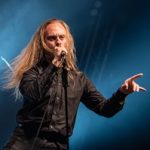
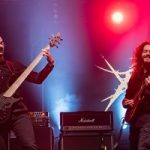




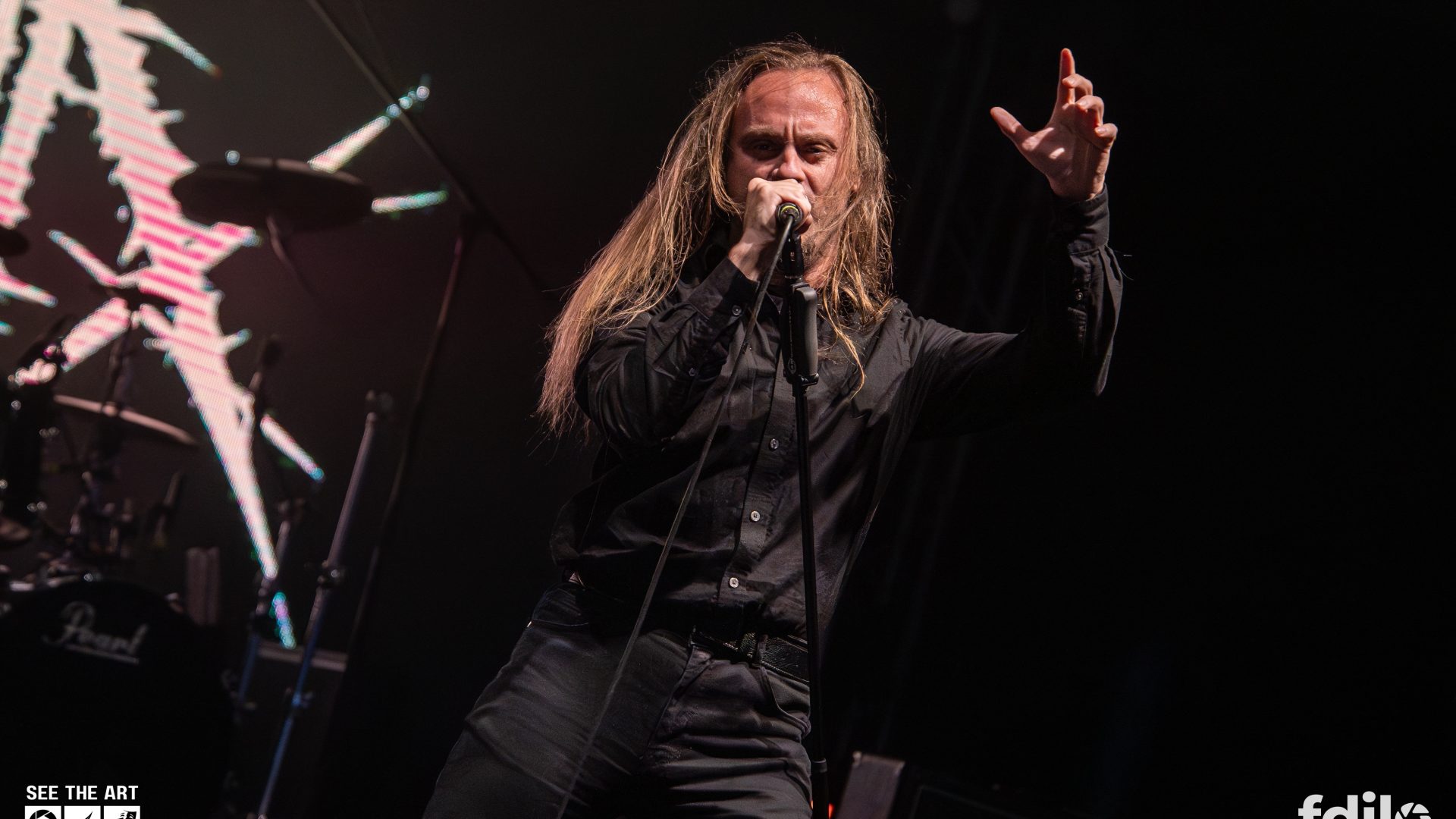
Mauna Sol during the gig at Quantic [9 June 2026]
© Florin Diaconescu