Jarle Kvåle began composing music during his adolescence, and from then until the present day his enthusiasm for art has not diminished. With a clearly defined goal, namely to create music that first satisfies himself, the artist was initially part of the band Ulcus, then Windir, and now channels his ideas through Vreid:
“I make music primarily to my own satisfaction. If other people appreciate that, that is fantastic. But primarily, I do not write to satisfy anyone. I write to satisfy myself.”
Through his efforts, as well as those of the other members of the band, Vreid have released a significant body of work, the most recent being the album “The Skies Turn Black” from 2026, which has received positive feedback from audiences. Melodic black metal. 11 songs. And some of those 11 songs were brought to the ears of listeners in Romania for the first time.
As part of the “Mass Hallucination Tour”, Vreid arrived at Arenele Romane on 15 April 2026 thanks to EMAGIC and Metalhead. They were quick to show their enthusiasm. But I will let Kvåle speak for himself on this:
“Romania and Latvia are the only two countries on this run that are new to us. We have been playing together for thirty-two years and we finally made it to Romania.
So it is an exciting night.”
And with the same enthusiasm, Kvåle spoke about what Vreid means to him, about the close friendship he had with Terje Bakken, and about his life as a promoter of the Tons of Rock festival. He spoke about all of this with sincerity, just before stepping onto the stage.

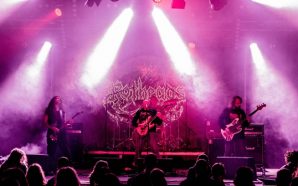
Jarle Kvåle of Vreid, a few hours later, performing for the very first time in Romania, Bucharest, Arenele Romane, 15 April 2026
© Florin Diaconescu
Greetings, Jarle, and welcome to Romania. For the first time Vreid set foot upon this soil, and I imagine many notions marched through your mind before the road brought you here. Tell me, please, when dawn broke today, and our country lay waiting ahead, what was the first thought that rose within you?
Jarle Kvåle: Hi. It is great to be here and talk with you before the show. That is a good question to start with.
The first thing I thought was that I needed to get up, get down on the bus, because I wanted to witness our entry into Romania. It is my first visit here. Since we came from Sofia in Bulgaria, I knew there was a bridge crossing over the Danube and I wanted to see that.
It was a beautiful sight. It is an old bridge from 1954 and it took me into one of the few countries in Europe I had never visited, which is Romania. So it was a special day for me.
A special day, then. Glad to hear that! Romania is no country to be measured in a handful of hours, nor Bucharest in a passing glance. If the road granted you more time than this brief halt, what corners of this land would you most wish to seek out first?
Jarle Kvåle: I have heard so much about Romania, but today, of course, we only have a few hours to see Bucharest. I would like to see more of it. I would love to go to the mountains, the Carpathians and Transylvania.
Of course, you cannot do that in one day, so today I wanted to check out the city. We came to the venue, then stopped by the Parliament building just to see it, because that is a massive sight. Then we walked around the city for a couple of hours. We were also invited to the Norwegian Embassy, so we actually got to see a bit of Bucharest today.
There is a lot of different architecture here, in Bucharest, and it impressed me a lot. It is a city I would like to see more of later.
It seems Bucharest has already left its mark upon you, even in so brief a meeting. Yet roads and cities are one thing, while the paths carved by music run even deeper. Your catalogue is vast, and we shall come to it in due time, for it has meant much to me in more ways than one. But first, we begin where fire met ash: “Kraft”. 2004. When you stood at that threshold, what was it like to shape that album?
Jarle Kvåle: Some of the material I had written already was supposed to be on a Windir fifth album, which of course never happened. So some of the ideas were brought forward, but the other songs were written in quite a short time. It was a reaction to what happened at that time.
We were in shock, we were in sorrow, there was a bit of fury. But for me it was a way of coping with what happened. So that album was done in just a few months. It was a kickstart for the band, I think.
Which song was the most challenging to do from “Kraft”?
Jarle Kvåle: I do not know which was challenging. Maybe the opening track, “Wrath of Mine”. We used a lot of different takes before I was happy with that one. So yes, maybe “Wrath of Mine”.
Was there a feeling of responsibility upon you when you wrote the album?
Jarle Kvåle: No. Basically, I do not take any responsibility when I make music. I make music primarily to my own satisfaction. If other people appreciate that, that is fantastic. But primarily, I do not write to satisfy anyone. I write to satisfy myself.
Would you share with our readers whether there is a track you are certain Bakken would have approved of, and felt proud to see carried in front of them?
Jarle Kvåle: Oh yes, absolutely. The song “Helvete”. We worked on it a great deal together. It was my song, but he contributed heavily to the first electronic section, so he was very much part of it. Also “Wrath of Mine”, we listened to that one together. He was involved in some of the ideas for the other songs as well. So I think he would appreciate a lot of those songs.
Great question.
That sense of shared authorship still lingers in the material. Thank you for the answer. Moving on from that shared creative ground to “Welcome Farewell”, the year of grace 2013, which song from that record feels closest to you personally?
Jarle Kvåle: From that album, “The Reap”.
Why?
Jarle Kvåle: It represented something a bit different in the Vreid catalogue. Musically, that is very important and close to my heart. I love 1970s rock music. For me, the song is a mixture of 1970s rock, 1980s thrash and 1990s black and extreme metal. That is what I know best.
With that one, I felt we really got a heavy melodic song that could almost have been recorded in the 1970s. So for me it has always been a special piece.
Indeed, that track stands apart within the Vreid catalogue. It is also one of my favourites. And you know what? I am also having favourite tracks from your newest album, “The Skies Turn Black”, released in 2026. One of them is “From These Woods”, the opening track. Tell me, please, about its origin and what set it in motion.
Jarle Kvåle: When we did a rehearsal for some of the songs, we had not made a demo of that song, but we started it at the end of a session. We were at a small cabin in Norway rehearsing together.
I woke up during the night, or early in the morning, and thought, “I have got this idea”. I had actually had the main riff lying around for several years, but it did not really work out. “What if we do something completely different with it?”, I said to myself. It just came to me.
I woke up the other guys. They woke up a bit hungover, and I said we really needed to try this idea. Immediately it felt like this was going to be one of the most important songs on the album. Sometimes you just get that feeling.
It was going to represent the album, it was going to start the album, and everything. Of course there was a lot more work needed to finish the song, but it became clear to me that morning that it would be one of the main tracks.
Quite a story!
Jarle Kvåle: Yes!
I always write a lot of ideas. When we had just finished “Wild North West”, the album from 2021, I started writing new ideas, but this time it took a long time.
This is how it works with me. Basically, I write a lot of ideas. I do the guitars, bass, keyboards and some drum ideas, then I present it to the other guys. Then they start doing their work better than I do, because they are much better musicians. They add a lot of other things and make it come alive.
For me it is a process of sitting alone when I write music. We do not really write music together.
You do not really write music together. May I ask you why?
Jarle Kvåle: We have tried more jamming things, but it feels awkward. It feels forced. It is more when we have the songs mostly set, then the questions start; “Should we do this, should we change something?”.
That is more arrangement work.
Jarle Kvåle: Yes.
But for me, the creative part is personal. I can create something on the bus, in the cabin, on a walk. Something pops into my head and then I get an idea, you know? It is not about sitting down together and saying that we should make something. That feels forced.
Even on the phone now I have recorded some ideas during this tour, just singing into it or plugging in a guitar or using GarageBand or whatever I have around. It is about being creative when the moment comes.
I was fortunate that when I started, I built my own studio in my house. If I get an idea in the middle of the night, I can go downstairs and record it.
Pretty much all of the songs were written by me. The song “Chaos” was written largely by Sture. He came up with a lot of different riffs and ideas and we tested many of them. Then he had this really cool riff that we tried changing the tempo of and figuring out how to use it.
It started off as a really heavy, slow song, then I started writing some riffs and we changed it a bit. It ended up being the fastest and most extreme song on the album. That was a really cool process.
Most of the time it has been me writing, but then, when he came with a lot of good riffs and I felt it fit really well, that song became something different.
So the picture becomes clearer: most sparks are struck in solitude in the quiet hours, on the road, in a cabin, in the middle of the night, while the band members later help shape the steel through arrangement and instinct. Yet now and then, when another hand brings the right riff to the table, the song can take a road you did not foresee, as happened with “Chaos”.
Keeping with that thread of creation, I would like to discuss “The Skies Turn Black”. How did that particular track come into being?
Jarle Kvåle: That song was pretty much written after I went to the last Ozzy show, and it was one of the best experiences of my life.
All my favourite bands were there. I work as a promoter and run a festival called Tons of Rock in Norway. I have had both Ozzy and Black Sabbath there.
To see him forcing it out one last time made me feel like a child again. Not only him, but seeing all the other bands and how much Sabbath and Ozzy had inspired them, whether Pantera, Slayer, Guns N’ Roses or Metallica.
It was the ultimate confirmation that heavy metal and rock and roll are such global movements and they will never die. There will be trends, but it will never die.
Then I understood that without this thing, who would I be in life? Heavy metal is my life.
How do you find time for everything?
Jarle Kvåle: Good question. I do not know [laughs]. We have not toured much with Vreid in the last years. We have done festivals and smaller tours. This is the first really big tour we have done in around seven years.
So in recent years my main focus has been running the festival and there has not been time for full touring. But now the festival has become really big, and there are a lot more people working on it.
I can also work remotely. Today I had a couple of calls and checked the mail, so I am available. It works during certain periods to do both.
For me it is just different pieces of the same picture.
Like a puzzle?
Jarle Kvåle: Yes, it is the big world of heavy metal. I am lucky enough first to be a fan of metal bands, then also able to create music that people come and listen to, which is great. And lastly, I can set up a festival and see both my childhood heroes and new bands coming through.
It is a great mixture.
What is one band you truly want to book?
Jarle Kvåle: I have had many of my favourites already. Metallica was special, and Slayer too. If I could have one more, though it is not very realistic, AC/DC would be great.
I see. Returning to Vreid, was there a moment when it was very difficult for you to create a song?
Jarle Kvåle: It was more about the band. Around two years after the last album we started to have some ideas, but I felt we were lacking energy as a band. So we took a break for a year for the first time in our lives.
We decided that if the energy was not one hundred per cent there, we should put it away. I do not want to be in a band where we feel we have to do something. It has to be a positive force where you want to create something and feel that full energy.
So we took a break, but I kept writing stuff. When we met again, it felt revitalised. Sometimes it is good to put it away for a while.
So you kept writing…
Jarle Kvåle: Yes, yes! I kept writing a lot of songs. I had ideas or demos for five songs. “Let us go to this cabin and try playing them and see how it works out. No pressure. If it works, we continue. If it does not, we do not continue”, this is exactly what I said to them.
I hope I can do this band for thirty more years, but it could also end tomorrow. There has to be a spark with everyone involved and passion around it.
I think the recording of this album was one of the best processes we have had. Also this tour. I do not think we have ever had better chemistry and energy within the band. It feels really good.
Right now I feel very positive about the future. But if something feels pushed, then we take a break.
I do not know what I would be doing without this, because this is what I have been doing since we were teenagers.
If we had quit the band, it would have been really strange. But I think it is more important to take breaks whenever you need them and stay focused, to feel that childish flame burning within you, that passion that wants to create the world’s greatest riff each time.
Of course, it is not the world’s greatest riff each time, but that is the feeling you are chasing.
I agree with you. Let us walk the road further back, to the years when the blood runs hot and the world first begins to whisper its callings. In your teenage days, what names, sounds, and forces first laid their claim upon you?
Jarle Kvåle: When I was a kid, what brought me into this world was Kiss, Alice Cooper and bands like that. They were cool. There was darkness and mystery. I loved it.
Then what really got me obsessed with metal was Metallica. There came a period when I listened to Metallica all the time. They were pretty much all I listened to for a couple of years.
Then it developed with Slayer, Death and Sepultura, those kinds of bands. That was when I wanted to start playing myself.
When we had just started playing, the Norwegian black metal wave arrived. It was very different and very interesting. Bands like Emperor, Darkthrone and Immortal were impressive.
For me, it is fantastic that we are now out here, thirty years later, touring with Abbath, because when I first heard Immortal albums like “Pure Holocaust”, I loved them. We feel blessed to be able to meet our inspirations and heroes.
Touring with Abbath seems great for you.
Jarle Kvåle: Oh yes, absolutely. They are a fantastic band. The whole band is great these days. Really, really good live act, and good guys. We are sharing a bus and having a great time.
Speaking of people, and the bonds that shape a life, let us turn to Windir and to Bakken. To the world he became a name and a force, but to you he was something closer. How do you remember him?
Jarle Kvåle: He was a crazy motherfucker.
He was my best friend. We grew up fifty metres from each other.
Often when people talk about Windir these days, they refer to him as a legend, and, of course, I understand it, but for me he was first and foremost my friend. We grew up together, so I have many memories that are not just about music.
We had a great time playing together. He was very unique, original, always going his own way. I think he ignited the whole path of starting this Sognametal sound.
He was a wild creator and a crazy person.
So the proximity played a role in that friendship.
Jarle Kvåle: Yes. We lived literally in the closest houses to each other, so we did not have much choice.
He and his older brother, who was one year older than me, and Valfar who was one year younger than me, we all spent time together. Then Jørn, our drummer, lived another two hundred metres away.
We were hanging around, playing football, listening to Kiss, doing childish things, and being little punks, I suppose.
We had a great upbringing. Then we shared a passion for music and got a rehearsal place of our own. From when we were fourteen or fifteen, we spent nearly all our time together working on music.
And going to Vreid, how do you see the group now after many years?
Jarle Kvåle: I think we pretty much have the same mindset as when we started, but we are older now, with many albums and many shows behind us.
We do not want to copy ourselves completely, but neither can we become a different band. A lot of our identity and sound must remain.
The main thing for us is to embrace our past. We have roots and DNA that we cannot change, but also to try to do something a little different each time. Small things, experimenting a bit. That keeps things fresh and alive and a little dangerous, instead of always playing it safe.
That is how we continue to develop and chase that perfect riff we never find [laughs].
So the search continues…
Jarle Kvåle: Oh yes.
Some big plans?
Jarle Kvåle: We have started with some new riffs, ideas and melodies, but nothing has really turned into songs yet.
I hope already this autumn to sit down and shape it into new songs. Then we will see whether we are ready to record something soon or whether it will take a while.
It also depends how much touring we want to do, because we are extremely satisfied with this new album. Often bands say that, but this one feels special.
We have so many songs we want to play from it and we want to do a lot of touring. On this tour we only do thirty or thirty-five minute sets, so we cannot play that many songs.
I hope we can tour this album for at least two or three years.
Which song from the newest album are you most eager to perform now?
Jarle Kvåle: I think “From These Woods”, because the reaction to it has been extremely good. It feels very natural to play it and flows very easily.
It can be technical in places. It is not the easiest song we have done, but it feels easy to play.
Also the title track, “The Skies Turn Black”, has a groove I really like to play live. At the moment those are the two favourites.
But I hope next year we can challenge ourselves and bring in more songs, maybe something like “A Second Death”, which would be fantastic live.
That would be amazing. By the way, are you playing “Chaos” tonight as well?
Jarle Kvåle: Unfortunately, no.
Got it. Remaining on the topic of the tour, any funny memories you would like to share with the audience?
Jarle Kvåle: Oh, there has been a lot of stupidity.
On day three we had two nightliner buses and a big truck with all the equipment. We woke up in the morning after travelling from Copenhagen to Gothenburg, while the truck had driven to the wrong city. It had gone to Stockholm.
So we woke up and realised it was six hours away. We had to start a bit later, but we got the equipment in the end.
There are always strange situations going on, but mostly it has been a fantastic tour with the audiences.
By far the best tour we have ever played. In Bratislava, Estonia and Sofia, cities we had not played in for many years, there were around 1,200 people and really good reactions.
To be opening the tour and still have so many people there for us is really cool.
It truly is! Speaking of audiences, can you remember one fan interaction that stayed with you?
Jarle Kvåle: It is great to see so many young people at the shows. We are not that young anymore, so it is good to recruit some new people.
Yesterday, in Sofia, there was a girl wearing a battle vest with a homemade back patch, mixed with a Bulgarian folklore shirt. She came with presents for us, though she could barely speak English.
To see new people obsessed with our past or with the new material is rewarding. It makes you humble.
My kids are fifteen and eighteen years old, so seeing people their age coming to our shows is amazing.
And for tonight, I hope it is going to be amazing. It is our first show in Romania ever.
Romania and Latvia are the only two countries on this run that are new to us. We have been playing together for thirty-two years and we finally made it to Romania.
So it is an exciting night. I hope the audience give a good response.
Is there any anxiety as well?
Jarle Kvåle: No, just excitement. It is always interesting when you play in a new country.
When we first played Japan, India, Mexico or wherever, it felt like we finally made it there as well. For now, I just hope people appreciate it.
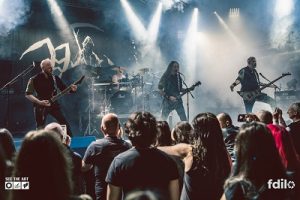
Vreid, a few hours later, performing for the very first time in Romania, Bucharest, Arenele Romane, 15 April 2026
© Florin Diaconescu
They will. We, as Romanians, are very close to Vreid and Windir, especially in the black metal community.
Jarle Kvåle: Indeed, we can notice that already.
We also see how people react during shows. There is a big difference between countries.
Further north, in Scandinavia, people are more chilled, standing with folded arms, though they are enjoying it. I am the same, so I cannot complain.
But the further south or east you go, people become more passionate and give more energy back. That is what you want, as a musician. You want energy from the audience. If you get good energy, then you give more back, and it builds the momentum you want.
It is a symbiosis.
Jarle Kvåle: Yes, yes!
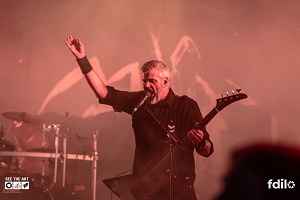
Jarle Kvåle of Vreid, a few hours later, performing for the very first time in Romania, Bucharest, Arenele Romane, 15 April 2026
© Florin Diaconescu
What is one lesson you learned through your discography and through life?
Jarle Kvåle: Never look back.
You cannot do anything about it. Of course, I studied history, so look back in that sense. But if you keep looking back with regret and thinking what you should have done, it is meaningless.
We make mistakes every day. You cannot do anything about them afterwards. March forward.
Life is only this long, and if you spend it regretting things you have done, it is meaningless.
Do not give a fuck. Look forward and have a good time.
I see. As we are about to wrap up, do you have any message for your supporters?
Jarle Kvåle: First of all, I am grateful. Big thanks to them for supporting us, because without that we would not be able to travel the world and meet all these people.
I just hope they continue to listen to our music and come to our shows, and we will give them one hell of a good time.
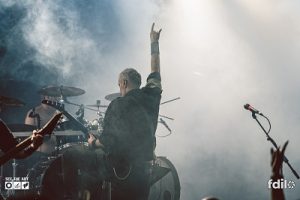
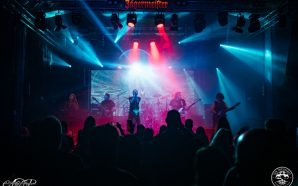
Vreid, a few hours later, ending their performance in Romania, Bucharest, Arenele Romane, 15 April 2026
© Florin Diaconescu