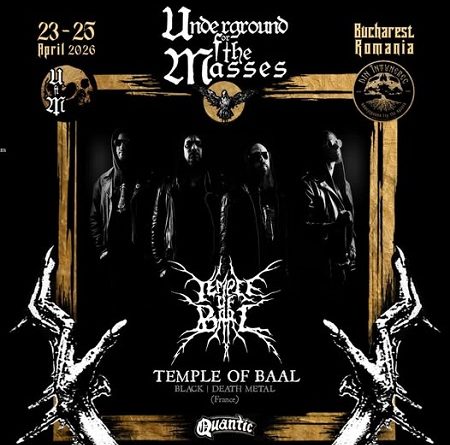
Forged in the flames of the French underground, Temple of Baal stands as one of the most enduring and uncompromising forces in black metal. Blending savage aggression with a dark, ritualistic atmosphere, the band has spent decades refining a sound that bridges traditional black metal ferocity with death metal intensity. From their early works to their latest offerings like Mysterium, Temple of Baal continues to channel chaos, darkness, and spiritual extremity. With their upcoming appearance at Underground for the Masses this week, the band is ready to bring their infernal energy to the stage once again. We spoke with them about their origins, evolution, and the fire that still drives them forward.
DinIntunerec: Hello, thank you for getting on board with this interview. Can you take us back to the early beginnings of Temple of Baal? How did the band form and what was the initial vision?
Amduscias: Hello, and thanks to you ! Temple of Baal was created by myself in 1998, originally to bring back the spirit and music of early black metal. It was, so to say, a reaction against the symphonic black metal trend, and the polishing of the genre that ensued.
DinIntunerec: The name “Temple of Baal” carries strong occult and historical connotations—what inspired it, and what does it represent for the band?
Amduscias: It is linked to the Occult of course, because that’s what black metal should be, in my opinion. Baal is linked to fire and lightning. The word Baal is also a honorific title that means Lord. It is also the name of an ancient god, and the name of a demon. Hence, there can be multiple interpretations of the name, and to be honest I think it’s much more interesting today to have the listeners make their own. Ours… Evolves as well, I think. Nothing is made of stone and rigid, but of course, originally, the interpretation was that of the Left Hand Path. Today in my own interpretation of it, it’s something larger.
DinIntunerec: How did the French black metal underground of the late ’90s and early 2000s influence your sound and identity?
Amduscias: Originally, the French bands that might have had an influence on Temple of Baal might have been bands like Vlad Tepes, Mütiilation or Antaeus in another black metal style. There was also a common spirit within the scene at that time, we had great relations with the whole Parisian scene, but also with the South West scene, Malhkebre for example have always been great friends. There was a sane emulation, I guess, and a creative boiling. We were all, in our own way, pushed to create by a force that was stronger than us all. We all listened to the demos and albums of one another… Great times.
DinIntunerec: Looking back at your debut Servants of the Beast, what were you aiming to achieve at that stage?
Amduscias: The aim was only to play very traditional black metal, influenced by Darkthrone, Bathory, Gorgoroth… With a strong statement on black metal being a Satanic music, when more commercial and polished bands were starting to dwell on concepts that weren’t even occult… We got good words about this album, and others that thought we were just rehashing old recipes… Anyway, it was our statement at that time, it was something we HAD to do this way.
DinIntunerec: Servants of the Beast has a very raw and aggressive energy—how do you view that album today in the context of your evolution?
Amduscias: It’s much more simpler than the music that we did afterwards, but I still cherish this album. There are great songs. Slaves To The Beast, Towards Eternal Death… The only thing that sucked was the original mastering which was very muddy. Adipocere Records just released a new edition in digipack, that has been remastered by Déhà, whom you might know for his numerous activities, and man, he did a stunning job. Finally, the album sounds the way it should have.
DinIntunerec: With Traitors to Mankind, there seems to be a stronger black/death balance—was that a conscious direction?
Amduscias: I would rather say it’s quite a black/thrash album. It has also got a few atmospheric touches and hints of depressive black metal, which is not very surprising considering my state at that time. I don’t think it was such a conscious direction… For the thrash influences, you have to take into consideration that I am, originally, quite a thrash metal person.
DinIntunerec: Traitors to Mankind is often seen as a defining release—what did it represent for the band at the time?
Amduscias: Indeed it was, to me, and it is still a release I hold in high esteem. There were lots of personal emotions in this record, in the music and in the lyrics. It was a great step forward compared to our first album, with more personality, I guess. Also, it was very well produced and mastered. It still holds the test of time even 30 years after. I think it ages very well.
DinIntunerec: Lightslaying Rituals feels darker and more ritualistic—what themes and atmosphere were you exploring on that record?
Amduscias: We dwelled on themes like heresy, opposition to the dogmas, to the herd mentality, the development of critical spirit, of intelligence and reflection. All of this, in our esoteric manner and vibe.
DinIntunerec: How did your songwriting process evolve during the creation of Lightslaying Rituals compared to earlier albums?
Amduscias: The point is that I had switched to a seven strings guitar at the end of Traitors To Mankind era and you can already hear it on Traitors. There’s also the fact that we all have listened to death metal in our history and so the death metal vibes were more prominent on Lightslaying Rituals. We also had a second guitar player for the first time, because our songwriting and arrangements were becoming more complex, more worked out.
DinIntunerec: On Verses of Fire, there’s a strong sense of refinement and intensity—what was your main goal with this release?
Amduscias: We wanted to bring back some black metal aspects that were missing a bit on Lightslaying Rituals. So, this album is a kind of blend between aggressive and violent tunes (Bloodangel for example) and more atmospheric and ritual, meditative moments even incorporating progressive structures (Walls of Fire). The spiritual aspect gets also more refined and rich, with more lyrics inspired by Crowley, Thelema, and the result of personal meditation, ritual experiences, emotional experiences, channeled into music.
DinIntunerec: Your latest album, Mysterium, feels both expansive and cohesive—how did you approach its composition and overall concept?
Amduscias: Mysterium is an extension of Verses Of Fire, but it’s more and more complex and progressive, and even more « black metal » in its approach. The concept deals with the mysteries of Faith and Death. Faith is personal and often very hard to explain. You feel it or you don’t. It’s not even a question of « believing », it’s really a question of feeling it deep within. So, the lyrics are reflections on this unexplainable dimension, and they also explore very much the concepts of Death, the Afterlife, the Beyond.
DinIntunerec: Across your discography, how do you balance the raw aggression of black metal with the heaviness and precision of death metal?
Amduscias: We actually don’t THINK about it. We compose as we go. I know that Saroth does the same as me. There comes a time when we take our guitars, plug in, and just let our minds flow. We record what we do, and afterwards, put it in shape of a song, using the best parts of what we’ve done. Sometimes, also, the song just builds up, from a riff.
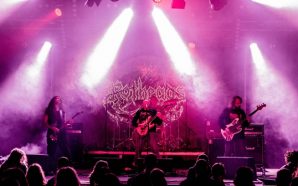
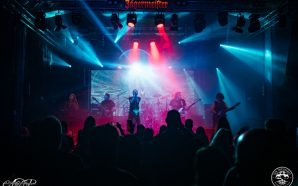
DinIntunerec: You’re set to perform at Underground for the Masses this very week—what can fans expect from your live performance?
Amduscias: Pure raw energy and hopefully a great alchemy with the crowd. Temple of Baal is a concentrate of emotion and devotion, its great work is spiritual transcendence through music. The energy grows even higher when the crowd goes wild and a virtuous circle ensues. The wilder you’ll get, the more energy we’ll give.
DinIntunerec: After so many years, how do you keep the creative fire alive while staying true to your identity?
Amduscias: It’s all about passion and devotion. And some kind of connection with the beyond. Of course, as life goes by, the connection can be blurred or sometimes lost, but eventually it comes back… Because there is nothing but sincerity and honesty in everything we do.
DinIntunerec: What were the main obstacles that you had to overcome during your activity?
Amduscias: Errrrrr… Being French I guess ? Haha ! It’s never been an easy task playing metal in France and trying to get your name over the world. Also, our everyday life has made somehow things complicated. But, you learn patience, humility, and to enjoy what you can.
DinIntunerec: What is the most important life lesson that you have learned so far?
Amduscias: Never totally place your trust even in your most close ones. Always keep a way out.
DinIntunerec: Looking ahead, what is the next chapter for Temple of Baal? Are there new ideas or directions already taking shape?
Amduscias: For the moment, we are only back to play live. Maybe it will inspire us to write new music, but I really don’t want to rush things and announce something that we can’t be 100% sure. It’s been a while since we haven’t played together. We have to rebuild the egregore, and see where it will lead us.
DinIntunerec: Thank you for your time, any final words for our readers?
Amduscias: Thank you for yours ! We’re really looking forward to playing in Romania, a country we’ve never had the chance to play before, so it’s pretty exciting. We hope to see you going fucking possessed during our show!
With a legacy built on fire, conviction, and unwavering dedication to the underground, Temple of Baal continues to stand as a pillar of French black metal. Their music embodies both chaos and control, blending raw aggression with ritualistic depth in a way few bands can match. As they move forward—on record and on stage—they remain a force that refuses to fade, instead burning ever brighter in the darkness.