“Metal is death. Death is metal. Nunslaughter, death metal”.
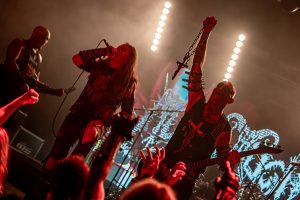
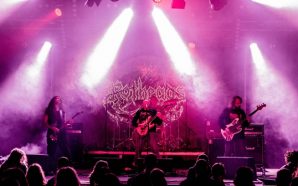
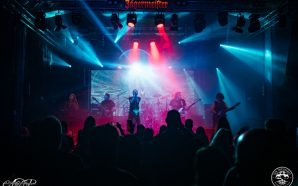
Nunslaughter live at Quantic [30 June 2026]
© Florin Diaconescu [Metalfan]
But before the gig organised by Official Romanian Thrash Metal Club began, an interview with Don took place.
Don spoke at length about his early days with Death Sentence, the thrash metal band formed in 1985, about the transition to death metal and, naturally, the [unholy]birth of Nunslaughter, about how James Paul Konya, known as Jim Sadist, motivated the band, and about the new album, “Satanic Chaos Legions”. He also spoke about their future plans, which include another full-length.
Hi. It is a genuine pleasure to have you in the pages of Din Întunerec. Thank you for setting aside a fragment of your time amid rehearsals, travelling and the endless march of death metal. Time has swallowed countless bands, yet few names have endured with their fangs still bared as long as Nunslaughter. Let us step into the fire together.
When you look back to those earliest days, what set everything in motion?
Don: Hi.
Thank you for doing this interview.
The first band that I was in was called Death Sentence, and we were kind of a thrash band. But one of the guys in that band, the drummer, and I, who was the singer, didn’t want to play thrash metal.
We wanted to start a death metal band. And the big reason we wanted to have a death metal band was the fact that where I grew up in Pittsburgh, Pennsylvania, there were no death metal bands.
So, we decided we wanted to be the first death metal band from our area, and that’s what started Nunslaughter. That was why Nunslaughter began.
The first song we composed under Nunslaughter was “I Am Death”. Actually, I wrote the lyrics for that song when I was in Death Sentence, and the drummer saved them.
Then we came to the first practice of Nunslaughter, he pulled out the lyrics, and we used them for the first song.
It was a very good time.
You survived changing scenes, changing generations and shifting currents within the underground without softening your identity. Looking back across nearly four decades, what has remained sacred to the band?
Don: I think that the part of the band that is sacred is trying to keep the ‘80s death metal vibe alive. Too many people wanted to change death metal as it went along.
And that’s fine. Those bands went on to be very successful. But I like the origins of the music and the craft.
That’s kind of what I tried to keep going with Nunslaughter. And then, even with the new guys coming in and out of the band, they kind of helped me continue that. They didn’t want to impress their kind of… what they thought death metal should be. They let me kind of run with it and kind of sided with me.
What has naturally changed with time?
Don: I think mainly we have much better musicians than we started with. I mean, I’m not a very good musician to begin with, but the people I’ve had in the band over the last 10 years or so are much better musicians than the ones we started with.
So, we were able to play the music better and craft the songs better.
Why are you saying that you are not a good musician?
Don: I was never a good musician. There are plenty of reasons.
For example, I wrote quite a few songs on guitar, but I just wasn’t very good at it. I reached a certain point, and that was as far as I could go.
I haven’t picked up a guitar in almost 10 years. Well, maybe not 10 years, but at least five.
Yeah, I’m not a very good musician.
Across your work, Satanism and death appear as constant reference points. Where did your fascination with these themes in lyrics begin?
Don: Even as a kid, I never thought that Christianity offered the world anything. And I had to go to church because my mother said so. But I never really believed in the whole religion thing.
As a young person rebelling in the usual way, I moved in the opposite direction. I became more interested in the bands, their lyrics, and the stories they told than in religion or ideas about God. That interest pulled me in quickly. Much like someone drawn to horror films and horror literature, I was attracted to music and lyrics centred on the Devil, Satan, Hell, and similar themes.
Every long road leaves behind places worth revisiting. Let us return to a few chapters of your discography before we speak of the present. “Hells Unholy Fire” was your first full-length album, arriving after years of demos, EPs and splits had already cemented your reputation. When you finally crossed that threshold in 2000, what was the thought that stood before all the others? What convinced you that the time had come to commit Nunslaughter to a full-length record?
Don: Actually, it was the band member Jim Sadist who pushed for a full-length album. And we got a label that actually solicited us to record an album.
I didn’t want to put out a full-length album, but Jim did. And it was through him pushing the band, or pushing me, to get into the studio for a full-length album. That was really the only reason.
I wasn’t interested in a full-length album, but he was. So, we went and we recorded “Hells Unholy Fire”.
Do you see that the record still represents the band?
Don: I think it represents the band very well. A little sloppy. Some of the songs are a bit amateurish. I mean, I wrote some of those songs when I was 16 or 17.
So, I wasn’t a very good songwriter, but I knew I wanted to make music. I just didn’t know how to. But I think “Hells Unholy Fire” represents that period of the development of Nunslaughter very well.
When you look back at “Hells Unholy Fire”, which song still stands above the others in your eyes?
Don: The number one song would be “I Am Death”. It sums up my attitude about death metal.
Some ideas find their purest form in a single song. Others demand the space of a full record. And every musician has an album that listeners return to time and again.
For many listeners, “Goat” from 2003 is that record. Tell me when you created it, did you realise you had created something that would become one of your most celebrated records?
Don: No, because the majority of the album was made up of demo songs.
It wasn’t my favourite record. It wasn’t my favourite recording, and that had a lot to do with it.
When it was recorded, it wasn’t in the correct tuning. We, in Nunslaughter, tune to C. And the guitarist that we had at the time, even though he practised all the songs in C, in the studio he played them in D, which was very frustrating. It just wasn’t heavy enough for me.
It’s more of a thrash sound, and I wanted a little heavier sound for the album. And we were just putting it out, you know, again, just for fun.
It did get a really good response. It’s probably the best-received and best-selling album that we have.
That’s a good part, I suppose. A lot of the songs from that album are still played live.
Yes, I’ve noticed you’ve been integrating songs from “Goat” into your live sets. And this year you also have material from “Satanic Chaos Legions” to bring to the audience.
Speaking about your latest album, which arrives five years after “Red Is the Color of Ripping Death”, can you tell me one song that you truly worked hard on?
Don: I would have to say the song “Heavenless”, and not just me, but as a band we put a lot of work into it. It was originally cut from the album and we did not intend to include it at all. Our A&R person asked for a bonus track, and at that point the song was not even finished.
We went back to the reels and listened through what we had. We realised there was this one track with no title, so we decided to finish it and see how it would sound. Once the title and lyrics came together, and Tormentor, or Noah, wrote the lyrics, everything started to fall into place. He then added his production work, and when we listened back, it felt like it had become something stronger than we had expected. I am glad it ended up on this version of the album rather than being left in a studio folder, never heard again.
After we brought it back to life, “Heavenless” became my favourite track on the album.
There’s one particular line in the song that has stayed with me: “bow to no one”. That pretty much sums up my life in musical terms: bow to no one.
That is probably the strongest way anyone could describe a life in music. Beyond that line, tell me, what else do you appreciate about the new album?
Don: What I also like about the rest of the album is that all the songs are newer material. We did not really draw from older demo ideas. That made the recording process easier and, in my view, better. Because Noah, Tormentor, owns a studio. That is where we recorded the album, and we were able to spend a few days demoing the tracks as we thought they should sound.
From there, we rearranged them where needed and shaped them more carefully. Having that time and access to a studio allowed us to refine the songs properly. Normally, bands go in, record, and hope they have made the right choices. We had the space to adjust things, and I think that helped make the album stronger than it might have been otherwise.
“Satanic Chaos Legions” struck hard.
Don: Haha, thanks!
Over the years, you have used at least twenty-five different logos, each with its own identity. What inspired those constant visual transformations instead of remaining with a single emblem?
Don: It actually started when we first formed the band. A friend of ours designed the first logo. It wasn’t necessarily great, but we didn’t know any other artists, so we used it.
Then, for the second demo, I thought, “I’ll draw one myself…”. It was better, but after we released it, we still felt it wasn’t quite right. So, we tried a third one, then a fourth one.
After that, artists simply started sending us their own versions. Someone would say, “Here’s a Nunslaughter logo I drew…”, I’d think, “That’s cool!”. Then another one would arrive, and I’d think, “That’s cool too!”. So, I started using them on different releases.
It wasn’t something I consciously planned. I was always searching for what I thought would be the perfect logo. To be honest, I’m still searching.
We still receive new logo designs every now and then, although nowadays we mainly use two of them. Each one works better in different situations. One looks better on T-shirts, another works better on flyers, so we switch between them.
I see. The search never really ends.
Don: Yeah. I guess the search never really ends.
I would also like to speak with you about James Paul Konya known as Jim Sadist. He remains a key figure in the history of the group. How do you remember him?
Don: He was the most talented musician I have ever known.
I looked up to him. When you find someone who can write songs so easily, you know there is a real connection. I think back to times when we were working on a song and it was coming out one way, but in my head I heard it differently. Before I even had the chance to explain what I wanted changed, Jim was already telling the guitarist to play it that way. I would just think: “That is exactly what I was going to say!”.
There was a strong symbiotic relationship between us. We normally butted heads when writing because we were both strong-willed about the music, but neither of us ever took it personally. On the full-length record, “Angelic Dread”, it was different. That was the easiest record we ever made, because I think we finally learned to work with each other rather than against each other. We stopped fighting every decision. If Jim wanted something a certain way, I would accept it, because I knew I would get my way another time. That was the first time the process felt balanced.
Unfortunately, it was also the last record we recorded together.
Beyond the musicianship, which was exceptional, Jim was genuinely a good person and a great friend. That is what I remember most.
Did you feel that, when composing the new album, his presence or instincts still guided you?
Don: Definitely. And not only then. On “Red Is the Colour of Ripping Death”, even the title came from something he said. I would never want him to be disappointed in what we do. Everyone in the band knew him at different stages, and he influenced all of us in different ways, so that stays in mind whenever we create something.
He comes up more often than people would think, during rehearsals and recording. Even in “Red Is the Colour of Ripping Death”, there is a direct reference to him in the lyrics.
So yes, he is always close to what we do.
Every time I go on stage, I think about him. Especially today, being the first time we play in Romania. I keep thinking how much I wish he could be here with us. I also think he would be proud of us being here tonight.
Every first concert in a new country has its own character. How does it feel to finally be here in Romania?
Don: Great! It’s fantastic to be finally here. I’ve been talking to Christina Cutler. Do you know her? Eric Cutler’s wife. We talked several times about bringing Nunslaughter to Romania, back around the Old Grave Fest days, and I was really excited about it.
For whatever reason, it just never worked out. But when I came here on a motorcycle trip, Christina gave me some great recommendations for places to visit and roads to ride. When we finally arrived here this morning, I took pictures of the concert hall.
I sent them to her and asked something like, “Do you still miss Romania?”. She replied, and that was really nice. What a fantastic country! The countryside is absolutely beautiful.
And I love the roads. I know there aren’t many highways, but that’s perfect for someone who just wants to ride a motorcycle.
Apart from music, motorcycles are another passion of yours.
Don: Yeah. This is all I do. I either ride motorcycles or make music. I don’t have a regular nine-to-five job, so I’ve been very fortunate in that respect.
Whenever I can, I ride. I like travelling to different countries on a motorcycle. A couple of years ago I rode through Vietnam and Scotland, and I’ve travelled all across Canada. Two weeks after I get back from this tour, I’m heading out on another ride in the United States, so I’m really looking forward to it.
Great! That sounds like quite a plan. Do you have any plans for Nunslaughter as well?
Don: First, we’ll finish this tour. We’ve got about twelve more shows left. Then we’ll head home for a couple of months.
At the end of the year, we’re going to South America for about two and a half weeks. Hopefully, early next year we’ll put together a US tour to continue promoting this album.
In the meantime, between the South American tour and the US run, we should have about eight songs ready. Hopefully we’ll flesh those out. It probably won’t happen in 2027 because we still want to give this album time, but it definitely won’t take another five years.
Could a few details be given about the new album?
Don: We don’t have any titles yet, but the music is already written. Noah will be recording everything at the studio again, and most of the songs will probably be about Satan. What a surprise!
That’s about as far as we’ve got.
We recently opened the folder with those recordings and listened back to them. As we work in the studio, whenever a good idea comes up, we make a rough recording and save it. That’s exactly how “Satanic Chaos Legions” was written over several years.
It just so happens we’ve already got about eight more songs sitting there. I’d like to have demo versions of them finished by the beginning of next year.
The future is already being written, but so much has changed since Nunslaughter first began. Looking back, do you think today’s scene is very different from the one you started in?
Don: Definitely.
I think music is much more accessible now. Maybe that’s also why people don’t spend as much time with a band. They can simply click on the next one. If they don’t like one song, they move on immediately.
It was very different back then. When I bought an album, it was often all I could afford. I took that one record home and listened to it all week because I couldn’t afford another one until the following weekend. I really got to know those albums inside out.
The same was true of demos. Before tape trading became common, you’d order a demo and then wait weeks for it to arrive in the post. Once it finally showed up, you’d listen to it over and over again. Later, when tape trading took off, you could get several demos on a single cassette, but you still spent far more time with each band and each release than most people do today.
Nowadays, people tend to skip from one song or band to the next. I think that’s the biggest difference.
Is it a bad thing? I don’t know. I wouldn’t say it’s bad. It’s just different.
Finally, the last question belongs to your listeners. What message would you like to leave for the Romanian underground before your first appearance here?
Don: I’d like to end with something Jim used to say. It’s printed on a lot of our shirts and appears on a lot of our records:
“Metal is death. Death is metal. Nunslaughter, death metal”.
I think that sums up the band and our attitude towards underground music.



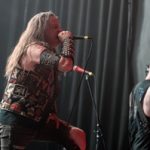

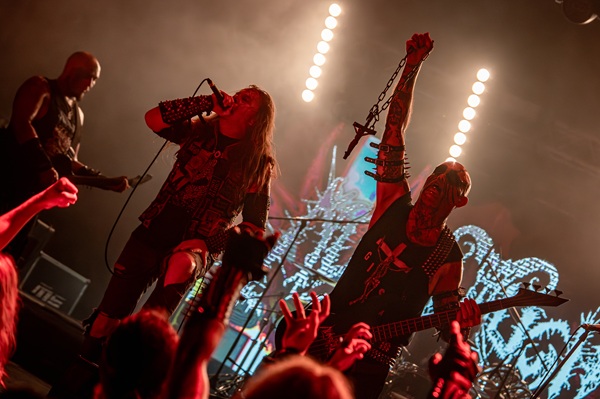
Nunslaughter a few minutes later in Quantic
© Florin Diaconescu [Metalfan]