When the sky cracked open, the hawk flew above a cursed blade.
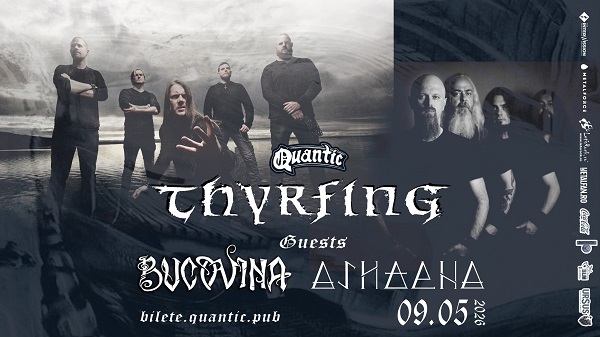
Thus, in but a handful of words, might one recount the story that unfurled at Quantic in Bucharest on 9 May 2026. That evening, the Romanian scene beheld and heard three names: two sprung from our own soil, Ashaena and Bucovina, and one borne from Sweden, Thyrfing. The occasion was defined by pagan black metal, folk metal, and viking/black metal, and marked by returns and first appearances upon the stage. While Bucovina and Ashaena had crossed our path in years gone by, Thyrfing were welcomed for the first time, and the hour was made all the more singular by their wish to bring before the listeners the very first song they had ever written.
What might otherwise have faded into a dull and forgettable night became, instead, one worthy of being carried in memory.
Official announcement poster
© Quantic
In the Beginning, the Sky Cracked Open
To Ashaena fell the charge of opening the evening. Ashaena was, in the beginning, a one-man band created by Cosmin “Hultanu” Duduc. In time, other devoted members joined the fold, and the discography grew bounteous. A portion of that legacy was brought to Quantic, there to remind all assembled of the mythology and history of Romania.
The current incarnation of Ashaena bears two full-length records to their name: “Cei născuți din pământ”, released in 2009, and “Calea”, issued in 2016. It was plain enough, dear reader, that the Romanians would hasten to place the title track from the latter album upon our ears. “Calea”, a composition stretching beyond seven minutes, swiftly seeped into the souls of those gathered before the stage. Such was owed not merely to the members’ vocal and instrumental prowess, but likewise to the marrow of the song itself.
“Calea” speaks of unwavering kinship to land and blood; of souls standing sentinel against war, death and the cold murk that creeps at the edge of the world. It is a hymn to forebears carried in the veins, to endurance beneath the forest eaves, to justice and light upheld as an eternal creed whilst ruin prowls ever near. There is in it the old oath of those who know they may perish, yet stand fast nonetheless beneath the sacred sign of the sun.
And if the air had already begun to smoulder from the outset, then naught remained for the band save to keep the blaze alive. So they sang of skies splitting asunder, of accursed demesnes trampled beneath hostile soles, of gods and of the wild places of the earth. By now, I deem, dear reader, that you have already divined from these descriptions which songs were summoned forth. If not, then let me speak plainly: “Crăpat di cer”, “Tapae 87” and “Moş urs”, all drawn from their most recent album.
Though I wrestled with myself at first, by the close of the night I had settled the matter within my own mind: of all the songs performed, “Moş urs” touched me most deeply. In truth, it was to its rhythms, carried through my headphones, that I departed from Quantic once the night had breathed its last. Yet more of that anon.
For now, however, I shall set down two further things that left their mark upon me during their set. The first concerns the band members themselves: the astounding vocal passage during “Crăpat di cer”, and the formidable display behind the drums throughout “Calea”. The second belongs to the crowd gathered within the hall: their receptiveness stirred me greatly, and I found a grim sort of joy in hearing the cry of “no” rise in unison when the band announced that “Moş urs” would be the final song of their repertoire.
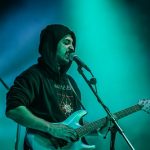
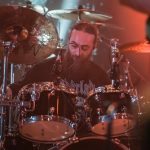
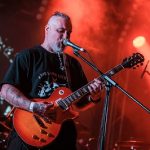
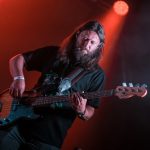
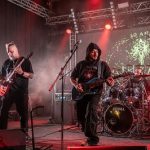
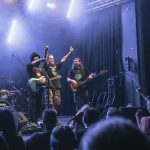
Ashaena, caught between rhythm and rite, during their set at Quantic, 9 May 2026
© Florin Diaconescu
Then the Hawk Took Flight, and Word Turned to the Last Winter
Next came Bucovina, a gathering of souls scarcely in need of introduction. For many among us, the Romanians marked childhood and adolescence alike through songs such as “Luna preste vârfuri” from “Ceasul aducerii-aminte” released in 2006, “Duh” from the 2010 EP of the same name, “Sub Piatra Doamnei” and “Șoim în văzduh” from the 2013 album “Sub stele”, and “Ultima iarnă” from “Nestrămutat”, issued in 2015. It is simple: here we turn our attention to nature, without drifting away from Romanian folklore. And thus, we enter the sphere of folk metal.
The band members know that the aforementioned songs have been with us, and whenever they ascend the stage, they choose to place them once more into the ears and hearts of those gathered before them. So it was at Quantic, where each composition found its rightful place within the evening’s unfolding chronicle.
Bucovina stepped upon the stage with their customary hunger for performance and communion with the crowd. Among the first songs performed stood “Duh”, which granted Bogdan Luparu and Florin Ţibu, known to many as “Crivăţ”, the chance to trade fierce vocal passages between themselves, whilst the remaining instrumentalists likewise left their own imprint upon the performance.
“Duh” struck true with the audience. I heard countless voices rise together during the song’s closing passage, and the same scene repeated itself throughout the pieces that followed, most notably during “Cărări în suflet” from “Nestrămutat”, alongside “Ultima iarnă” and “Sub Piatra Doamnei”.
Now, dear reader, I must admit that there is always something deeply stirring in witnessing the mingling of generations during a Bucovina concert: seeing young and old alike know the lyrics, record the songs, live within them. I have long believed the peculiar magic of this band lies precisely there. The members possess the gift of drawing together countless strangers beneath the same roof; folk who may never have crossed paths before, yet who join their voices as though they had marched side by side for years. Or who are fated to meet for the very first time within the mosh pit itself, for yes, before the end of the concert, we were granted that sight as well.
We were also given a cover of “Legends of Fire and Ice”, originally released in 2011 by Demonaz. According to Crivăţ, the song was dedicated to an old friend of the band.
And when the hourglass revealed that the evening was drawing to its close, the members closed their recital with “Spune tu, vânt” from “Sub stele” and “Mestecăniș” from the EP “Duh”. A fitting close to the performance, answered with heavy applause from every corner of the hall.
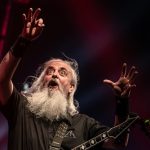
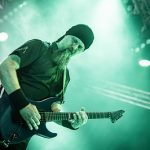
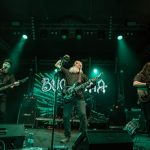
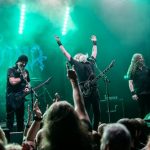
Bucovina before the gathered crowd, where the past found breath again and was spoken aloud through many throats [Quantic, 9 May 2026]
© Florin Diaconescu
By the End, the Blade Fell
The blade arrived without warning. No common blade, either. We speak here of Thyrfing.
A band with a vast and timeworn discography, the members’ roots are deeply sunk in Sweden. And they placed Romania upon the map of their live appearances for the very first time. What stands out about Thyrfing is the manner in which they choose to answer for themselves through their lyrics. Upon a first listening, one might believe their words merely retell the old myths and sagas as they once were. Yet the deeper one treads into their catalogue, the clearer it becomes that something else lingers beneath the surface, something that sets them apart from many other viking and black metal bands.
The crowd gathered at Quantic came to understand this over the course of the entire recital.
Yet the first thing the beings had to realise that evening was far simpler: Thyrfing came prepared. They did not treat their stop in Romania as a mere mark upon a long ledger of live appearances.
The first thing to claim our gaze was the stage setting itself. Two tattered banners stood flanking the drums. Then came a piece meant to usher us into their vision of the world. Only after that, a few heartbeats later, did the members appear one by one upon the stage.
They wasted no time with needless exchanges between themselves and the people gathered before the stage. Straight away, they unleashed “Mot Helgrind” from the 2013 album “De ödeslösa”, much to the delight of those standing in the front rows. As the song unfolded, I could not help but tell myself it had been a wise choice, for the piece granted the band the chance to reveal from the very outset precisely what they were capable of. I watched Jens Rydén and Patrik Lindgren living wholly within the moment, surrendering themselves to the lyrics and the rhythms alike, and I found genuine joy in witnessing that. After all, what could be finer than seeing the members of a band present in both flesh and spirit?
They continued with “The Voyager” from “Vansinnesvisor”, released in 2002, alongside “Vargavinter”, which first found its place upon the 1996 demo “Hednaland”, an old composition bearing such renewed breath that one could scarcely resist headbanging to it, and with “Storms of Asgard”, first released as a single in 1999. Now, “Storms of Asgard” is a piece that carries a particular significance for the entire band, as Lindgren himself also stated in the interview conducted prior to the concert.
Naturally, “Fredlös” and “Jordafärd” could not be absent either, two songs drawn from their latest album “Vanagandr” [2021], and favourites of Rydén himself, as he told me during the interview. What more is there to say? They guided us through the breadth of their discography, while also taking a moment between songs to express their gratitude for performing in Romania for the first time:
“We are really glad to be here, for the first time in Romania. Did you know that this band was around for 30 years?”
Thirty years, no small feat. They know that. And they gave their best during the show. A striking performance. I do not believe there was a single soul within the hall left dissatisfied by it.
Nor do I believe there was anyone who failed to cast at least a glance towards the merchandise stand, which offered a wealth of finely crafted items. It is known well enough by now: at concerts held in Quantic, one arrives with a full purse, for it would be a pity to desire something only to leave it behind.
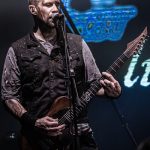
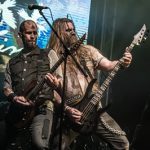
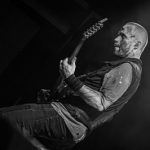
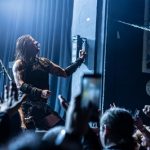
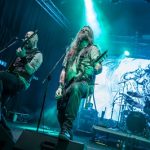
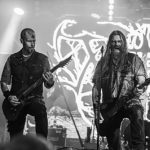
All in all, it was a triumphant concert, one that shall remain with me for a long while yet, and one for which I remain more than grateful to have witnessed.
Till next time.
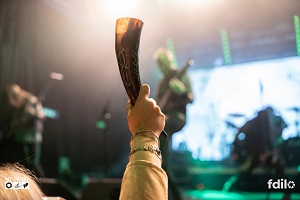
The crowd at Quantic, 9 May 2026
© Florin Diaconescu