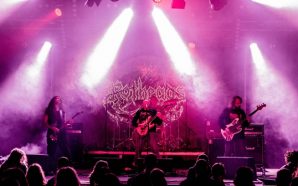
Few names carry the same weight and mystique as Varathron. Emerging from the primordial fires of the early Greek black metal scene, the band has spent nearly four decades shaping a sound that is both arcane and unmistakably their own—steeped in ritual, melody, and dark atmosphere. From the legendary His Majesty at the Swamp to the more recent The Crimson Temple, Varathron has remained a cornerstone of Hellenic black metal. Now, with a special appearance at Underground for the Masses this April—celebrating 38 years of unholiness—the band prepares to honor its past while invoking new darkness. Hence, an interview was compulsory, delving into their origins, legacy, and enduring vision.
DinIntunerec: Hello, thank you for getting on board with this interview. Can you take us back to the very beginning—how did Varathron form, and what was the vision in those early days of the Greek black metal scene?
Stefan Necroabyssious: We extend our gratitude for your devotion and your interest in our covenant. The entity known as Varathron was conjured in the waning years of the 1988, to be precise, at a time when all things remained unrefined, untamed, and pure. There was no “scene” as it is perceived today only an insatiable compulsion to manifest. The vision was absolute: to forge something obscure, atmospheric, and profoundly spiritual, severed from trends and superficial decay. We did not merely form a band we unsealed a gateway. Every rehearsal, every primitive recording, every exchange of thought became part of a greater invocation. The Greek reality, its history, and the metaphysical dimension of existence have always pulsed at our core.
DinIntunerec: The name “Varathron” has a very distinct and ominous feel—what is the story and meaning behind it? In Greek, it means “extremely deep gorge”, therefore how does it convey your artistic message?
Stefan Necroabyssious: The name “Varathron” was chosen for the primordial weight it bears. As a concept, the “βάραθρον / varathron” evokes the unknown, the abyssal depth, the fall and the revelation that follows. It is not merely a physical chasm, but a symbolic passage. It signifies the descent into the inner darkness, where one is forced to confront their ultimate truth. This is the essence of our artistic doctrine: spiritual and inner exploration without fear. In ancient Greek perception, Varathron was both a place of punishment and a threshold a descent into realms where transformation is achieved through the annihilation of the self. This duality stands at the heart of our expression. The name embodies a conscious surrender to descent, a willingness to abandon the surface and embrace the uncharted depths. It reflects our artistic dogma.
DinIntunerec: How did the early Greek scene shape your identity, especially alongside other pioneering bands of that era?
Stefan Necroabyssious: The early Hellenic black metal current possessed something singular- an authenticity seldom encountered today. There was a shared current, yet each entity retained its own identity. We did not seek to mirror Scandinavia; we carved something inherently our own: more ritualistic, more epic, more imbued with melody. This divergence defined us and preserved our essence through time. Communication was scarce, yet the bond among those involved was instinctual and profound.
Alongside Rotting Christ and Necromantia, we formed a triadic manifestation of a unified current, each channeling distinct facets of the same dark force. There was mutual respect, and an unspoken understanding that each entity walked its own path. We sought no validation from external movements, nor did we mimic northern aesthetics. Instead, we turned inward toward our heritage, our mythology, our inner past. The result was a sound steeped in ritual depth, melodic gravity, and an aura of primordial presence. The Hellenic scene stands among the strongest manifestations worldwide.
DinIntunerec: Your debut His Majesty at the Swamp is considered a cornerstone of Hellenic black metal—what was your mindset when creating it?
Stefan Necroabyssious: With His Majesty at the Swamp, the approach was purely instinctual. There was no strategy, no contemplation of how it would be perceived. It was a raw manifestation of the era and our inner state. We sought to capture an atmosphere something akin to ritual, to invocation. Each composition emerged as a fragment of a greater unseen structure, like pieces of a ceremony assembling itself without full awareness of its final form. The swamp became a symbol a realm of decay and stagnation, yet also of concealed life and ancient presence. It embodied the subconscious, the buried strata of existence where forgotten entities dwell. The result was spontaneous and perhaps for that reason, it remains authentic to this day.
DinIntunerec: His Majesty at the Swamp has a unique blend of atmosphere and melody—how did you approach that balance at the time?
Stefan Necroabyssious: The balance between atmosphere and melody arose organically. It was never calculated. Our influences already carried this dual nature darkness intertwined with epic resonance. Melody was never “beautiful” in the conventional sense; it was haunting, archaic, and subservient to the overarching atmosphere. These melodies did not stem from technical intention they surfaced as if guided by unseen forces, shaped beyond conscious control.
There was an innate pull toward minor tonalities, repetitive structures, and hypnotic rhythms elements that deepened the sense of descent. The atmosphere was dense, suffocating, yet within it, the melodies functioned as threads leading the listener deeper into the labyrinth. This equilibrium was never perfected by design; it manifested through the act of creation itself. In many ways, it defined what would later be recognized as the Hellenic sound.
DinIntunerec: Can you walk us through the creation of His Majesty at the Swamp from writing the music to recording it? Also, tell us a bit about the album’s artwork.
Stefan Necroabyssious: The creation of His Majesty at the Swamp was a raw and unfiltered process. The compositions were forged through immediate emotion, without excessive refinement. In the studio, we preserved that primal energy we refused to cleanse the sound to the point of losing its spirit. The recording conditions were limited, almost primitive, yet this became an advantage. It retained the rawness, the imperfection, the unfiltered essence of the material. No attempt was made to beautify beyond necessity. The cover artwork serves as a visual extension of the music a symbolic gateway into the swamp itself. It stands as a threshold, urging the observer to abandon clarity and embrace the obscure, the decayed, and the concealed.
DinIntunerec: With Walpurgisnacht, there’s a darker and more occult atmosphere—what themes were central to that release?
Stefan Necroabyssious: With Walpurgisnacht, we traversed deeper into occult pathways. The themes revolve around ritual, dark forces, and the communion between humanity and the transcendent. There was a heightened inwardness a deeper descent into the arcane. The atmosphere grew denser, more suffocating, like a night from which there is no return. The concept of Walpurgisnacht, rooted deeply in European esoteric tradition, became the axis upon which the work revolved. It is the night of convergence the moment when boundaries dissolve, when entities cross, and rituals reach their apex. The album embodies this energy through its darker intensity and its focus on transformation, invocation, and transcendence through forbidden means. It is not merely an exploration, but an active engagement, a sonic ritual designed to summon and channel these forces.
DinIntunerec: How did your songwriting evolve between His Majesty at the Swamp and Walpurgisnacht?
Stefan Necroabyssious: The transition from His Majesty at the Swamp to Walpurgisnacht was a natural evolution. The former bore a raw, instinctive essence, while the latter delved deeper into structure and atmosphere. The compositions became more ritualistic, emphasizing flow and the creation of a cohesive dark journey rather than isolated fragments. Each piece was conceived as part of a broader ceremonial framework. Transitions became deliberate, arrangements more refined, yet without sacrificing the primal force that defined our origins. This progression allowed us to intensify the impact, to move from spontaneous invocation to controlled manifestation. It was not a departure, but intensification, a deeper descent into the same abyss.
DinIntunerec: Crowsreign marked your return after several years—what did that album represent for Varathron at that point?
Stefan Necroabyssious: Crowsreign was a return, not merely discographic, but existential. After years of silence, there arose a necessity to affirm that the spirit remained alive. Its a work bearing maturity, yet without relinquishing the darkness of the past. It stands as a re-emergence of that force a declaration that the path remains unbroken through time. It carries an aura of authority and reaffirmation, as though the entity itself reclaims its position within the continuum. The crow, as symbol, embodies death, observation, and dominion over decay, a fitting harbinger for this phase of resurgence.
DinIntunerec: On Stygian Forces of Scorn, there’s a strong sense of aggression and epic atmosphere—what inspired that direction?
Stefan Necroabyssious: In Stygian Forces of Scorn, aggression was a deliberate invocation. During that era, an inner tension demanded a more immediate and forceful expression. Yet, we refused to abandon the epic element… It remains an integral essence of our sound. The inspiration draws from the Stygian archetype the river that binds oaths, the boundary between realms, the force that punishes betrayal. This conceptual foundation shapes both the intensity and the epic nature of the compositions. The aggression is not chaotic, it is directed, a controlled release of force with purpose. Each passage functions as an invocation of power, amplifying the sense of inevitability and dominion that defines the work.
DinIntunerec: Untrodden Corridors of Hades feels very immersive and mystical—what concepts were you exploring there?
Stefan Necroabyssious: Untrodden Corridors of Hades stands among our most introspective and mystic manifestations. Within it, we traverse concepts of descent, transformation, and communion with the unknown. It is a work that functions as ritual an inward journey through shadowed passages of mind and existence. The “corridors” are not physical constructs, but symbolic pathways through which the soul moves beyond the tangible realm. They cannot be charted nor comprehended through conventional means; they are experiential, accessible only through inner descent. This work seeks to transcribe that passage to render the immaterial into sound. It exists both as guide and reflection a mirror turned toward unseen dimensions beyond death and perception.
DinIntunerec: With Patriarchs of Evil, there’s a powerful balance between tradition and modern production—how did you approach that album?
Stefan Necroabyssious: With Patriarchs of Evil, our intent was to unify past and present. To preserve the authentic Hellenic essence while channeling it through a production capable of conveying its full force. We held no interest in pursuing contemporary trends only in wielding modern means without corrupting the core. The challenge lay in safeguarding the integrity of the original current while embracing advancements in sound and execution. The result is a work that bridges epochs retaining ritual depth and melodic identity, yet presented through a more defined and potent sonic vessel. It is not adaptation, it is reaffirmation of a timeless essence through present-day manifestation.
DinIntunerec: Your latest album, The Crimson Temple, has been praised for its cohesion and atmosphere—what was your main vision going into it?
Stefan Necroabyssious: In The Crimson Temple, the central axis was cohesion. We sought to shape the work as a singular entity with beginning, middle, and end akin to a ceremonial rite. The atmosphere had to remain unbroken, hypnotic, with each composition serving the greater whole. The vision was one of continuous flow, where each piece stands as a chamber within a vast temple of sound. This demanded unity on both sonic and conceptual planes. The outcome unfolds as a singular experience, guiding the listener through successive stages of immersion. It stands as a culmination refined, aligned, and manifested as a cohesive whole. Works of greater maturity, greater focus.
DinIntunerec: Across your discography, how do you maintain the signature Hellenic sound while still evolving as a band?
Stefan Necroabyssious: The preservation of the “Hellenic” sound is not a conscious effort, it is intrinsic to our being. It emerges naturally through influence, perception, and the manner in which we shape sound into meaning. Our approach has always been rooted in melody, atmosphere, and the sense of ritual progression. These elements remain constant, even as form evolves. Evolution comes through time and experience, yet the essence endures: atmosphere, melody, and spiritual depth.
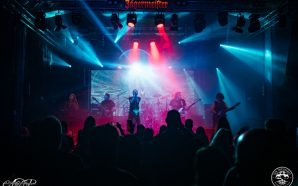
DinIntunerec: You’re set to perform at Underground for the Masses this April, with a special show, celebrating 38 years of unholiness—what can fans expect from this unique performance?
Stefan Necroabyssious: For Underground for the Masses, we prepared something beyond a mere live performance. It is a rite marking 38 years of the Varathron path. The set list will traverse multiple eras, yet maintain a continuous flow and experiential integrity, featuring compositions of particular significance to us. Those who gather will not simply witness a performance, they will enter a collective ritual, a shared descent into the current that has defined our existence. Expect an experience intense, dark, and unfiltered as all Varathron manifestations are meant to be.
DinIntunerec: After nearly four decades, what continues to drive Varathron creatively and spiritually?
Stefan Necroabyssious: What sustains us is the primal necessity to create, to forge dark hymns in devotion to the Primordial God. This was never a matter of “career.” It is something deeper- an inner compulsion to manifest and to explore. As long as this call endures, Varathron shall persist.
DinIntunerec: What were the main obstacles that you had to overcome during almost four decades of activity?
Stefan Necroabyssious: Across nearly four decades, the path has been marked by trials line-up shifts, periods of silence, external pressures seeking to fracture continuity, struggles within the recording realm, and personal ordeals. Yet, these obstacles serve a purpose. They test the strength of the bond, the depth of devotion. The greatest trial is the preservation of authenticity, the resistance against the erosion imposed by time and external influence. To remain faithful to the original essence, despite all transformation, is the ultimate ordeal. What matters is that we never yielded we continue, unwavering, to create.
DinIntunerec: What is the most important life lesson that you have learned so far?
Stefan Necroabyssious: Perhaps the most vital lesson is this: remain authentic. Do not be swayed by external forces walk your own path, no matter how arduous. Time itself separates the essential from the superficial. Success and recognition are transient they hold no true weight in the greater continuum. What endures is devotion to the unholy path to the original ideals once invoked and accepted, and the will to persist regardless of circumstance. To walk this path demands acceptance of isolation, misinterpretation, and resistance. Yet, through this endurance, true meaning is unveiled.
DinIntunerec: Looking ahead, what is the next chapter for Varathron—are there new ideas or directions already taking shape?
Stefan Necroabyssious: The next chapter of Varathron is already forming beneath the surface, though not yet fully revealed. Ideas emerge gradually, shaped by the same current that guided all prior manifestations. There is no fixed direction, no predetermined outcome, only alignment. A process through which the next form is allowed to take shape naturally. When the moment arrives, it shall manifest with the same inevitability as all that came before.
DinIntunerec: Thank you for your time, any final words for our readers?
Stefan Necroabyssious: Gratitude for your time and your support. To those who have walked alongside us through the years and to those who now uncover Varathron only this: remain true, and continue to seek the depths beyond the surface. The abyss does not call, it waits.
With a legacy spanning 38 years, Varathron stands as one of the true pillars of black metal—unchanged in spirit, yet ever-evolving in form. Their music continues to embody the essence of the Hellenic sound: dark, epic, and deeply ritualistic. As they take the stage once more to celebrate their unholy journey, one thing is certain—Varathron is not merely a band of the past, but a living force that continues to shape the shadows of black metal’s future.